
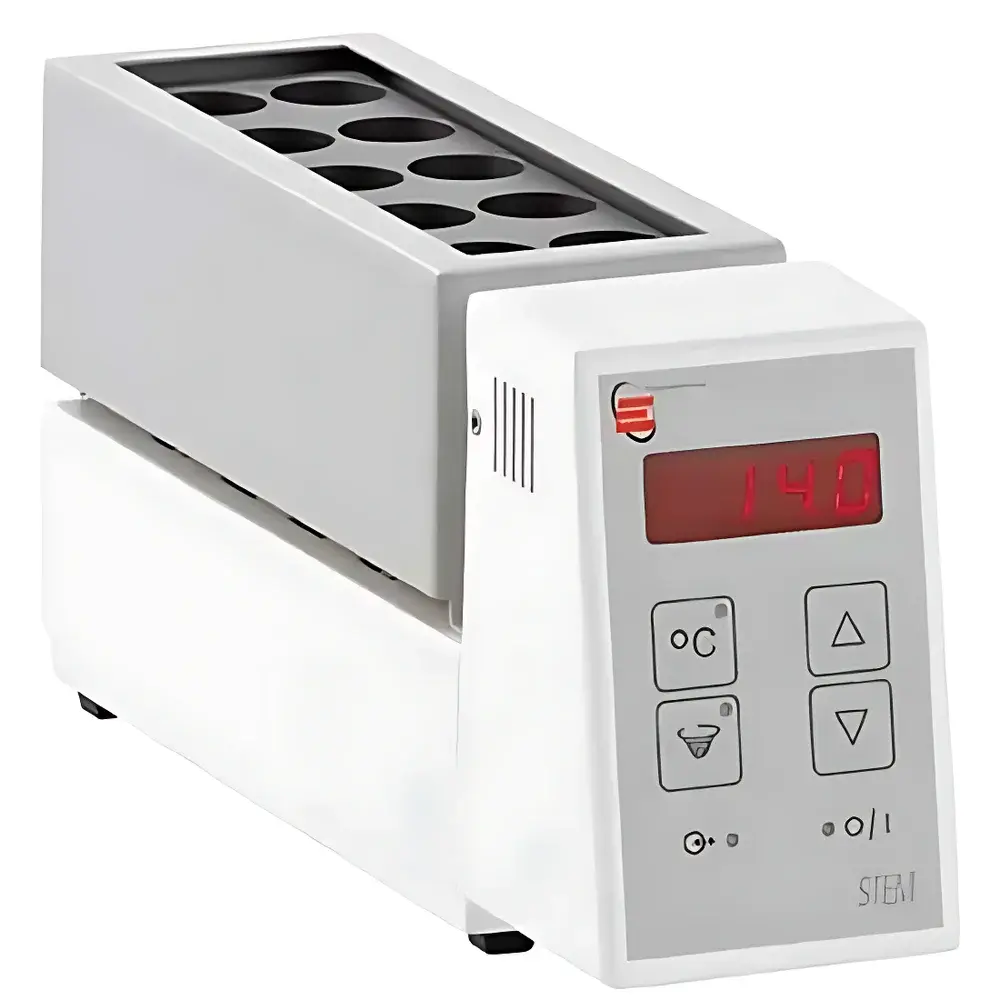
Electrothermal STEM RS1000 Parallel Reaction Station
| Brand | Electrothermal |
|---|---|
| Origin | United Kingdom |
| Model | RS1000 |
| Temperature Range | +5°C to 150°C |
| Stirring Speed | 400–2000 rpm |
| Sample Capacity | 10 positions, 10–30 mL per vial |
| Tube Diameter Compatibility | 24/25 mm (with optional adapters for 11 mm, 16 mm, or 1 mL tubes) |
| Temperature Stability | ±1.0°C |
| Heating Time to Max Temp | ≤15 min |
| Dimensions (D×W×H) | 80 × 150 × 305 mm |
| Weight | 4 kg |
| Power Supply | 230 V / 115 V, 50–60 Hz, 300 W |
| Control Interface | Manual knobs + RS232/RS485 digital port |
| Optional High-Temp Variant | RS1000H (up to 300°C) |
Overview
The Electrothermal STEM RS1000 Parallel Reaction Station is a compact, benchtop-ready thermal-stirring platform engineered for reproducible, multi-vessel reaction screening under controlled temperature and agitation conditions. Designed around Couette-type magnetic stirring and resistive heating principles, the RS1000 delivers uniform thermal distribution and precise rotational control across ten independent reaction positions—making it ideal for synthetic chemistry optimization, catalyst evaluation, kinetic profiling, and parallel library synthesis in academic labs and pharmaceutical process development units. Its modular architecture supports seamless integration into automated liquid handling workflows via standard RS232/RS485 serial communication protocols, enabling synchronization with third-party scheduling software or LIMS environments.
Key Features
- Ten independently heated and stirred positions with simultaneous operation and identical thermal/mechanical performance.
- Wide tube compatibility: accommodates standard 24/25 mm OD screw-threaded glass vials (e.g., SVL-type), with interchangeable PTFE-lined adapters for 11 mm, 16 mm, and micro-volume 1 mL tubes—ensuring flexibility across diverse vessel geometries and reagent volumes (10–30 mL nominal, down to 1 mL with appropriate inserts).
- Precise temperature control from +5°C to 150°C (RS1000) or up to 300°C (RS1000H variant), with stability maintained within ±1.0°C across all positions during steady-state operation.
- Adjustable soft-start stirring function (0–10 min ramp time) to prevent splashing or vortex disruption during initiation of high-speed agitation (400–2000 rpm range).
- Low-footprint design (80 × 150 × 305 mm) optimized for space-constrained fume hoods or robotic workcells; weighs only 4 kg for easy repositioning and system-level integration.
- Dual-control mode: local manual adjustment via front-panel dials and digital remote command via industry-standard RS232/RS485 interface—compatible with LabVIEW, Python-based automation scripts, and SCADA systems.
Sample Compatibility & Compliance
The RS1000 is routinely deployed in GLP-compliant laboratories conducting method development per ICH Q5, Q7, and USP . Its stainless-steel heating block, chemically resistant PTFE-coated stir bar housings, and inert SVL-thread vial interface minimize cross-contamination risk and support solvent compatibility with common organic media (e.g., DMF, THF, acetonitrile, toluene) and aqueous buffers. All electrical components conform to CE marking requirements (EN 61010-1:2019) and meet EMC directive standards (EN 61326-1:2013). While not intrinsically rated for hazardous area use, optional enclosure kits are available for enhanced containment in volatile solvent environments.
Software & Data Management
The RS1000 operates as a standalone instrument but interfaces natively with host systems via ASCII-based serial command sets (documented in the OEM Protocol Manual). When integrated into regulated environments, timestamped temperature/stir speed logs can be captured through external data acquisition modules supporting FDA 21 CFR Part 11 audit trail requirements—including user authentication, electronic signatures, and immutable record storage. No proprietary software is required; configuration and monitoring are achievable using open-source terminal emulators (e.g., PuTTY, Tera Term) or custom Python/Node-RED drivers.
Applications
- High-throughput reaction condition scouting (temperature, stoichiometry, residence time).
- Catalyst activity comparison under identical thermal-mechanical stress profiles.
- Solvent effect studies in cross-coupling, esterification, and condensation reactions.
- Crystallization parameter mapping (supersaturation, cooling rate, seeding timing).
- Stability testing of APIs and intermediates under accelerated thermal stress (ICH Q1A).
- Preparative-scale small-molecule derivatization prior to HPLC or MS analysis.
FAQ
What tube types are supported without adapters?
Standard 24/25 mm outer diameter SVL-threaded glass vials (e.g., ATS10075) are natively compatible.
Can the RS1000 be used under inert atmosphere?
Yes—when paired with PTFE-sealed caps (e.g., ATS10377) and Schlenk-line compatible vials, nitrogen or argon purging is feasible.
Is temperature calibration traceable to NIST standards?
Calibration certificates (optional at time of order) include traceability to UKAS-accredited reference standards; field recalibration is supported via embedded PT100 sensor access points.
Does the RS1000 meet GMP documentation requirements?
It supports GMP-aligned operation when integrated with validated data capture systems; full IQ/OQ documentation packages are available upon request.
How is heat distribution verified across all 10 positions?
Factory verification includes thermal mapping using 10-channel calibrated thermocouples per IEC 60601-2-61, with positional deviation reported in the Certificate of Conformance.



