
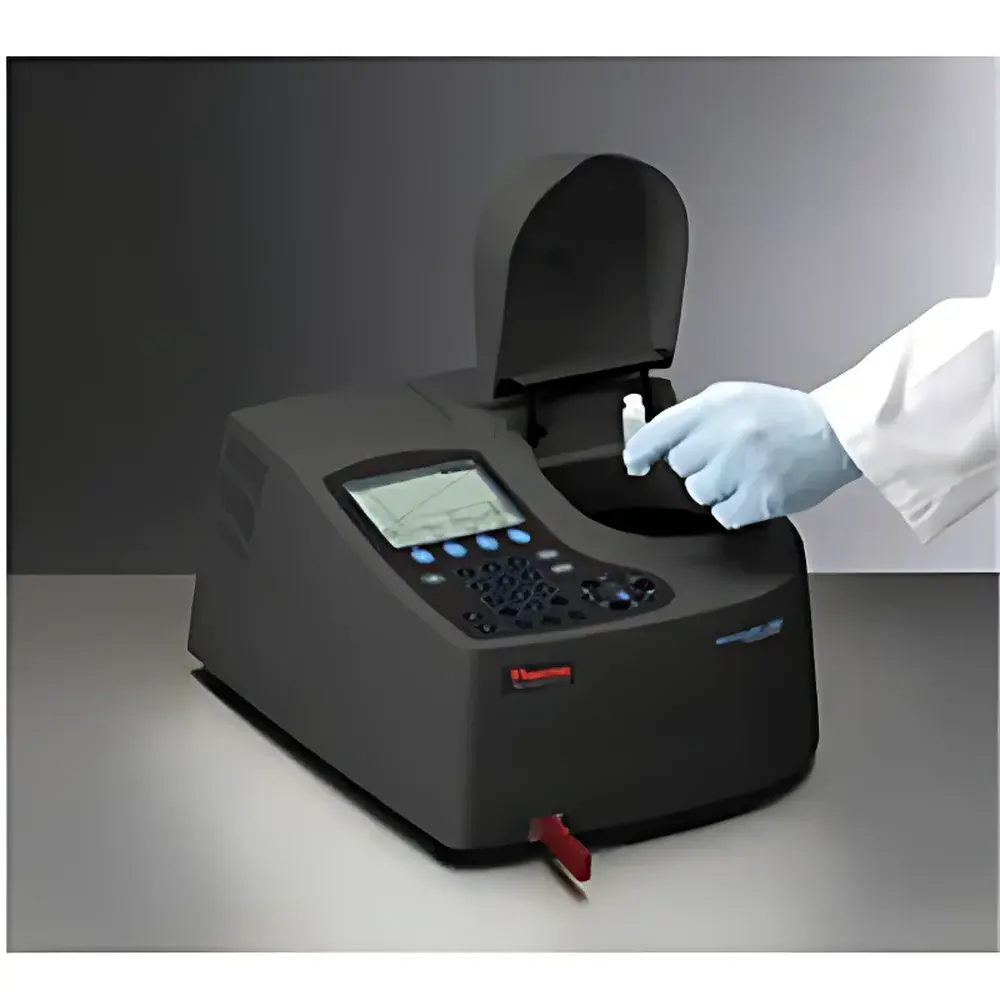
Orion AquaMate 8000 UV-Visible Water Quality Spectrophotometer
| Brand | Orion |
|---|---|
| Origin | USA |
| Manufacturer Type | Authorized Distributor |
| Origin Category | Imported |
| Model | AQ8000 |
| Quotation | Upon Request |
| Instrument Configuration | Dual-Wavelength |
| Detector Type | Silicon Photodiode |
| Wavelength Range | 190–1100 nm |
| Automation Level | Automatic Wavelength Selection |
| Spectral Bandwidth | 1.8 nm |
| Wavelength Accuracy | ±1.0 nm |
| Stray Light | <0.08% T at 220 nm and 340 nm |
| Optical Design | Double-Beam with Integrated Reference Detector |
| Light Source | Pulsed Xenon Lamp (5-year lifetime) |
| Detector | Dual Silicon Photodiodes |
| Wavelength Repeatability | ±0.5 nm |
| Scan Speed | 10–4200 nm/min |
| Data Acquisition Intervals | 0.2, 0.5, 1.0, 2.0, 3.0, 5.0 nm |
| Absorbance Range | –0.5 to 5.0 A |
| Transmittance Range | –1.5 to 125% T |
| Concentration Range | ±9999 c (user-defined units) |
| Linearity Accuracy | ≤±3.5 A at 260 nm |
| Noise | ≤±0.005 A at 1.0 A (RMS) |
| Drift | <0.0005 A/hr |
| Display | Backlit LCD (9.7 × 7.1 cm) |
| Interface | Front USB-A (flash drive), Rear USB-B (PC connectivity), Rear USB-A (printer) |
| Dimensions | 30 W × 40 D × 25 H cm |
| Weight | 8.6 kg |
| Power Supply | 100–240 V, 50–60 Hz |
Overview
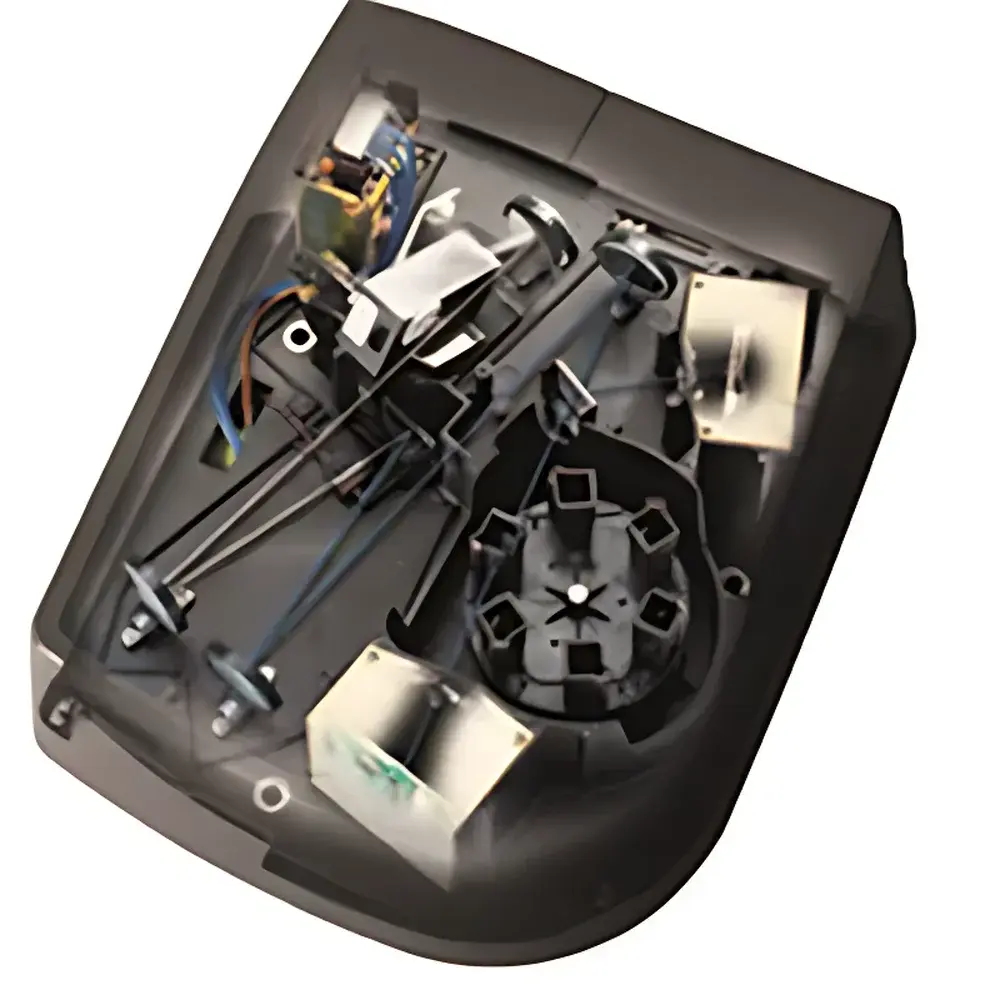
The Orion AquaMate 8000 UV-Visible Water Quality Spectrophotometer is a double-beam, microprocessor-controlled spectrophotometer engineered for precision, reproducibility, and regulatory compliance in environmental and water quality laboratories. It employs a pulsed xenon lamp as its broadband light source—eliminating warm-up time, minimizing thermal drift, and ensuring stable spectral output across the full 190–1100 nm range. The instrument’s double-beam optical architecture incorporates an integrated reference detector, enabling real-time compensation for source intensity fluctuations and detector response variations. This design delivers high photometric stability and superior baseline reproducibility—critical for long-duration kinetics studies, low-concentration trace analysis, and multi-point calibration protocols required under EPA Methods 365.3, 365.4, and ISO 7027 for turbidity, nitrate, phosphate, COD, and heavy metal speciation in drinking water, wastewater, and surface water matrices.
Key Features
- Double-beam optics with built-in reference channel for continuous correction of lamp intensity drift and detector sensitivity shifts
- Pulsed xenon lamp (5-year rated lifetime) providing uniform irradiance from deep UV (190 nm) through near-IR (1100 nm) without filament degradation or warm-up delay
- 1.8 nm spectral bandwidth optimized for resolution of closely spaced absorption peaks while maintaining high photon throughput and signal-to-noise ratio
- Wavelength accuracy of ±1.0 nm and repeatability of ±0.5 nm—validated per ASTM E275 and ISO 6326-1 calibration standards
- Low stray light (<0.08% T at 220 nm and 340 nm) ensuring accurate quantitation of highly absorbing samples and reliable detection at high absorbance (up to 5.0 A)
- Backlit LCD display with intuitive icon-driven menu navigation; sealed membrane keypad resistant to liquid ingress and chemical exposure
- Dual USB interface architecture: front USB-A for method-loaded flash drives (pre-programmed EPA, APHA, and Standard Methods protocols), rear USB-B for direct PC connection (compatible with Thermo Scientific™ AquaSoft™ v3.x), and rear USB-A for dedicated printer output
Sample Compatibility & Compliance
The AquaMate 8000 accommodates standard 10 mm rectangular cuvettes (including quartz for UV applications), round vials (13–25 mm), and extended-path cells (10–100 mm) via interchangeable sample holders—including 1-, 3-, and 6-position cuvette changers. Its optical path design ensures compatibility with turbid, colored, and particulate-laden aqueous samples common in municipal wastewater and industrial effluent testing. The system supports GLP/GMP workflows through audit-trail-enabled software (AquaSoft™), with user-access logging, electronic signatures, and data integrity features compliant with FDA 21 CFR Part 11 requirements when configured with appropriate IT infrastructure. All factory calibrations are traceable to NIST SRM 930e (neutral density filters) and SRM 2034 (peak wavelength standards).
Software & Data Management
AquaSoft™ software (v3.2 or later) provides full instrument control, method development, kinetic profiling, multi-wavelength quantitation, and compliance-ready reporting. It includes over 250 pre-validated water quality methods aligned with US EPA, APHA Standard Methods (23rd ed.), and ISO guidelines—including colorimetric assays for ammonia, chlorine, iron, manganese, silica, and total organic carbon (TOC) surrogate metrics. Data export supports CSV, PDF, and XML formats; all raw spectra and measurement logs are timestamped and digitally signed. Software validation packages—including IQ/OQ documentation and risk-based URS—are available for regulated environments requiring formal qualification under ISO/IEC 17025 or CAP accreditation.
Applications
The AquaMate 8000 serves as a primary analytical platform for accredited environmental testing laboratories performing routine and non-routine water analysis. Key applications include: quantification of orthophosphate and total phosphorus (EPA 365.3); nitrate-nitrogen determination by UV absorbance (EPA 353.2); hexavalent chromium speciation (EPA 7196A); residual chlorine monitoring (Standard Method 4500-Cl G); turbidity measurement per ISO 7027; and method development for emerging contaminants such as perfluoroalkyl substances (PFAS) precursors using UV screening. Its dual-beam stability enables reliable measurement of unstable analytes—e.g., ozone-decaying disinfection byproducts—and supports automated batch analysis of up to 96 samples when integrated with optional autosamplers.
FAQ
What is the difference between the AquaMate 7000 and 8000 models?
The AquaMate 7000 operates from 325–1100 nm and uses a tungsten-halogen lamp, limiting UV capability; the 8000 extends to 190 nm with a pulsed xenon lamp, enabling full UV-Vis quantitation of nitrate, nitrite, and aromatic organics.
Is the instrument compliant with EPA Method requirements?
Yes—the AquaMate 8000 meets optical performance criteria specified in EPA guidance documents for Methods 365.3, 365.4, 353.2, and 7196A when used with validated reagents and calibrated cuvettes.
Can the AquaMate 8000 be integrated into a LIMS environment?
Yes—via USB-B connection and AquaSoft™’s ODBC-compliant database export, it supports direct data transfer to laboratory information management systems meeting ASTM E1482 and ISO/IEC 17025 data exchange requirements.
What maintenance is required for the xenon lamp?
The lamp is solid-state pulsed and requires no alignment or replacement during its 5-year operational life; no warm-up period is needed before measurement.
Does the system support multi-point calibration curves with error weighting?
Yes—AquaSoft™ supports linear, quadratic, and cubic regression with 1/x, 1/x², or relative standard deviation (RSD)-based weighting for heterogeneous sample matrices.
Related Products




