
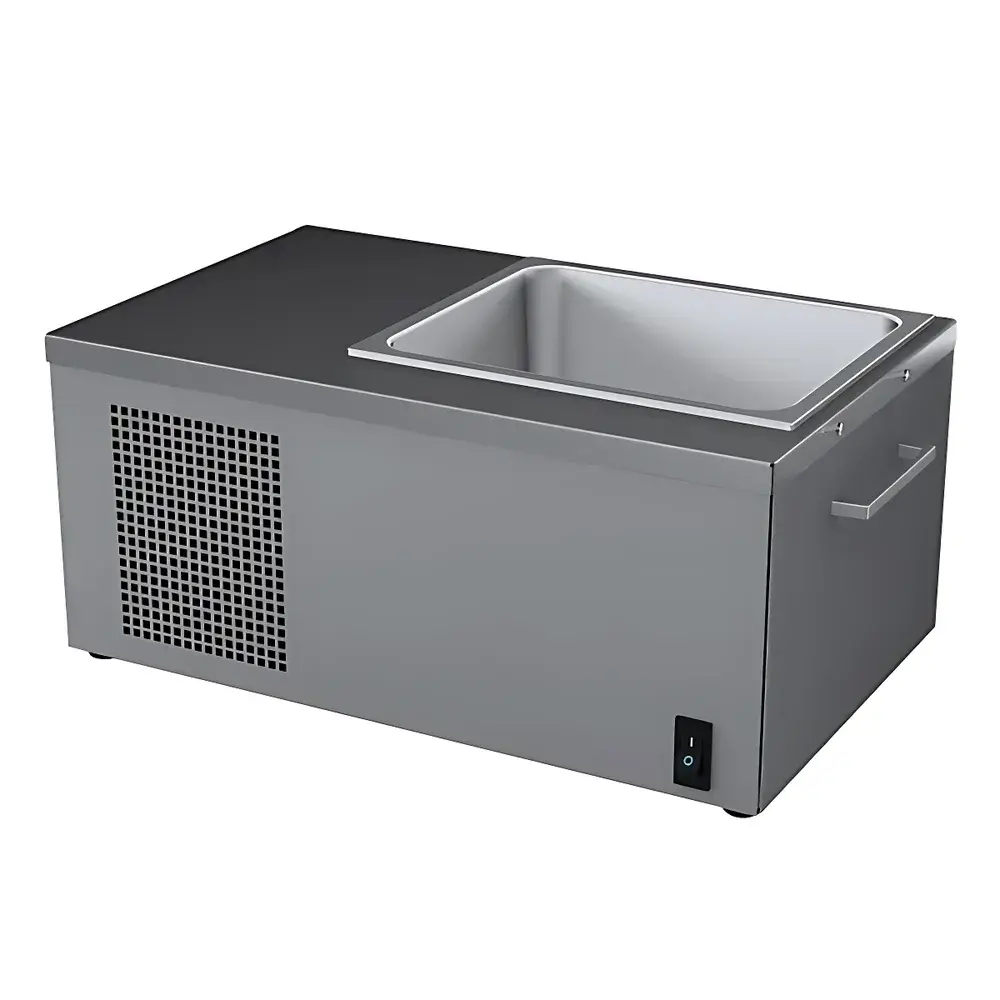
Polystat 12110-05 Refrigerated Circulating Bath
| Brand | Polystat |
|---|---|
| Origin | USA |
| Model | 12110-05 |
| Bath Volume | 13 L |
| Temperature Range | 0–150 °C (with external circulator) |
| Temperature Stability | ±0.05 °C (typical, dependent on circulator and load) |
| Cooling Capacity | 400 W at 20 °C (120 VAC), 330 W at 20 °C (230 VAC) |
| Refrigerant | R-134a |
| Bath Material | 304 Stainless Steel |
| Internal Dimensions (L×W×D) | 22.9 × 29.8 × 19.7 cm |
| Open Bath Opening | 22.9 × 29.8 × 19.7 cm |
| Power Supply | 120 VAC, 60 Hz / 230 VAC, 50 Hz |
| Circulation | Internal & External |
| Temperature Control | Dual-mode (heating & refrigeration) |
| Low-Level Cut-off | Not equipped |
| Drain Valve | None |
Overview
The Polystat 12110-05 Refrigerated Circulating Bath is a precision-engineered open-bath thermal control platform designed for laboratory applications requiring stable, sub-ambient to elevated temperature operation without sealed bath constraints. Unlike closed-loop chillers or immersion-cooled systems, the 12110-05 features a deep-drawn, seamless 304 stainless steel reservoir—optimized for compatibility with external recirculating chillers or heating circulators. Its architecture enables direct integration into custom thermal management setups, including jacketed reactors, viscometers, spectrophotometer cells, and calorimetric test stations. The unit operates on vapor-compression refrigeration using environmentally compliant R-134a refrigerant, delivering active cooling down to 0 °C while maintaining precise proportional-integral-derivative (PID) controlled heating up to 150 °C when paired with a compatible external circulator. Temperature stability of ±0.05 °C is achievable under steady-state conditions with appropriate load matching and fluid selection—making it suitable for applications governed by ASTM E2927, ISO 17025 calibration traceability requirements, and GLP-compliant thermal validation protocols.
Key Features
- Seamless 304 stainless steel bath reservoir—resistant to corrosion from water, glycol/water mixtures, silicone oils, and low-viscosity heat transfer fluids
- Dual-mode thermal regulation: integrated refrigeration + external heating capability supports full 0–150 °C operational range
- High-capacity open-bath design (13 L / 3.4 gal) with generous internal dimensions (22.9 × 29.8 × 19.7 cm) for accommodating large probes, reactor jackets, or multi-sensor arrays
- Independent internal circulation pump plus dual-port external circulation interface (inlet/outlet NPT fittings) for flexible system integration
- Refrigeration optimized for ambient start-up: delivers 400 W cooling power at 20 °C ambient (120 VAC) and 330 W (230 VAC), enabling rapid thermal equilibration in variable lab environments
- Robust electrical architecture compliant with UL 61010-1 and IEC 61010-1 safety standards; CE-marked for use in EU laboratories
Sample Compatibility & Compliance
The 12110-05 accommodates a broad spectrum of thermal transfer media—including deionized water, 30/70 ethylene glycol/water, mineral oil (up to 150 °C), and silicone-based fluids—subject to viscosity and flash point constraints. Its open-bath configuration eliminates pressure vessel classification, simplifying regulatory oversight under ASME B31.5 and local fire codes. While the unit itself does not include low-level protection or drain functionality, its mechanical design permits integration with external level sensors and automated fluid management subsystems for ISO/IEC 17025-accredited facilities. It meets electromagnetic compatibility (EMC) requirements per EN 61326-1 and is routinely deployed in FDA-regulated QC labs where temperature-controlled dissolution testing (USP ) and stability chamber qualification (ICH Q5C) require documented thermal uniformity mapping.
Software & Data Management
As a hardware-only thermal platform, the 12110-05 does not embed onboard data logging or network connectivity. However, its analog voltage output (0–10 V DC) and RS-232 interface enable seamless integration with third-party data acquisition systems—including LabVIEW, MATLAB, and SCADA platforms—supporting 21 CFR Part 11-compliant audit trails when paired with validated software. Users commonly couple it with programmable circulators featuring Ethernet or USB interfaces, allowing centralized monitoring of bath temperature, compressor status, and flow rate via enterprise LIMS or ELN environments. Calibration records adhere to ISO/IEC 17025 clause 6.4.10, with annual verification recommended using NIST-traceable RTD probes.
Applications
- Temperature control of analytical instrumentation: UV-Vis cuvette holders, FTIR sample compartments, and HPLC column ovens
- Calorimetry support: serving as a stable thermal sink/source for differential scanning calorimeters (DSC) and isothermal titration calorimeters (ITC)
- Material testing: conditioning polymer samples per ASTM D618 prior to tensile or impact evaluation
- Biological incubation support: maintaining precise temperatures for enzyme kinetics assays or cell culture equipment pre-conditioning
- Process simulation: replicating industrial thermal profiles during formulation development of pharmaceutical suspensions or battery electrolytes
FAQ
Does the 12110-05 include an integrated heater?
No—the unit provides refrigeration only; heating requires connection to an external circulator or immersion heater compatible with its temperature range and fluid chemistry.
Can it operate continuously at 150 °C?
Yes, but only when used with a high-temperature external circulator and thermally stable fluid such as silicone oil; the bath’s structural integrity remains intact within this limit.
Is the refrigerant R-134a compliant with current EPA SNAP regulations?
Yes—R-134a is listed under EPA SNAP Subpart G for laboratory refrigeration applications and carries zero ozone depletion potential (ODP = 0).
What is the recommended maintenance interval for the compressor?
Under normal lab usage (8 hrs/day, 5 days/week), compressor service—including refrigerant pressure check and condenser coil cleaning—is advised every 18 months.
Can the bath be used with flammable solvents?
Not recommended—open-bath design poses vapor accumulation risk; non-flammable heat transfer fluids must be selected per NFPA 30 and local safety authority guidelines.



