
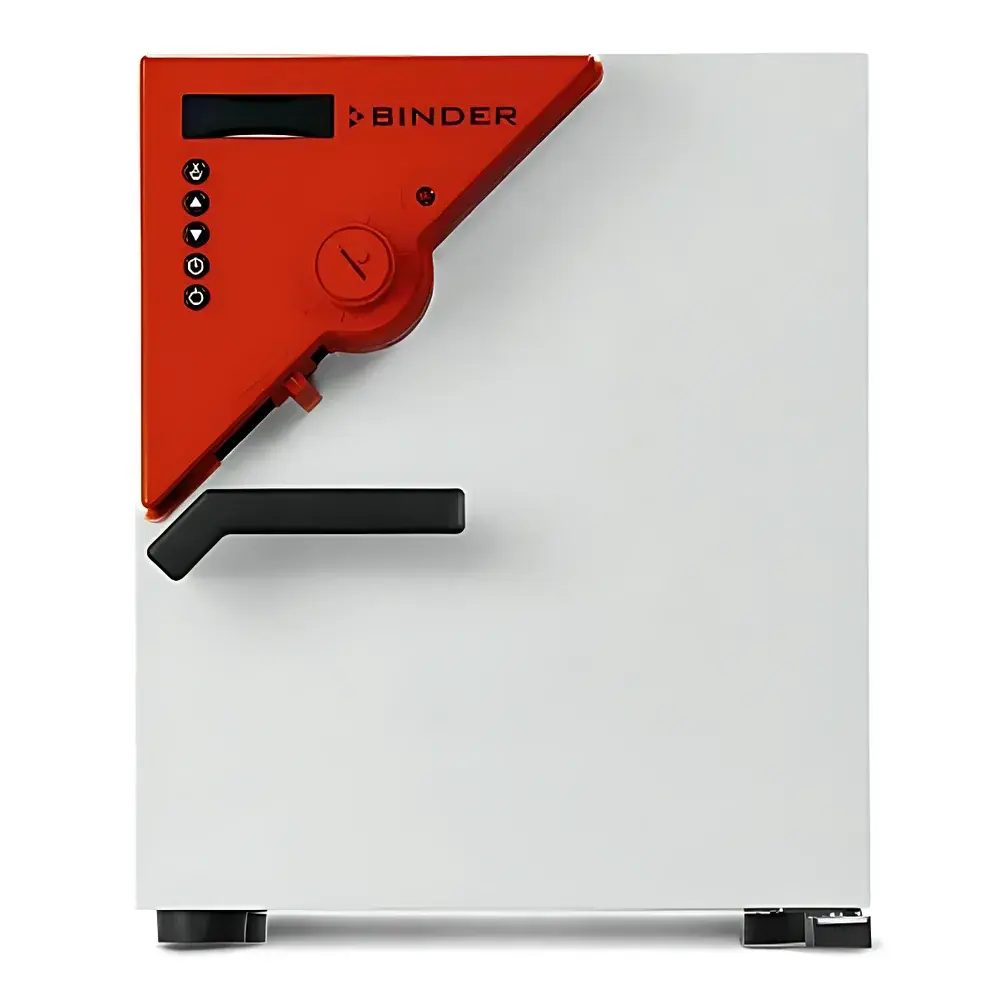
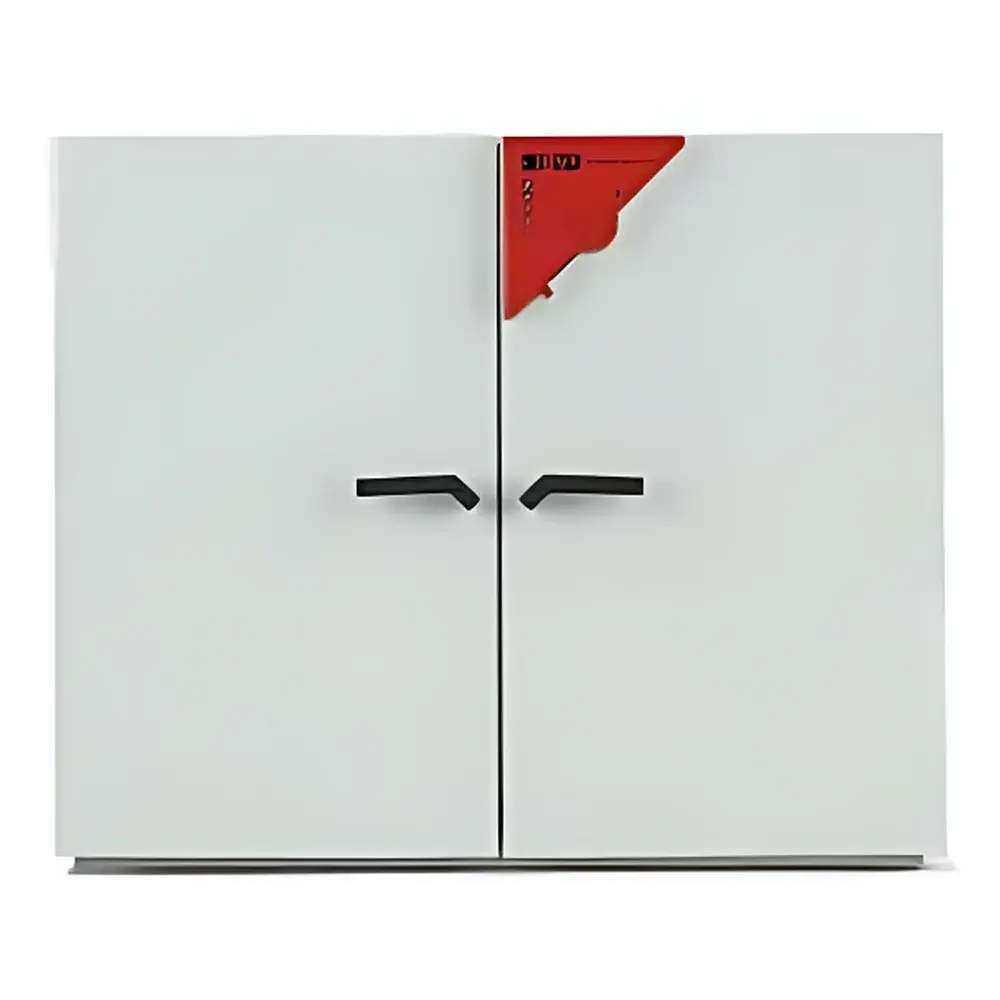
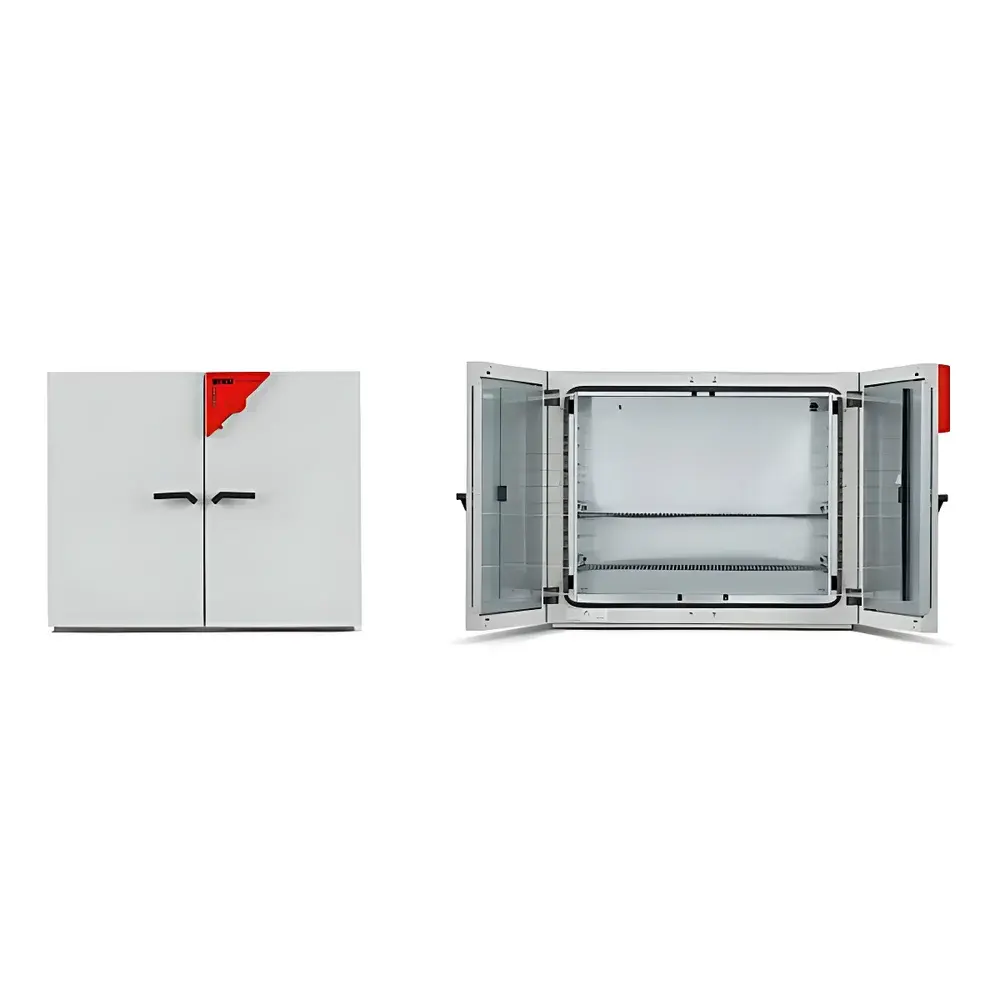
BINDER ED23 and ED400 Natural Convection Drying Ovens
| Brand | BINDER |
|---|---|
| Origin | Germany |
| Model | ED23 / ED400 |
| Temperature Range | Ambient +5 °C to 300 °C |
| Temperature Uniformity at 150 °C | ±2.8 K (ED23) / ±3 K (ED400) |
| Temperature Fluctuation at 150 °C | ±0.5 K |
| External Dimensions (W×H×D) | 435×495×520 mm (ED23) / 1235×1025×765 mm (ED400) |
| Internal Dimensions (W×H×D) | 222×330×300 mm (ED23) / 1000×800×520 mm (ED400) |
| Internal Volume | 20 L (ED23) / 400 L (ED400) |
| Net Weight (empty) | 27 kg (ED23) / 125 kg (ED400) |
| Max. Load Capacity | 25 kg (ED23) / 90 kg (ED400) |
| Max. Load per Shelf | 12 kg (ED23) / 35 kg (ED400) |
| Heating Method | Natural Convection |
| Standard Equipment | 2 Chrome-Plated Shelves (ED23), 2–10 Shelves (ED400) |
Overview
The BINDER ED23 and ED400 natural convection drying ovens are precision-engineered laboratory instruments designed for reliable thermal processing across a broad operational spectrum—from ambient +5 °C up to 300 °C. These ovens operate exclusively via natural convection, eliminating forced-air mechanisms to ensure gentle, uniform heat distribution without mechanical disturbance to sensitive samples. This principle is especially critical for applications involving powders, granules, biological specimens, or temperature-sensitive reference materials where airflow-induced segregation or desiccation artifacts must be avoided. The integrated APT.line™ preheating chamber technology—a hallmark of BINDER’s thermal architecture—surrounds the working chamber with a thermally insulated, independently heated jacket. This design minimizes thermal gradients during ramp-up and stabilizes chamber conditions during door openings, directly contributing to improved temperature uniformity (±2.8 K at 150 °C for ED23; ±3 K for ED400) and reduced recovery time (28 min for ED23, 31 min for ED400 after a standard door opening at 150 °C). As Class II dry heat sterilization-capable units compliant with DIN 12880, they support validated processes in pharmaceutical QC, material science labs, and academic research environments requiring reproducible, traceable thermal treatment.
Key Features
- Natural convection heating system ensures laminar, vibration-free thermal transfer—ideal for moisture content analysis (e.g., ASTM D2231, ISO 4611), residual solvent determination, and pre-weighing sample conditioning
- APT.line™ preheating chamber technology enhances thermal homogeneity and reduces transient drift during temperature transitions
- Dual-stage independent temperature safety device (DIN 12880 Class 2) with optical alarm provides redundant overtemperature protection, satisfying GLP/GMP risk mitigation requirements
- Adjustable exhaust valve enables fine-tuned control of vapor pressure and humidity dynamics inside the chamber, supporting controlled drying kinetics
- Microprocessor-based controller with integrated timer function allows programmable hold times and unattended operation—compatible with 21 CFR Part 11 audit trail configuration when paired with optional BINDER Software Suite
- Chrome-plated, height-adjustable shelves (2 standard in ED23; up to 10 in ED400) support flexible load configurations while maintaining structural integrity under maximum specified loads (12 kg/shelf for ED23; 35 kg/shelf for ED400)
Sample Compatibility & Compliance
The ED23 and ED400 accommodate a wide range of sample formats—including Petri dishes, weighing boats, crucibles, glassware, polymer pellets, ceramic green bodies, and filter papers—without requiring custom fixtures. Their stainless steel interior (1.4301/AISI 304), rounded corners, and smooth surfaces meet hygiene standards for routine cleaning and decontamination. Both models conform to IEC 61010-1 (Safety Requirements for Electrical Equipment for Measurement, Control, and Laboratory Use) and carry CE marking. For regulated environments, the dual-stage safety thermostat satisfies DIN 12880 compliance for dry heat sterilization validation, and the oven’s stable thermal profile supports method qualification per USP and ISO 17025 clause 5.4.2. Optional calibration certificates (traceable to DAkkS or NIST) and IQ/OQ documentation packages are available upon request.
Software & Data Management
While the base controller delivers standalone operation, integration with BINDER’s optional BINDER Software Suite enables remote monitoring, data logging, and electronic record generation. When configured for 21 CFR Part 11 compliance, the system supports user-level access control, electronic signatures, and immutable audit trails—including timestamps for setpoint changes, door openings, and alarm events. Logged temperature data (sampled at 10-second intervals) can be exported in CSV or PDF format for inclusion in stability studies, regulatory submissions, or internal quality reports. The software also facilitates comparative analysis across multiple runs, supporting statistical process control (SPC) workflows aligned with ISO 9001 and ICH Q5C guidelines.
Applications
- Moisture content determination in pharmaceutical excipients and active ingredients (USP , Ph. Eur. 2.2.32)
- Drying and conditioning of soil, sand, and aggregate samples prior to particle size or density analysis (ASTM D2216, ISO 11274)
- Thermal aging studies of polymers, composites, and elastomers (ISO 188, ASTM D573)
- Pre-sterilization drying of glassware and stainless steel components in cleanrooms
- Residual solvent removal from coated substrates and thin-film samples in materials R&D
- Stabilization of hygroscopic reference standards before gravimetric analysis
FAQ
What distinguishes natural convection from forced convection in drying ovens?
Natural convection relies solely on buoyancy-driven air movement, eliminating fan-induced turbulence that may displace lightweight samples or compromise surface integrity. It yields gentler, more predictable drying kinetics—particularly advantageous for fragile or particulate materials.
Can the ED23/ED400 be used for dry heat sterilization?
Yes—both models achieve and maintain temperatures up to 300 °C with sufficient uniformity and stability to support dry heat sterilization cycles per DIN 12880 and ISO 15883-5, provided validation protocols (including thermocouple mapping and biological indicator testing) are executed.
Is the exhaust valve compatible with solvent-laden vapors?
The adjustable exhaust valve is rated for non-corrosive, low-concentration organic vapors. For high-boiling-point or acidic solvents, BINDER recommends optional connection to an external fume extraction system via the rear-mounted vent port.
How is temperature uniformity verified during qualification?
Uniformity is assessed using a minimum 9-point sensor grid (per ISO 17025 Annex C) placed across the working volume at defined setpoints (e.g., 100 °C, 150 °C, 250 °C). Data is recorded over ≥30 minutes after stabilization, with acceptance criteria derived from the maximum deviation from the mean.
Are replacement shelves and accessories available separately?
Yes—BINDER offers additional chrome-plated shelves (part no. 11-01-0010), shelf supports, and specialized trays (e.g., wire mesh, perforated stainless steel) with full compatibility documentation and dimensional specifications.



