
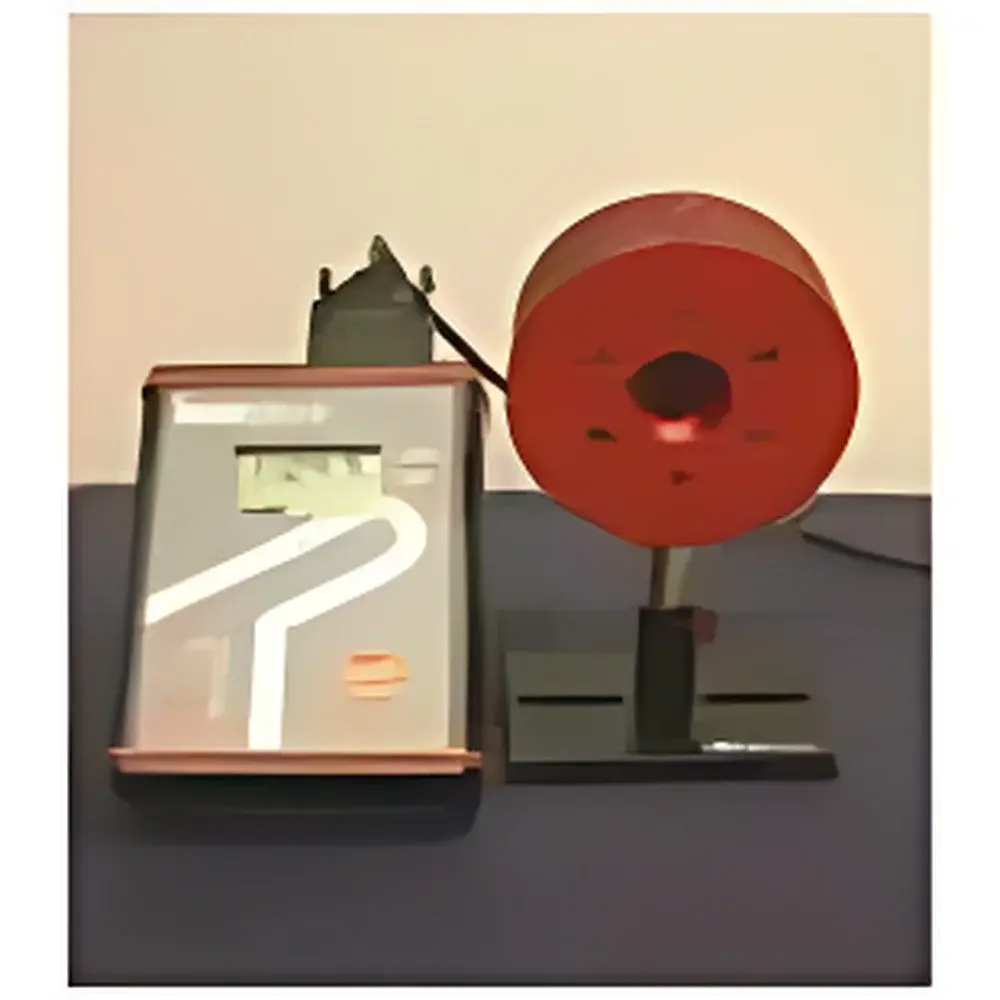
Thorlabs PM100 Series Digital Laser Power and Energy Meter
| Brand | Thorlabs |
|---|---|
| Model | PM100 |
| Origin | USA |
| Detector Compatibility | S120/S130/S140 (photodiode), S200 (thermopile) series |
| Power Range | 5 nW – 1 W (sensor-dependent) |
| Energy Range | up to 20 µJ (pulsed, sensor-dependent) |
| Wavelength Range | 200 nm – 1800 nm (broadband coverage across photodiode & thermopile sensors) |
| Dynamic Range | 60 dB |
| Sampling Rate | 6 Hz (analog), 3 Hz (digital) |
| Accuracy | ±1% (meter), ±5% (system, NIST-traceable calibration) |
| Display | 240 × 160 pixel backlit LCD with GUI-driven interface |
| Interface | RS232 (DB9), analog output (SMA), optional USB via PM300E |
| Power Supply | Rechargeable NiMH battery (1500 mAh, 3.6 V), >18 h operation (no backlight) |
| Operating Temperature | 5–40 °C |
| Compliance | NIST-traceable calibration data |
Overview
The Thorlabs PM100 Series is a precision digital laser power and energy meter system engineered for laboratory-grade optical power measurement across research, quality control, and manufacturing environments. Based on calibrated photodiode and thermopile detection principles, the system delivers traceable, low-noise measurements of continuous-wave (CW) and pulsed laser sources. Its modular architecture separates detector head (e.g., S120B silicon, S144A InGaAs, or S212A thermopile) from a universal meter console—enabling seamless interchangeability without recalibration. The core measurement principle relies on photovoltaic conversion (for photodiode heads) or thermal absorption and thermoelectric voltage generation (for thermopile heads), both referenced to NIST-traceable standards. With wavelength-dependent responsivity correction applied automatically upon user-defined λ input—and integrated calibration coefficients embedded in each sensor—the PM100 ensures metrologically sound results compliant with ISO/IEC 17025–aligned workflows.
Key Features
- Modular detector compatibility: Supports Thorlabs’ full range of calibrated photodiode (S120, S130, S140 series) and thermopile (S200 series) sensors—including standard, linear array, and integrating sphere configurations.
- Wide spectral coverage: From deep UV (200 nm) to mid-infrared (1800 nm), achieved through material-optimized detectors (Si, Ge, InGaAs, pyroelectric, and broadband thermopiles).
- High dynamic range and resolution: Up to 60 dB span with 16–24-bit digitization (0.01% full-scale resolution); noise floors as low as 100 pW (S130A) enable reliable sub-nanowatt measurements.
- Multi-format display: Real-time numerical readout (nW to W, dBm), analog-style pointer simulation, bar graph, X-Y trend plotting, and statistical analysis (min/max/avg/std dev) on a 240 × 160 pixel backlit LCD.
- Dual-output interface: Simultaneous RS232 (configurable baud rates up to 115.2 kbps) and analog voltage output (0–4.095 V, software-scaled, 12-bit resolution) for integration into DAQ systems or closed-loop control.
- Battery-powered portability: Integrated rechargeable NiMH battery enables >18 hours of field operation; automatic power-down and included wall charger ensure operational continuity.
Sample Compatibility & Compliance
The PM100 system accommodates diverse laser sources—from low-power alignment diodes (<1 µW) to high-brightness fiber lasers (up to 1 W CW). Detector selection is determined by application requirements: silicon-based photodiodes (S120/S130) offer high sensitivity in visible/NIR; germanium (S122B) and InGaAs (S144A) extend coverage to SWIR; thermopiles (S210–S213) provide flat spectral response from 250 nm to 10.6 µm and handle higher average powers. All sensors feature SM1-threaded mounts, standardized connector geometries, and NIST-traceable calibration certificates. The system supports compliance with ISO 11554 (laser beam parameter measurements), ASTM E275 (spectral responsivity), and FDA 21 CFR Part 11 when used with validated software and audit-trail-enabled data acquisition protocols.
Software & Data Management
While the PM100 console operates autonomously, its RS232 and optional USB interfaces (via PM300E upgrade) enable bidirectional communication with Thorlabs’ Kinesis® or third-party LabVIEW, Python, or MATLAB environments. Data logging includes timestamped power/energy values, statistical aggregates, and raw analog output traces. Firmware updates preserve backward compatibility with legacy sensors. For regulated environments, configuration files, calibration metadata, and measurement records can be exported in CSV or XML format—supporting electronic record retention per GLP and GMP requirements. Optional software modules provide real-time spectral correction, pulse energy integration (with user-defined gate width), and multi-channel synchronization for dual-probe setups.
Applications
- Laser source characterization in R&D labs: stability testing, mode-hop detection, and long-term drift monitoring using trend analysis and statistical reporting.
- Optical component qualification: transmission/reflection loss measurement of filters, coatings, and waveguides using ratio-mode calculations (PM300E).
- Medical laser validation: verification of output power and pulse energy for dermatology, ophthalmology, and surgical systems per IEC 60825-1 safety standards.
- Industrial process control: inline monitoring of fiber-delivered laser power in welding, cutting, and additive manufacturing cells.
- Educational optics laboratories: intuitive GUI and multiple display modes facilitate student comprehension of photodetection fundamentals and signal conditioning.
FAQ
Is the PM100 compatible with non-Thorlabs sensors?
No—only Thorlabs-certified S-series photodiode and thermopile sensors are supported due to embedded calibration coefficients and electrical interface specifications.
Can the PM100 measure pulsed laser energy?
Yes, when paired with appropriate energy-capable sensors (e.g., S132A, S213A) and configured in energy mode; PM300E adds programmable trigger thresholds and repetition rate support.
What is the uncertainty budget for a typical measurement?
System-level uncertainty is ±5% (k=2), combining meter accuracy (±1%), sensor calibration uncertainty (±2–4%), and wavelength-dependent responsivity deviation; full uncertainty analysis is provided in each NIST-traceable certificate.
Does the PM100 support analog output scaling for custom DAQ systems?
Yes—the 0–4.095 V analog output is software-adjustable from 0.001 V/mW to 1000 V/mW, enabling direct interfacing with oscilloscopes, PLCs, or industrial controllers.
How is thermal drift managed during extended measurements?
Photodiode sensors include temperature compensation circuitry; thermopile heads (S200 series) feature active TEC cooling or passive heat sinking depending on model—ensuring stable baseline performance over 8+ hour sessions.




