
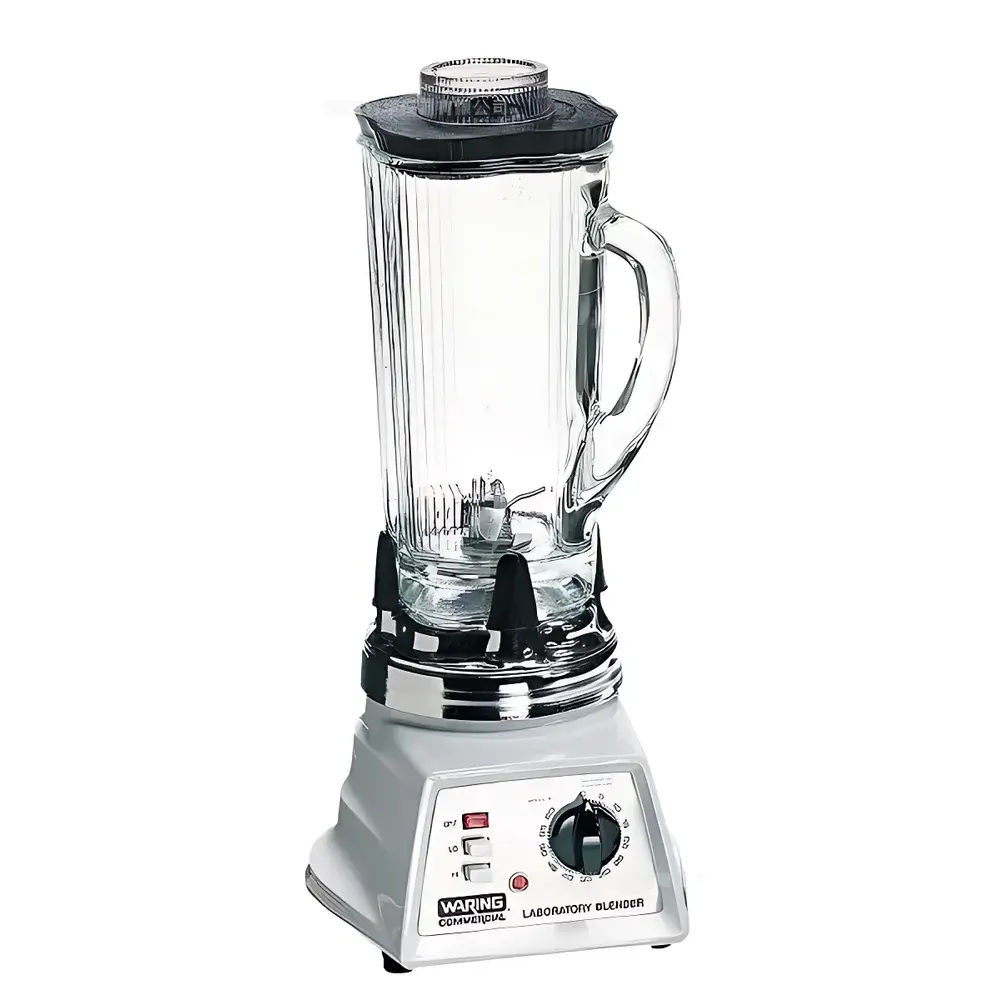
Waring 8010S/8010G/8010ES/8010EG Dual-Speed Timer-Controlled Laboratory Homogenizer
| Brand | Waring |
|---|---|
| Origin | USA |
| Model | 8010S / 8010G / 8010ES / 8010EG |
| Sample Capacity | 1 L |
| Speed Settings | 18,000 rpm and 22,000 rpm |
| Timer | Mechanical 60-second auto-shutoff |
| Construction | Epoxy-coated base |
| Container Options | Stainless steel (8010S), heat-resistant borosilicate glass (8010G), or polycarbonate (CAC19, CAC64) |
| Dimensions (H) | 38 cm (8010S) / 40.5 cm (8010G) |
| Weight | 4.3 kg (8010S) / 5.2 kg (8010G) |
| Compliance | CE-marked, UL-listed for laboratory use |
Overview
The Waring 8010S/8010G/8010ES/8010EG series represents a precision-engineered line of benchtop dual-speed homogenizers designed for reproducible mechanical disruption of biological, pharmaceutical, food, and chemical samples. Operating on the principle of high-shear rotor-stator homogenization, these units generate intense fluid vortices and cavitation forces through a rotating stainless-steel blade assembly housed within a sealed container. The fixed two-speed configuration—18,000 rpm for moderate shear applications and 22,000 rpm for demanding tissue dissociation or emulsification—ensures consistent energy input without variable-speed complexity. A robust epoxy-coated metal housing provides structural stability and corrosion resistance during routine laboratory operation. All models integrate a mechanical 60-second countdown timer with automatic power cutoff, eliminating operator dependency for endpoint control and supporting standardized, repeatable processing protocols across multiple users and shifts.
Key Features
- Dual fixed-speed operation (18,000 rpm and 22,000 rpm) optimized for balance between throughput and sample integrity
- Mechanical 60-second timer with fail-safe auto-shutoff—no battery or software dependency, ensuring long-term reliability and GLP-compliant timing consistency
- Interchangeable container system supporting material-specific compatibility: 1 L stainless steel (8010S), 1.2 L heat-resistant borosilicate glass (8010G), and optional polycarbonate vessels (CAC19, CAC64) for transparency or impact resistance
- Integrated stainless-steel blade assembly with precision-balanced geometry for minimal vibration and uniform shear distribution
- Ergonomic handle-equipped containers and dual-layer polyethylene/polystyrene lids for secure sealing and reduced aerosol generation
- UL-listed and CE-certified electrical architecture compliant with IEC 61010-1 for Class II laboratory environments
Sample Compatibility & Compliance
The 8010 series accommodates a broad range of sample matrices including soft animal tissues (liver, spleen), plant material (leaves, roots), microbial pellets, viscous food pastes (cheese, meat emulsions), and suspension-based pharmaceutical formulations. Its 1 L nominal capacity supports scalable preparation of lysates, homogenates, and pre-analytical extracts in accordance with ASTM D7263 (standard test method for particle size analysis of suspensions) and ISO 13320 (laser diffraction particle sizing—where homogenization precedes measurement). The unit meets requirements for equipment qualification under FDA 21 CFR Part 11 when used with documented SOPs and manual log entries; while it lacks built-in electronic audit trails, its mechanical timer ensures unambiguous process duration recording. All container materials comply with USP for plastic components and ISO 3585 for borosilicate glass.
Software & Data Management
This is a hardware-only, non-programmable instrument with no embedded firmware, touchscreen interface, or digital connectivity. Process parameters—including speed selection and timer activation—are executed manually via tactile push-button controls. Data management relies entirely on user-generated documentation: operators record batch number, sample ID, speed setting, timer duration, and container type in laboratory notebooks or LIMS-integrated electronic logs. The absence of software eliminates cybersecurity vulnerabilities and validation overhead associated with computerized systems, making it suitable for GMP Annex 11–aligned environments where simplicity and traceability are prioritized over automation. Optional accessories such as the CAC32 (1.2 L glass) and CAC33 (1 L stainless steel) containers expand method flexibility without altering core operational logic.
Applications
- Life sciences research: Preparation of cell lysates from mammalian, insect, or plant tissues prior to Western blotting, ELISA, or nucleic acid extraction
- Biopharmaceutical manufacturing: Homogenization of vaccine adjuvant suspensions and monoclonal antibody formulation intermediates requiring controlled particle dispersion
- Clinical diagnostics: Standardized disruption of biopsy specimens for histopathological embedding or molecular testing workflows
- Food safety & quality control: Emulsification of meat analogs, cheese blends, and dairy-based sauces for rheological and microbiological analysis
- Chemical R&D: Formation of stable oil-in-water or water-in-oil emulsions, pigment dispersions, and polymer suspension preforms
FAQ
Is the 8010 series compatible with sterile processing?
Yes—stainless steel (8010S) and borosilicate glass (8010G) containers can be autoclaved at 121°C for 20 minutes; polycarbonate accessories (CAC19, CAC64) are not autoclavable but support chemical sterilization with 70% ethanol or 0.5% sodium hypochlorite.
Can I operate the unit continuously beyond 60 seconds?
No—the mechanical timer is non-bypassable and resets automatically after each cycle; for extended processing, manual restart is required, ensuring thermal management and blade longevity.
What maintenance is required?
Routine cleaning of the blade assembly and container post-use; annual inspection of motor coupling integrity and timer mechanism function is recommended per Waring Technical Bulletin TB-8010-REV3.
Does Waring provide IQ/OQ documentation support?
Yes—Waring supplies standard Equipment Qualification templates (IQ/OQ checklists) upon request, aligned with ISO/IEC 17025 and ASTM E2500 guidance for laboratory instrumentation.



