
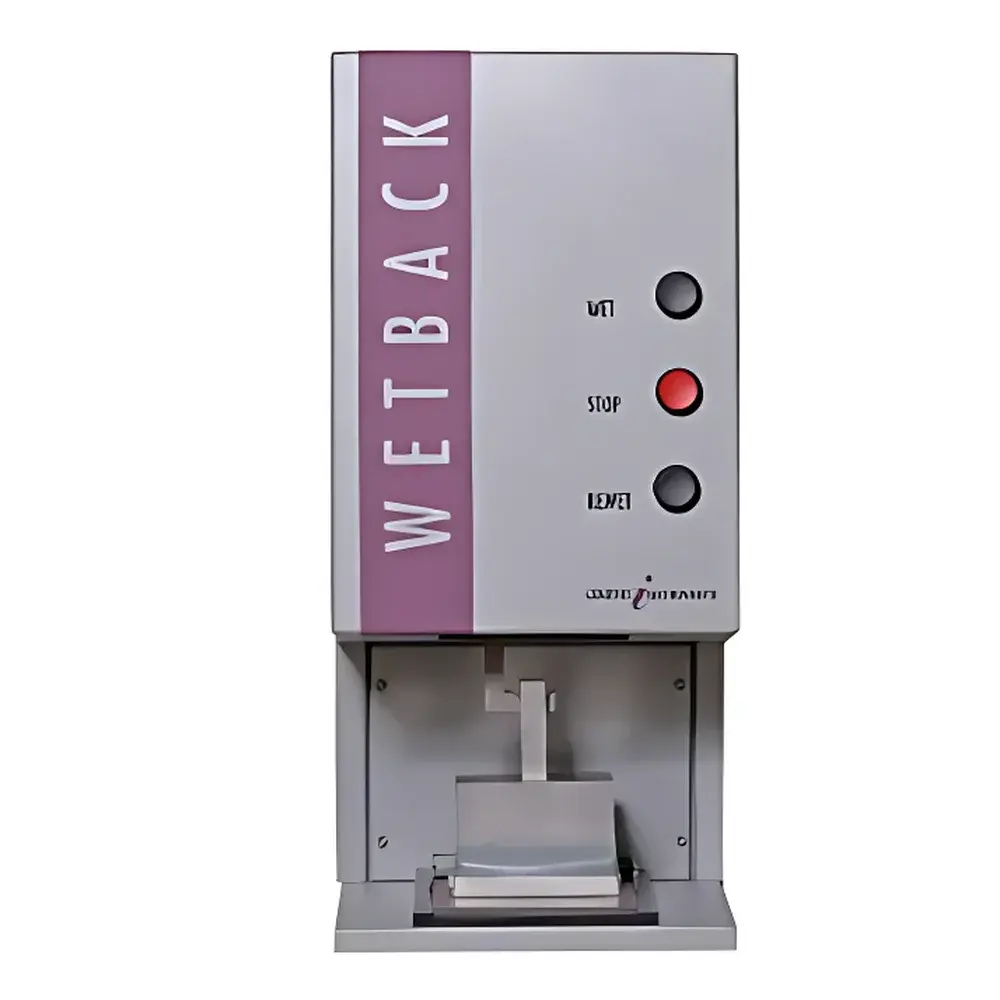
Lenzing Instruments WETBACK Nonwoven Wetback Tester
| Brand | Lenzing Instruments |
|---|---|
| Origin | Austria |
| Model | WETBACK |
| Compliance | EDANA WSP 80.10 (ERT 151.3(02)), EDANA WSP 70.8 (ERT 154.0(02)), ISO 9073-14:2002 |
| Wetback Time | 2 min ± 2 s |
| Humidification Time | 3 min ± 3 s |
| Simulated Infant Load | 4000 g ± 20 g |
| Load Application Duration | 5 s ± 1 s |
| Load Drop Distance | 5 cm |
| Measurement Principle | Gravimetric Absorption via Precision Balance |
| Sample Requirement | Post-LISTER Fluid Penetration Test Specimens |
Overview
The Lenzing Instruments WETBACK Nonwoven Wetback Tester is an automated, gravimetric measurement system engineered for the precise quantification of rewet—the re-emergence of liquid onto the surface of a used absorbent hygiene product—under standardized mechanical loading conditions. Designed in strict accordance with internationally recognized test protocols, including EDANA WSP 80.10 (equivalent to ERT 151.3(02)) and WSP 70.8 (equivalent to ERT 154.0(02)), as well as ISO 9073-14:2002, the WETBACK instrument eliminates operator-induced variability inherent in manual wetback assessment. Its core measurement principle relies on controlled mechanical compression of a pre-conditioned nonwoven specimen (required to be tested *after* completion of the LISTER fluid penetration test), followed by high-resolution gravimetric capture of liquid transferred to an underlying filter paper. This methodology ensures traceable, repeatable, and inter-laboratory comparable data essential for R&D validation, QC release testing, and regulatory documentation in absorbent hygiene product development.
Key Features
- Automated pneumatic loading mechanism delivering a precisely calibrated 4000 g ± 20 g simulated infant load at a defined descent velocity and consistent 5 cm drop distance
- Programmable humidification cycle (3 min ± 3 s) and wetback dwell time (2 min ± 2 s), fully compliant with EDANA timing tolerances
- Integrated high-precision electronic balance (0.1 mg resolution minimum, per ISO 9073-14 requirements) for direct gravimetric quantification of rewet mass
- Dedicated test sequence logic ensuring strict adherence to EDANA-specified load application duration (5 s ± 1 s) and post-compression stabilization
- Robust mechanical architecture with stainless-steel test chamber and corrosion-resistant components suitable for long-term use in QC laboratories
- No user-dependent manual timing or weight recording—full process automation minimizes procedural drift and human error
Sample Compatibility & Compliance
The WETBACK tester is validated exclusively for conditioned nonwoven substrates used in disposable absorbent hygiene products—including diaper topsheets, sanitary napkin acquisition layers, and incontinence pad facing materials. It requires specimens previously subjected to the LISTER fluid penetration test (per EDANA WSP 70.6 / ERT 150.3), ensuring standardized pre-wetting and saturation state prior to rewet evaluation. All operational parameters—including load magnitude, dwell time, humidification duration, and measurement sensitivity—meet the metrological and procedural specifications outlined in EDANA WSP 80.10 and ISO 9073-14:2002. The system supports GLP-aligned documentation workflows and is compatible with laboratory audit requirements under ISO/IEC 17025 accreditation frameworks.
Software & Data Management
The WETBACK operates via embedded firmware with intuitive push-button control and real-time status feedback (LED indicators for humidification, load actuation, and measurement phases). Raw mass data from the integrated balance are timestamped and stored internally with sample ID tagging. Export is supported via USB interface to CSV format, enabling seamless integration into LIMS environments or statistical analysis platforms (e.g., JMP, Minitab). While the base unit does not include proprietary PC software, its deterministic output structure facilitates automated parsing and trending—critical for SPC charting, batch release reporting, and FDA 21 CFR Part 11–compliant electronic records when deployed with validated third-party data handling systems.
Applications
- Quantitative comparison of rewet performance across nonwoven fiber architectures (e.g., spunbond vs. meltblown blends, bi-component filaments, hydrophilic/hydrophobic treatments)
- Formulation screening of surfactants, silicone finishes, or surface modifiers intended to reduce surface re-wetting
- Process validation of calendering, thermal bonding, or plasma treatment parameters affecting capillary resistance
- Stability assessment of absorbent core/nonwoven interface integrity after accelerated aging (e.g., 40°C/75% RH for 4 weeks)
- Regulatory submission support for CE marking (EN 13726-1), FDA 510(k), or Health Canada Class II device dossiers requiring objective rewet metrics
- Supplier qualification testing where EDANA-conformance is contractually mandated
FAQ
Is the WETBACK compatible with samples tested using ASTM or AATCC fluid penetration methods?
No. Per EDANA WSP 80.10 and ISO 9073-14:2002, the WETBACK requires specimens preconditioned specifically via the LISTER method (WSP 70.6). Substitution with ASTM D5254 or AATCC 199 is non-compliant and invalidates reported results.
Can the instrument be recalibrated in-house?
Yes—routine calibration uses NIST-traceable weights (4000 g class M1) and certified reference balances per ISO 17025 procedures. Full verification of pneumatic timing and descent velocity requires factory service.
What is the minimum sample size required?
Standard test specimens are 100 mm × 100 mm, cut from the same lot and orientation as used in the preceding LISTER test. Smaller formats are not supported without protocol deviation and re-validation.
Does the system meet FDA 21 CFR Part 11 requirements?
The standalone WETBACK does not include electronic signature or audit trail functionality. Compliance is achievable only when integrated with validated third-party data management software meeting Part 11 criteria.
Is training provided with purchase?
Lenzing Instruments offers on-site or virtual operator training covering EDANA protocol execution, preventive maintenance, troubleshooting, and raw data interpretation—delivered by certified application engineers.





