
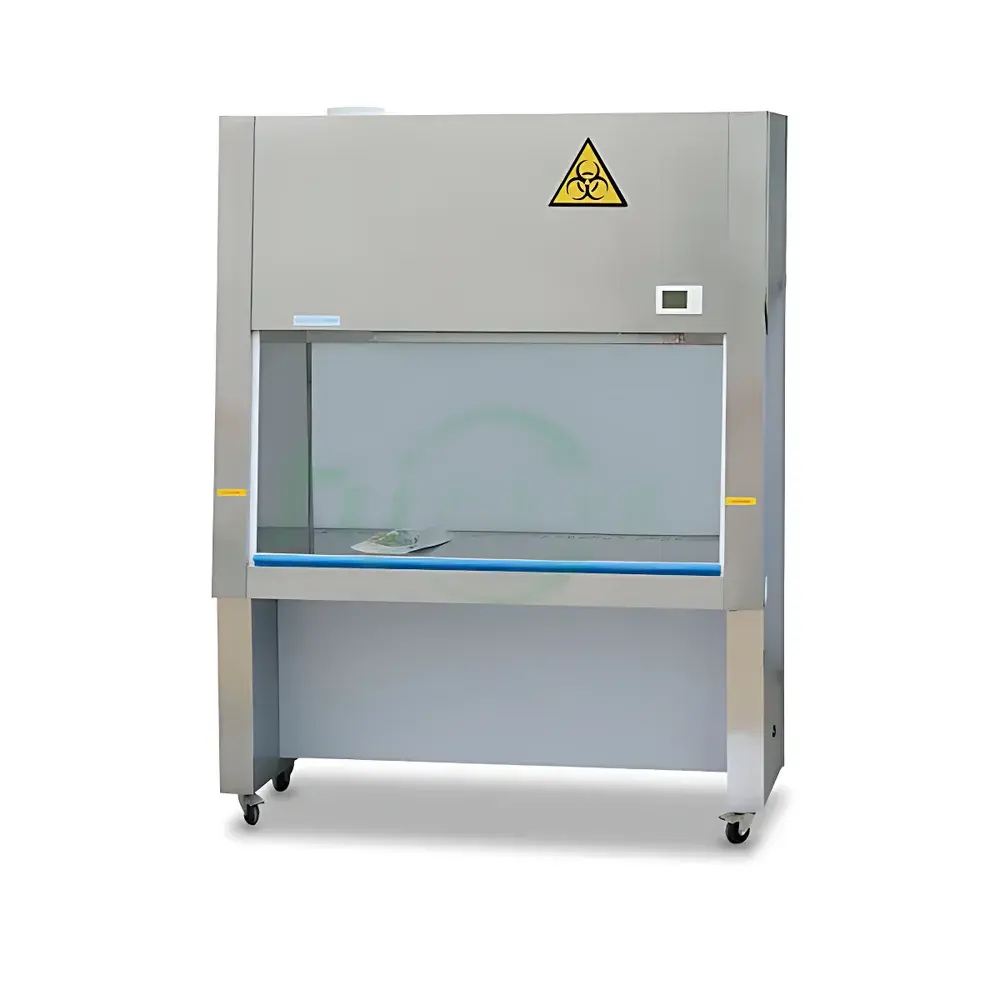
HJ BSC-1300IIB2 Class II Type B2 Biological Safety Cabinet
| Brand | HJ Purification |
|---|---|
| Origin | Shanghai, China |
| Manufacturer | Yes |
| Country of Origin | China |
| Model | BSC-1300IIB2 |
| Price | USD 3,500 (approx.) |
| External Dimensions (L×W×H) | 1500 × 750 × 1950 mm |
| Internal Work Area Dimensions (L×W×H) | 1300 × 650 × 580 mm |
| Filter Capture Efficiency | ≥99.999% at 0.3 µm (HEPA), 100% particulate retention per ISO 14644-1 Class 5 (equivalent to Fed Std 209E Class 100) |
| Average Inflow Velocity | 0.55 ± 0.025 m/s |
| Downflow Velocity (Center) | 0.26 ± 0.025 m/s |
| Noise Level | ≤62 dB(A) |
| Vibration (Half-Peak) | ≤3 µm |
| Power Supply | AC 220 V, 50 Hz |
| Max. Power Consumption | 1000 W |
| Net Weight | 200 kg |
| Work Surface Material | 304 Stainless Steel |
| Lighting | 30 W LED Fluorescent Lamp ×1 |
| UV Lamp | 30 W ×1 |
| Control Interface | LED-based Digital Panel with Real-time Alarms |
Overview
The HJ BSC-1300IIB2 is a certified Class II, Type B2 (total exhaust) biological safety cabinet engineered for maximum personnel, product, and environmental protection in microbiological and molecular biology laboratories. It operates on the principle of directional laminar airflow generated by a dual-blower system: inward-facing inflow across the work opening protects the operator, while vertically downward, HEPA-filtered downflow ensures product sterility. All air is exhausted externally via dedicated ductwork—zero recirculation—making it suitable for applications involving volatile toxic chemicals, radionuclides, or open-flame procedures where containment integrity and absolute exhaust are non-negotiable. The cabinet complies with NSF/ANSI 49-2022, EN 12469:2000, and GB/T 16292–16294-2010 standards for biosafety cabinet classification, performance verification, and microbial control.
Key Features
- Air curtain isolation system with fully negative-pressure vertical laminar flow and 100% external exhaust ensures zero cross-contamination between operator, sample, and environment.
- Motorized or manually adjustable sash window with positional memory and height-limit alarm prevents accidental over-lifting and supports validated decontamination cycles.
- Integrated power outlets (IPX4-rated waterproof) and liquid waste port located within the stainless-steel work area streamline workflow for centrifuges, pipette controllers, and reagent dispensers.
- Dual-stage filtration: pre-filter captures coarse particulates; primary ULPA/HEPA filter (1295 × 554 × 550 mm, ≥99.999% @ 0.3 µm) ensures ISO Class 5 (Fed Std 209E Class 100) cleanroom-grade air quality in the work zone.
- Electropolished 304 stainless-steel interior with seamless, radius-curved corners and sloped rear wall eliminates harborage points for microorganisms and facilitates validated cleaning and disinfection protocols.
- Microprocessor-based LED control panel provides real-time monitoring of inflow/downflow velocities, filter differential pressure, UV lamp status, and operational alarms—including HEPA saturation warning and sash breach alert.
- Ergonomically optimized 10° forward tilt of the front fascia reduces operator fatigue during prolonged use and aligns with ISO 13732-1 thermal comfort and posture guidelines.
Sample Compatibility & Compliance
The BSC-1300IIB2 accommodates standard benchtop instruments including biosafety-certified centrifuges, PCR workstations, microplate readers, and open-vessel cell culture systems. Its total-exhaust architecture permits safe handling of Risk Group 2 (RG2) and select RG3 agents under appropriate institutional biosafety committee (IBC) oversight. The unit meets GLP-compliant installation requirements when integrated into HVAC systems with dedicated exhaust ducting and static pressure compensation. Certification documentation includes factory-verified airflow mapping (ISO 14644-3 Annex B), filter integrity testing (DOP/PAO scan per EN 1822), and microbial challenge validation (using Bacillus atrophaeus spores per NSF/ANSI 49 Annex D). It supports audit readiness for ISO/IEC 17025, CLIA, and CAP-accredited labs.
Software & Data Management
While the BSC-1300IIB2 operates via embedded firmware without cloud connectivity, its control system logs timestamped operational events—including sash position changes, alarm triggers, filter runtime hours, and UV exposure cycles—in non-volatile memory. Data export is supported via RS-232 serial interface for integration into laboratory information management systems (LIMS) or preventive maintenance scheduling platforms. All alarms comply with IEC 62304 software lifecycle requirements and support FDA 21 CFR Part 11–aligned electronic record retention when paired with validated third-party data acquisition modules.
Applications
- Primary and secondary cell culture under aseptic conditions requiring chemical compatibility (e.g., methanol, ethanol, formaldehyde).
- Recombinant DNA manipulation involving antibiotic selection and plasmid transfection.
- Diagnostic assay development and validation in clinical microbiology and virology labs.
- Preparation of sterile pharmaceutical intermediates compliant with USP and EU GMP Annex 1.
- Environmental sampling analysis where aerosol-generating procedures (e.g., vortexing, sonication) must be contained without recirculation.
FAQ
What distinguishes Type B2 from Type A2 cabinets?
Type B2 cabinets provide 100% exhausted airflow with no recirculation, whereas Type A2 recirculates ~70% of filtered air. B2 units require dedicated hard-ducted exhaust and are mandatory when working with volatile hazardous chemicals.
Is ductless operation possible with this model?
No. The BSC-1300IIB2 is strictly a total-exhaust cabinet and must be connected to an external exhaust system meeting minimum static pressure and flow rate specifications per NSF/ANSI 49.
How often should the HEPA filter be replaced?
Filter replacement interval depends on usage intensity and ambient air quality but is typically 5–7 years. The built-in differential pressure sensor and saturation alarm provide objective, real-time indication of end-of-service life.
Can UV lamps be used while the sash is open?
No. Interlock circuitry automatically deactivates UV irradiation when sash height exceeds 5 cm to prevent operator exposure—consistent with IEC 62471 photobiological safety requirements.
Does this cabinet support GMP/GLP documentation requirements?
Yes. Factory calibration certificates, airflow validation reports, and filter test records are provided. Optional IQ/OQ documentation packages are available upon request for regulated environments.




