
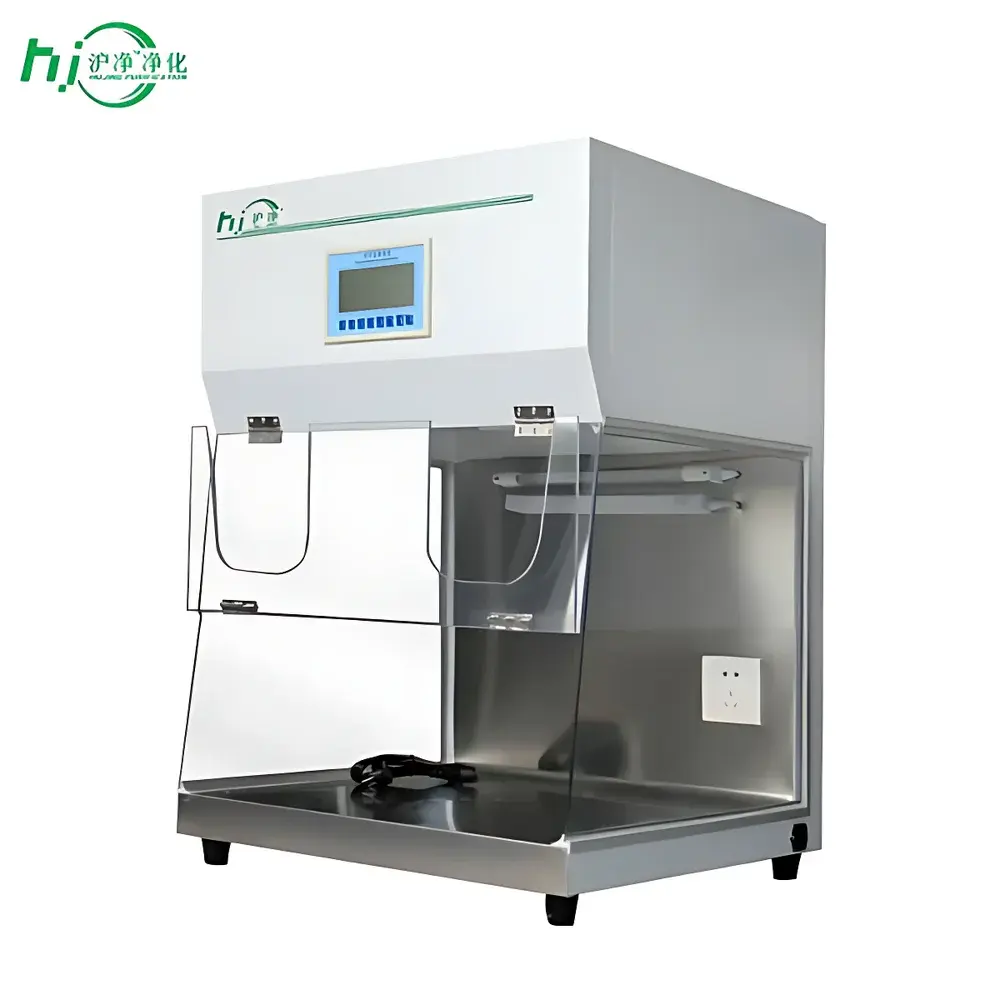
HJ PCR-600 Vertical Laminar Flow Clean Bench
| Brand | HJ |
|---|---|
| Origin | Shanghai, China |
| Manufacturer Type | Direct Manufacturer |
| Product Category | Domestic |
| Model | PCR-600 |
| Instrument Type | Vertical Flow Clean Bench |
| Cleanliness Class | ISO Class 5 (100 @ ≥0.5 µm, Fed. Std. 209E) |
| Noise Level | ≤62 dB(A) |
| User Capacity | Single-user, front-facing |
| Airflow Pattern | Vertical Downflow |
| Average Air Velocity | 0.25–0.45 m/s |
| Microbial Contamination | ≤0.5 CFU/plate·hr (Φ90 mm Petri dish) |
| Vibration | ≤5 µm (peak-to-peak, X/Y/Z axes) |
| Illumination | ≥300 lx |
| Power Supply | AC 220 V, 50 Hz |
| Max. Power Consumption | 800 W (including outlet) |
| Net Weight | 50 kg |
| Work Area Dimensions | 580 × 500 × 450 mm (W×D×H) |
| Overall Dimensions | 600 × 550 × 840 mm (W×D×H) |
| HEPA Filter Size & Qty | 515 × 405 × 50 mm × 1 |
| Fluorescent Lamp | 5 W × 1 |
| UV Lamp | 10 W × 1 |
Overview
The HJ PCR-600 Vertical Laminar Flow Clean Bench is an ISO Class 5-certified laminar flow workstation engineered specifically for polymerase chain reaction (PCR) sample preparation and other low-bioburden molecular biology applications. It operates on the principle of unidirectional vertical airflow: ambient laboratory air is drawn through a prefilter and then passed through a single integrated HEPA filter (efficiency ≥99.995% at 0.3 µm), generating a continuous, particle-free downflow across the entire work surface. This controlled environment maintains ≤0.5 colony-forming units per 90-mm Petri dish per hour—meeting stringent requirements for contamination-sensitive nucleic acid handling. Unlike biosafety cabinets, the PCR-600 does not recirculate air nor provide personnel or environmental protection; its design prioritizes sample integrity in non-hazardous, DNA/RNA-centric workflows where operator protection is not required.
Key Features
- Integrated vertical laminar airflow system with precisely calibrated velocity range (0.25–0.45 m/s) to ensure uniform particle removal and minimal turbulence within the work zone.
- Front-access flip-up tempered glass sash with dual side-view windows, enabling unrestricted visual monitoring while maintaining ergonomic working height and minimizing cross-contamination risk.
- Seamless one-piece stainless steel work surface with large-radius edge bending—resistant to corrosion, non-porous, and compliant with routine disinfection protocols using ethanol, isopropanol, or diluted sodium hypochlorite.
- Top-mounted service hatch allows full access to the blower assembly and HEPA filter without disrupting the clean zone—enabling filter replacement and fan maintenance under ISO Class 5 conditions.
- Interlocked UV and fluorescent lighting system: UV lamp (10 W) automatically deactivates when the sash is opened or the fluorescent lamp (5 W) is engaged, ensuring operator safety and preventing inadvertent UV exposure.
- Microprocessor-based control panel with real-time status indicators for airflow, UV operation, and lighting—supporting repeatable startup sequences and operational logging for GLP-aligned lab documentation.
- Cold-rolled steel enclosure with electrostatic powder coating—mechanically robust, scratch-resistant, and compatible with standard laboratory cleaning agents.
Sample Compatibility & Compliance
The PCR-600 accommodates common PCR ancillary equipment including microcentrifuges, thermal cyclers, pipette racks, tube holders, and multi-channel pipettors within its 580 × 500 × 450 mm work area. Its ISO Class 5 performance complies with Fed. Std. 209E and aligns with ISO 14644-1:2015 Annex B for cleanroom classification. While not certified to NSF/ANSI 49 or EN 12469, the unit satisfies internal quality control requirements for non-sterile molecular diagnostics, academic research, and teaching laboratories conducting PCR, qPCR, RT-PCR, and NGS library prep where containment of aerosolized nucleic acids—not biological agents—is the primary concern. It supports adherence to CLSI MM18-A and ISO/IEC 17025 documentation practices for equipment qualification.
Software & Data Management
The HJ PCR-600 features embedded firmware—not PC-dependent software—with non-volatile memory for operational history (e.g., cumulative UV exposure time, total runtime). No network connectivity or remote interface is provided; all settings are managed locally via tactile push-button controls. The system includes a dedicated grounded AC outlet (IEC 60320 C13) rated for 800 W maximum load, facilitating direct connection of peripheral devices without external power strips. Audit trails are manually recorded by lab personnel as part of equipment logbooks—a practice consistent with FDA 21 CFR Part 11 “paper-based equivalent” compliance pathways for low-risk instrumentation.
Applications
- Pre-PCR reagent setup and master mix preparation
- Template DNA/RNA dilution and aliquoting
- Primer and probe handling prior to amplification
- Cloning workflow stages involving restriction digests and ligation
- NGS library construction steps requiring low-background environments
- Teaching laboratory exercises in molecular biology techniques
- Quality control testing in food, environmental, or clinical screening labs performing target-specific amplification
FAQ
Is the PCR-600 suitable for handling infectious agents or hazardous chemicals?
No. This is a clean bench—not a biosafety cabinet. It provides no personnel or environmental protection and must not be used with biohazards, toxins, or volatile organic compounds.
Can the HEPA filter be replaced without professional service?
Yes. The top-mounted access panel enables user-level filter replacement following manufacturer-recommended procedures and post-installation airflow verification.
Does the unit meet ISO 14644-1 Class 5 certification out-of-the-box?
It is designed and tested to achieve ISO Class 5 performance at installation. Certification requires on-site validation (e.g., particle count, airflow velocity, and microbial settling plate tests) per ISO 14644-3.
What maintenance intervals are recommended?
Pre-filter inspection every 2 weeks; HEPA filter replacement every 12–24 months depending on usage intensity and ambient air quality; UV lamp replacement annually or after 1,000 hours of operation.
Is the lighting configuration compliant with EN 12464-1 for laboratory visual tasks?
Yes. The ≥300 lx uniform illumination across the work surface meets minimum requirements for precision manual tasks defined in EN 12464-1:2021 Section 5.3.



