
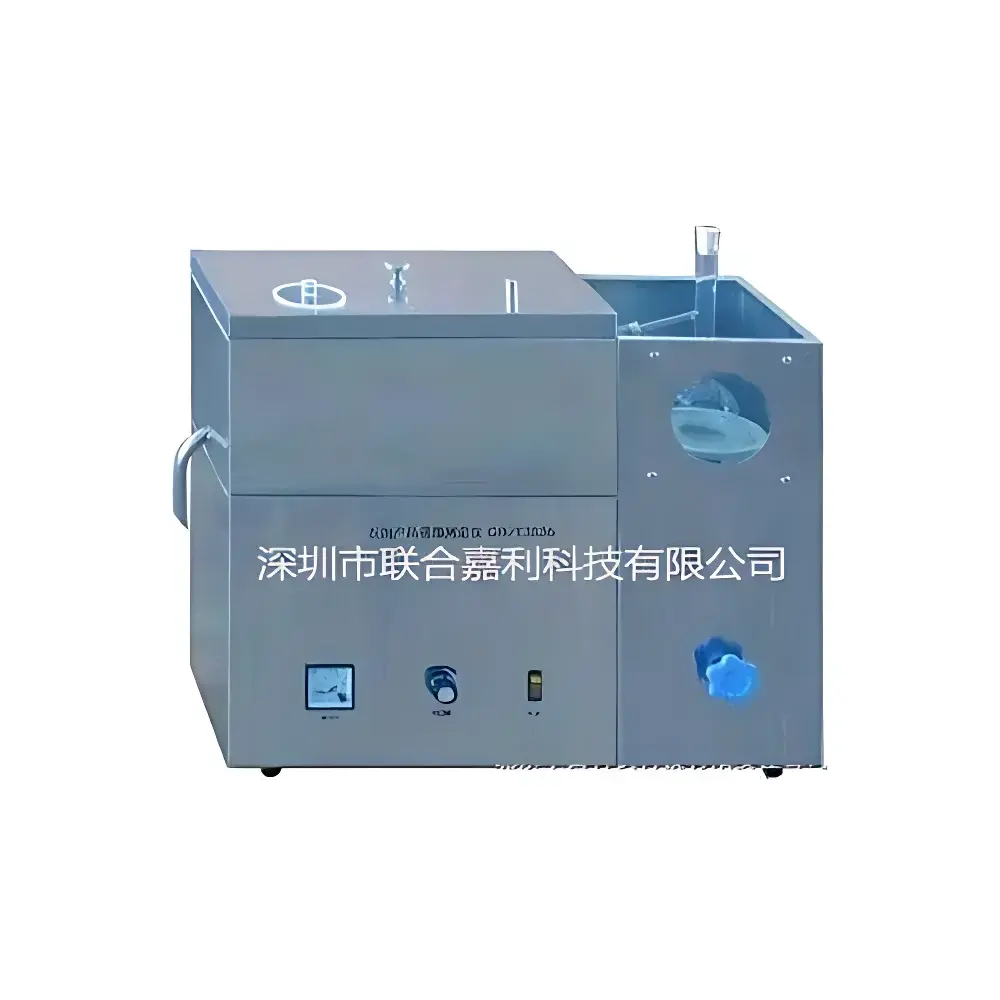
KA-105B Single-Tube Petroleum Distillation Apparatus
| Brand | KARRIE |
|---|---|
| Origin | Shenzhen, China |
| Model | KA-105B |
| Heating Power | Bath Heater: 800 W |
| Electric Furnace | 1000 W (0–1000 W continuously adjustable) |
| Power Supply | AC 220 V ±10%, 50 Hz |
| Bath Temperature Control Accuracy | ±1 °C |
| Condenser Type | Straight-tube, single-channel |
| Compliance | GB/T 255, SH/T 0121 |
Overview
The KA-105B Single-Tube Petroleum Distillation Apparatus is a precision-engineered laboratory instrument designed for the standardized determination of distillation characteristics of light petroleum products in accordance with GB/T 255 “Test Method for Distillation of Petroleum Products” and SH/T 0121 “Technical Specifications for Petroleum Distillation Equipment”. It implements the classical ASTM D86–like principle—namely, batch-wise atmospheric distillation under controlled heating rates—to quantify initial boiling point (IBP), final boiling point (FBP), and intermediate recovery temperatures (e.g., 10 %, 50 %, 90 % recovered by volume). The apparatus operates via direct resistive heating of the sample flask using a high-stability electric furnace, coupled with a thermostatically regulated metal bath to ensure uniform preheating and thermal inertia management. Its single-tube configuration adheres strictly to standard-defined geometry and vapor path length, minimizing fractionation artifacts and ensuring reproducibility across laboratories conducting routine QC testing of gasoline, aviation turbine fuel, naphtha, solvent oils, and other volatile hydrocarbon streams.
Key Features
- Single-tube straight condenser assembly compliant with GB/T 255 dimensional specifications, ensuring consistent vapor condensation kinetics and minimal hold-up volume.
- Independent dual-heating system: 800 W thermostatic metal bath heater (±1 °C stability) and 1000 W continuously adjustable electric furnace (0–1000 W via solid-state voltage regulator).
- 0–220 V AC analog voltage control enables precise, stepless ramping of furnace power—critical for replicating the prescribed heating rate profiles (e.g., 4–5 °C/min up to 220 °C per GB/T 255).
- Integrated observation window in the heating chamber allows real-time visual monitoring of sample boiling behavior, foam formation, and distillate flow without interrupting the test.
- Robust mechanical construction with corrosion-resistant stainless steel and high-temperature insulation materials ensures long-term operational integrity in demanding refinery or petrochemical QA environments.
Sample Compatibility & Compliance
The KA-105B is validated for use with transparent, non-viscous petroleum fractions having initial boiling points above 30 °C and final boiling points below 350 °C. Typical applications include motor gasoline (GB 17930), aviation gasoline (GB/T 6536 equivalent scope), industrial solvent naphthas (GB/T 1922), and light distillates from crude assay fractions. All operational parameters—including bath temperature setpoint accuracy, furnace power linearity, and condenser cooling geometry—conform to the physical and procedural requirements of GB/T 255 and SH/T 0121. While not certified to ASTM E29 or ISO/IEC 17025 out-of-the-box, the apparatus supports GLP-compliant documentation when integrated with external calibrated thermometers (e.g., ASTM E77-certified mercury-in-glass or platinum resistance thermometers) and volumetric receivers traceable to national standards.
Software & Data Management
The KA-105B is a manually operated, analog-control instrument and does not incorporate embedded digital controllers or data logging firmware. Temperature readings are obtained via external calibrated thermometers inserted into standardized thermometer wells; volume recovery is measured visually using class-A graduated cylinders meeting GB/T 12804 or ISO 4787 specifications. Laboratories requiring electronic data capture may integrate the unit with third-party PC-based acquisition systems via optional RTD or thermocouple interfaces (not supplied). For regulatory compliance in GMP or FDA-regulated facilities, users must implement manual audit trails, including operator signatures, raw observation logs, and calibration records aligned with ISO/IEC 17025 Clause 7.7 and USP Analytical Instrument Qualification protocols.
Applications
- Routine quality control of gasoline blending components and finished fuels in refinery laboratories.
- Distillation curve verification for compliance with product specifications (e.g., GB 17930, ASTM D4814, EN 228).
- Research and development of new fuel formulations where volatility profile impacts engine performance and emissions.
- Educational instruction in petroleum engineering curricula for hands-on demonstration of fractional volatility behavior.
- Third-party testing labs performing contract analyses under CNAS-accredited methods referencing GB/T 255.
FAQ
Does the KA-105B comply with ASTM D86?
No—the KA-105B is engineered specifically for GB/T 255 and SH/T 0121. While functionally similar to ASTM D86 apparatuses, it lacks the standardized ASTM condenser dimensions, receiver placement tolerances, and thermometer immersion depth controls required for formal ASTM D86 conformance.
Can the unit be upgraded with digital temperature control?
Not natively—the KA-105B uses analog solid-state voltage regulation. Retrofitting with PID-controlled digital modules requires external engineering validation and may void compliance with GB/T 255 unless re-verified per SH/T 0121 Annex B.
What thermometer calibration standards are recommended?
Class I mercury-in-glass thermometers per JJG 130 or ASTM E77, with calibration intervals ≤6 months and documented traceability to NIM (China National Institute of Metrology) or equivalent national metrology institutes.
Is the apparatus suitable for viscous or heavy-end samples?
No—it is restricted to light distillates only. Samples with kinematic viscosity >8 mm²/s at 40 °C or containing residuum, wax, or suspended solids are incompatible and may cause coking or inaccurate endpoint detection.
What maintenance is required for long-term accuracy?
Monthly inspection of heating element continuity, annual recalibration of bath temperature sensor (if equipped), and quarterly cleaning of condenser bore with appropriate hydrocarbon solvents to prevent polymer buildup.
Related Products






