
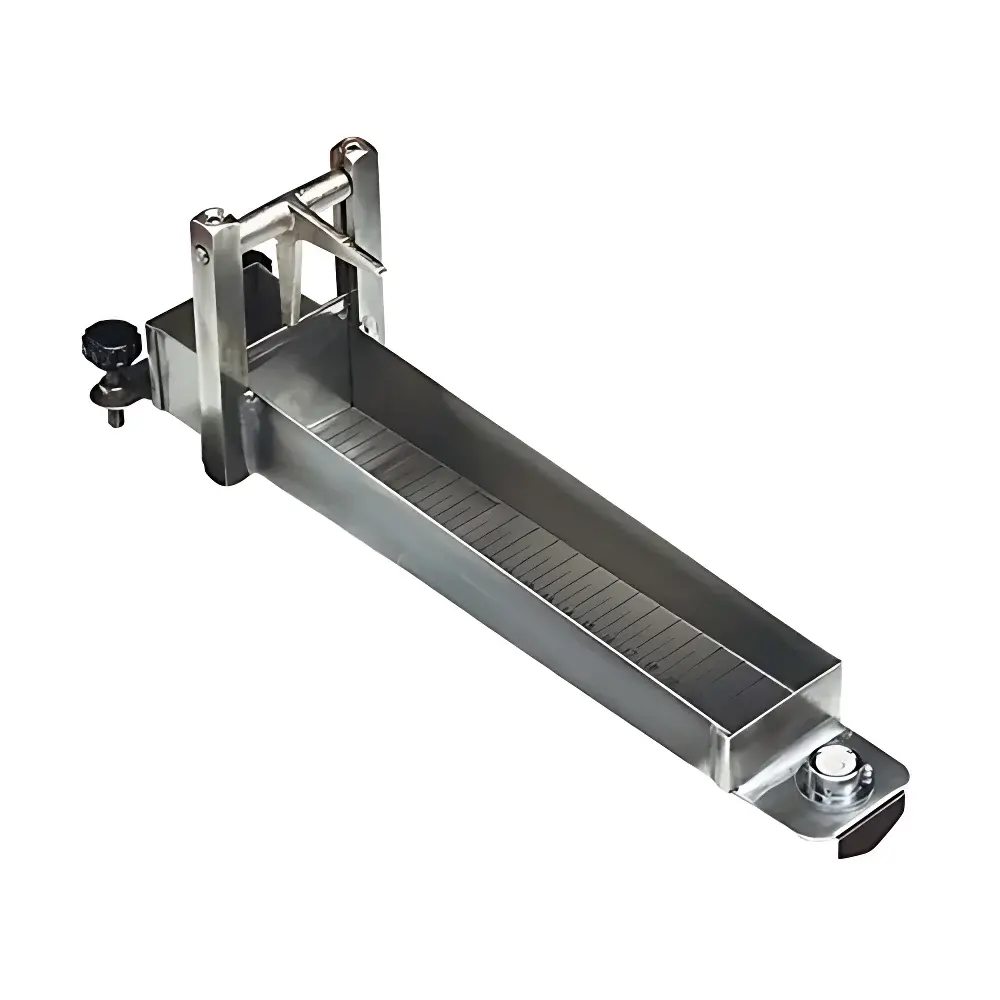
Endecotts Bostwick Consistometer Extended Version ZXCON-CON3
| Origin | UK |
|---|---|
| Manufacturer Type | Authorized Distributor |
| Origin Category | Imported |
| Model | ZXCON-CON3 |
| Instrument Type | Bostwick Consistometer |
| Compliance | ASTM F1080-93, MIL-SPEC R-81294D |
| Test Channel Length | 300 mm |
| Minimum Scale Division | 0.5 cm (60 divisions) |
| Channel Width | 84 mm |
| Overall Dimensions (L×W×H) | 415 × 88 × 104 mm |
| Adjustable Height Range | 110–139 mm |
| Material | 2 mm electropolished stainless steel |
| Sample Volume | 75–100 mL |
| Leveling | Dual adjustable leveling feet + bubble level |
| Gate Mechanism | Spring-loaded gate for precise, instantaneous release |
| Weight | Approx. 2.8 kg |
Overview
The Endecotts Bostwick Consistometer Extended Version (Model ZXCON-CON3) is a precision gravity-driven flow consistency tester engineered for rapid, repeatable assessment of semi-solid and highly viscous materials. Unlike rotational or capillary viscometers, the Bostwick method relies on controlled gravitational flow under standardized conditions—specifically, the distance (in centimeters) a sample flows in 30 seconds along a calibrated inclined channel. This empirical yet rigorously standardized approach delivers robust comparative consistency data for products where yield stress, structural breakdown, and flow onset behavior dominate performance. Designed and manufactured in the UK by Endecotts—a globally recognized name in physical testing instrumentation—the ZXCON-CON3 extends the classic Bostwick platform with a 300 mm test channel, enabling enhanced resolution for low-to-medium mobility samples without compromising portability or operational simplicity.
Key Features
- Extended 300 mm test channel with 60 precisely engraved 0.5 cm scale divisions—optimized for improved measurement sensitivity across a broader consistency range.
- Electropolished 2 mm stainless steel construction ensures long-term dimensional stability, corrosion resistance, and compliance with food-grade and industrial hygiene requirements.
- Spring-actuated gate mechanism provides zero-delay, reproducible sample release—critical for minimizing operator-induced variability and ensuring strict adherence to ASTM F1080-93 timing protocols.
- Dual adjustable leveling feet and integrated bubble level guarantee consistent 0° inclination during testing, eliminating angular error that could skew flow distance measurements.
- Compact footprint (415 × 88 × 104 mm) and lightweight design (≈2.8 kg) allow seamless integration into QC labs, pilot plants, or production line environments with minimal bench space.
- Designed for use with standard 75 mL or 100 mL sample containers—minimizing material consumption while maintaining representative bulk behavior.
Sample Compatibility & Compliance
The ZXCON-CON3 is validated for routine consistency evaluation of non-Newtonian, shear-thinning, and yield-stress fluids across regulated and non-regulated sectors. It meets ASTM F1080-93 (“Standard Test Method for Consistency of Tomato Products Using the Bostwick Consistometer”) and MIL-SPEC R-81294D, supporting traceable quality control in food manufacturing, paint formulation, personal care product development, and chemical process validation. Its stainless-steel architecture complies with FDA 21 CFR Part 11–aligned documentation practices when paired with lab notebook entries or LIMS-integrated reporting workflows. No calibration fluids or external standards are required—performance verification is conducted via geometric inspection and timed water-flow checks per ASTM guidelines.
Software & Data Management
As a mechanical, analog consistency tester, the ZXCON-CON3 operates independently of software or digital interfaces—ensuring immunity to firmware updates, cybersecurity vulnerabilities, or system compatibility constraints. All measurements are directly readable from the engraved scale, facilitating immediate manual recording in paper-based or electronic lab notebooks. For laboratories operating under GLP or GMP frameworks, the device supports full auditability through documented operator training records, periodic mechanical verification logs (e.g., gate release timing, leveling accuracy), and raw data traceability via dated, signed test sheets. Optional accessories—including calibrated sample cups and NIST-traceable reference gels—enable cross-laboratory correlation studies.
Applications
- Food & Beverage: Tomato paste, ketchup, fruit purées, yogurt, cheese spreads, jams, jellies, soups, and infant nutrition formulations.
- Coatings & Adhesives: Epoxy removers, polyurethane coatings, latex paints, sealants, and structural adhesives where sag resistance and application viscosity are critical.
- Personal Care: Shampoos, conditioners, facial creams, body lotions, and toothpastes—particularly during formulation screening and batch release testing.
- Chemical & Industrial: Drilling muds, ceramic slips, battery slurries, pharmaceutical ointments, and polymer dispersions requiring yield-point estimation without complex rheological modeling.
FAQ
What standards does the ZXCON-CON3 comply with?
ASTM F1080-93 and MIL-SPEC R-81294D—both specifying test geometry, timing, sample volume, and reporting conventions for Bostwick-style consistency measurement.
Is operator training required to achieve reproducible results?
Yes—consistent gate release technique, sample loading uniformity, and timing discipline are essential. Endecotts recommends initial operator qualification per internal SOPs aligned with ISO/IEC 17025 competency requirements.
Can the ZXCON-CON3 be used for regulatory submission data?
It is routinely accepted in FDA, EFSA, and CFIA submissions for food product specifications when employed within a validated, documented QC process—including equipment verification, environmental controls, and analyst competency records.
How often should mechanical verification be performed?
Daily visual inspection of gate function and leveling; weekly verification of scale linearity using gauge blocks or certified rulers; annual metrological review if used in GLP/GMP environments.
Does the device require recalibration or certification?
No—its measurement principle is geometric and time-based, not sensor-dependent. Verification focuses on physical integrity and procedural adherence—not electronic recalibration.



