
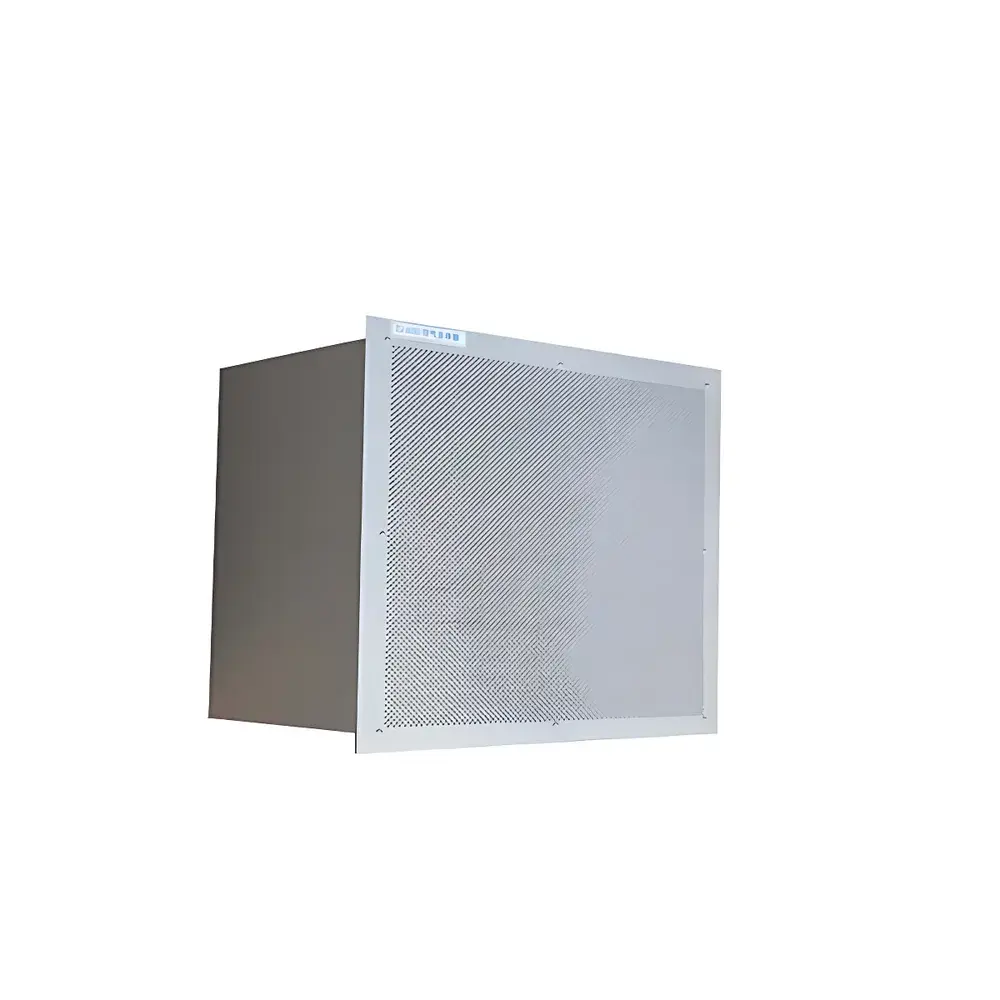
HJ ZJ-1000 Ceiling-Mounted Air Self-Cleaning Unit
| Brand | HJ Purification |
|---|---|
| Origin | Shanghai, China |
| Manufacturer Type | OEM Manufacturer |
| Country of Origin | China |
| Model | ZJ-1000 |
| Rated Airflow | 1000 m³/h |
| External Dimensions (mm) | 930 × 710 × 550 |
| Cutout Dimensions (mm) | 880 × 660 |
| HEPA Filter Size (mm) | 820 × 600 × 150 |
| Application Area | Up to 5 m² |
| Cleanliness Class | ISO Class 8 (equivalent to US FED STD 209E Class 10,000 for ≥0.5 µm particles) |
| Noise Level | ≤62 dB(A) |
| Construction | Powder-coated steel housing with internal acoustic foam lining |
| Filtration Stages | Pre-filter + HEPA H13 (EN 1822-1:2019 compliant) |
| Installation | Ceiling-recessed or surface-mounted with recirculating indoor air mode |
Overview
The HJ ZJ-1000 Ceiling-Mounted Air Self-Cleaning Unit is an engineered local air purification solution designed for controlled laboratory environments where spatial constraints and unidirectional airflow are not required, but consistent particulate reduction is essential. Unlike laminar flow hoods or cleanroom HVAC systems, the ZJ-1000 operates on a recirculating principle: ambient room air is drawn in via a forward-swept centrifugal fan, passed sequentially through a G4-grade pre-filter (capturing coarse dust, lint, and fibers >5 µm), then through a certified H13-class HEPA filter (minimum 99.95% efficiency at 0.3 µm per EN 1822-1:2019), and discharged vertically downward as low-turbulence, particle-depleted air. Its static pressure chamber ensures uniform velocity distribution across the entire outlet face, enabling stable air curtain formation over work surfaces. The unit achieves ISO Class 8 (formerly US FED STD 209E Class 10,000) cleanliness—defined as ≤3.52 × 10⁶ particles ≥0.5 µm per cubic meter—when installed above a defined 5 m² zone with appropriate ceiling height (≥2.6 m) and minimal cross-draft interference. It is not intended for sterile barrier applications or ISO Class 5–7 environments but serves effectively in QC labs, sample preparation areas, reagent weighing stations, and low-risk microbiological support zones.
Key Features
- Integrated dual-stage filtration architecture: washable G4 pre-filter extends HEPA service life and reduces maintenance frequency
- H13 HEPA filter compliant with EN 1822-1:2019, individually tested and certified with scan report traceability
- Low-noise operation (≤62 dB[A] at 1 m) enabled by vibration-damped fan mounting and internal acoustic foam lining
- Powder-coated cold-rolled steel enclosure (thickness ≥1.2 mm) with corrosion-resistant finish suitable for laboratory chemical exposure
- Ceiling-recessed installation option with standardized cutout dimensions (880 × 660 mm) for seamless architectural integration
- Modular filter access from below—no tools required for routine HEPA replacement or pre-filter cleaning
- No external ducting or exhaust requirement; fully self-contained recirculation mode minimizes HVAC load
Sample Compatibility & Compliance
The ZJ-1000 is compatible with non-hazardous solid and liquid samples handled under general laboratory conditions. It is unsuitable for volatile organic compound (VOC)-laden atmospheres, biohazardous aerosols (BSL-2+), or radioactive particulates without supplemental engineering controls. The unit conforms to GB/T 14295–2019 (Chinese national standard for air filters), and its electrical design meets GB 4706.1–2005 (IEC 60335-1 equivalent) for safety. While not certified to UL 507 or IEC 61000-6-3 for EMC, it incorporates EMI-suppressed motor drivers and grounded chassis construction. For GLP-compliant laboratories, filter change logs, airflow verification (using calibrated anemometer), and periodic particle count audits (ISO 14644-1:2015 Annex B) are recommended to maintain documented environmental control.
Software & Data Management
The ZJ-1000 is a standalone electromechanical device with no embedded microprocessor, touchscreen interface, or digital connectivity. Operational status is indicated solely via a single LED power indicator. As such, it generates no electronic records, does not support audit trails, and is inherently compliant with FDA 21 CFR Part 11 requirements by absence of electronic record creation. Maintenance documentation—including filter replacement dates, pre-filter cleaning intervals, and annual airflow verification results—must be retained manually per institutional SOPs. Integration with building management systems (BMS) or IoT platforms is not supported; however, optional external particle counters (e.g., TSI 3330 with ISO 21501-4 calibration) may be deployed downstream for continuous environmental monitoring.
Applications
- Local particle control above analytical balance tables in chemistry and pharmaceutical QC labs
- Supplemental air cleaning in glovebox antechambers or low-flow fume hood sashes during weighing operations
- Environmental stabilization in polymer characterization labs where electrostatic dust interference affects DSC/TGA measurements
- Preparation zones for optical component handling (e.g., spectrometer mirrors, laser optics) requiring sub-10,000-particle/ft³ conditions
- Support environments for ISO/IEC 17025-accredited testing laboratories needing documented ambient particulate mitigation without full cleanroom infrastructure
FAQ
Can the ZJ-1000 be used in biosafety cabinets or containment enclosures?
No. It lacks negative pressure containment, gas-tight seals, and certified downflow velocity profiles required for biological safety applications.
Is the HEPA filter replaceable with third-party alternatives?
Only H13-grade HEPA filters meeting EN 1822-1:2019 dimensional and performance specifications (820 × 600 × 150 mm, ≤120 Pa initial resistance at rated airflow) are validated for use; non-certified substitutes compromise ISO Class 8 compliance.
Does the unit require external exhaust ducting?
No. It operates exclusively in recirculation mode and must not be connected to external ductwork unless modified by qualified engineering personnel—a configuration that voids factory warranty and ISO performance claims.
What is the recommended filter maintenance schedule?
Pre-filter: clean every 2 weeks in high-dust environments; HEPA filter: replace annually or after 7,500 operating hours, verified by upstream/downstream particle challenge testing.
Can multiple ZJ-1000 units be synchronized for larger areas?
No synchronization protocol exists. Coverage scaling requires independent installation per 5 m² zone, with minimum 1.2 m lateral separation to prevent airflow interference and turbulence-induced particle resuspension.



