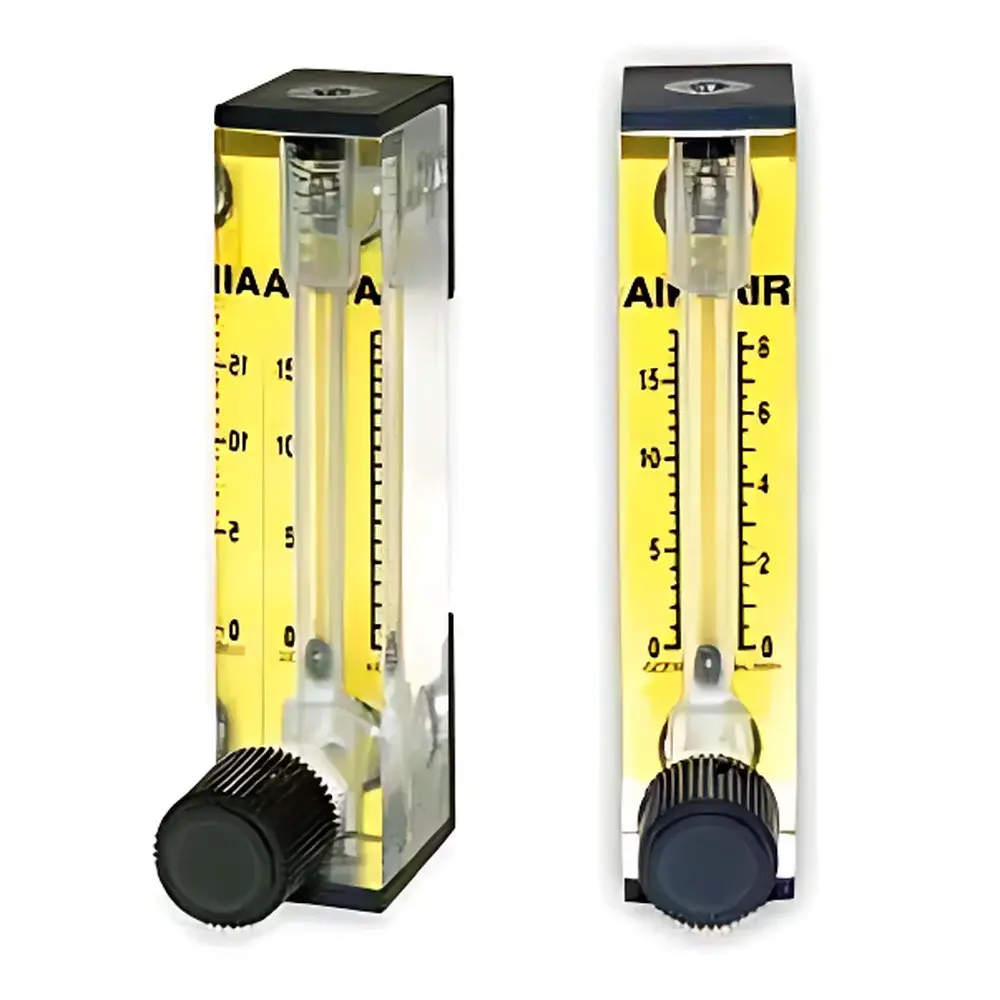
Cole-Parmer Acrylic Variable-Area Flowmeter for Gases and Water
| Brand | Cole-Parmer |
|---|---|
| Origin | USA |
| Manufacturer Type | Authorized Distributor |
| Origin Category | Imported |
| Model | 68560-14 |
| Flow Principle | Differential Pressure (Variable-Area / Rotameter) |
| Materials | Acrylic Body, Float Options (Glass, Stainless Steel 316, Tungsten Carbide), Brass or SS 316 Fittings |
| Max Flow Range | 2.8–100 scfh (air), 0.3–22 GPH (water) |
| Scale | Dual-scale (English & Metric), Direct-Reading |
| Valve | Integrated Low-Hysteresis Needle Valve (optional valve-less configuration available) |
Overview
The Cole-Parmer Acrylic Variable-Area Flowmeter (Model 68560-14 and related variants) is a precision-engineered differential-pressure flow measurement instrument designed for reliable, real-time volumetric flow monitoring of clean, non-corrosive gases—including air, oxygen, nitrogen, CO₂, and argon—as well as low-viscosity liquids such as water and aqueous solutions. Operating on the classic rotameter principle, it utilizes gravity-driven float displacement within a vertically oriented, tapered acrylic tube: fluid flow lifts a calibrated float until drag force balances gravitational and buoyant forces, with position directly indicating flow rate against a dual-scale (imperial and metric) engraved reference. Its all-acrylic construction provides optical clarity for unambiguous visual reading, chemical resistance to water and common industrial gases, and mechanical robustness under moderate pressure and temperature conditions (typically up to 125 psi and 60 °C). As a mechanical, analog device with no electronics or external power requirement, it delivers inherently stable, drift-free operation ideal for benchtop process verification, calibration transfer standards, pilot-scale gas delivery systems, and educational laboratory demonstrations.
Key Features
- Optically clear acrylic tube enables direct, parallax-minimized visual flow reading with dual imperial/metric graduations etched permanently into the tube surface.
- Integrated low-hysteresis needle valve allows precise manual flow regulation upstream of the metering section—reducing turbulence and improving measurement repeatability.
- Modular design permits rapid disassembly without tools: end fittings, float assembly, and tube can be separated for thorough cleaning, inspection, or component replacement.
- Multiple float material options (glass, 316 stainless steel, tungsten carbide) ensure compatibility across a wide range of fluid densities and abrasion sensitivities—critical for accurate calibration per ISO 4009 and ASTM D3527.
- Choice of inlet/outlet fittings (brass or 316 stainless steel) supports integration into diverse tubing systems while maintaining pressure integrity and corrosion resistance.
- No electrical components, batteries, or firmware—eliminates electromagnetic interference concerns and ensures operational continuity in environments where intrinsic safety or explosion-proof certification is not required.
Sample Compatibility & Compliance
This flowmeter is validated for use with non-aggressive, particle-free media. Gas applications include compressed air, medical-grade O₂, high-purity N₂, food-grade CO₂, and ultra-high-purity Ar in analytical, pharmaceutical, and semiconductor tooling support lines. Liquid applications are limited to deionized water, distilled water, and low-conductivity aqueous buffers at ambient temperatures. It complies with general-purpose industrial safety standards for pressure-rated glass/acrylic devices (ASME B31.1 guidance for low-pressure instrumentation). While not certified to ATEX or IECEx, its passive design renders it suitable for Class 1, Division 2 environments when installed per manufacturer-recommended orientation and pressure limits. Calibration traceability follows NIST-traceable procedures; individual units are supplied with a factory calibration certificate referencing standard conditions (e.g., 20 °C, 1 atm) per ISO/IEC 17025-compliant practices.
Software & Data Management
As a purely analog, visual-read instrument, this flowmeter does not incorporate digital output, data logging, or software connectivity. It functions independently of control systems and requires no driver installation, network configuration, or cybersecurity validation. Its role in regulated environments (e.g., GLP or GMP labs) is typically limited to operator-verified setup checks, leak testing, or as a secondary verification standard against primary electronic mass flow controllers. For audit purposes, calibration records—including date, technician ID, reference standard used, and as-found/as-left readings—must be maintained manually or entered into a compliant LIMS or ELN platform per 21 CFR Part 11 requirements when used in FDA-regulated workflows.
Applications
- Verification and adjustment of gas flow rates in environmental chambers, incubators, and glovebox purge systems.
- Calibration cross-check for thermal mass flow meters (MFM) and Coriolis-based liquid flow sensors in R&D laboratories.
- Process monitoring in water purification skids, reverse osmosis feed lines, and reagent delivery manifolds.
- Educational use in fluid mechanics courses to demonstrate laminar vs. turbulent flow regimes and Reynolds number effects.
- Gas blending station commissioning, where stoichiometric ratios of carrier and reactive gases must be visually confirmed prior to reactor startup.
- Quality assurance sampling lines for continuous emission monitoring systems (CEMS) requiring stable, known dilution flows.
FAQ
Is this flowmeter suitable for measuring corrosive or abrasive fluids?
No. The acrylic tube and standard float materials are incompatible with strong acids, solvents, halogens, or slurries containing suspended solids. Use only with clean, low-viscosity gases and water-based liquids.
Can the flowmeter be mounted horizontally?
No. Rotameters require strict vertical alignment (±2° tolerance) to ensure gravitational float equilibrium. Deviation invalidates calibration and introduces significant measurement error.
What is the recommended recalibration interval?
Annual calibration is advised for critical applications. More frequent verification (e.g., quarterly) is recommended if subjected to mechanical shock, thermal cycling, or exposure to condensate.
Does Cole-Parmer provide NIST-traceable calibration certificates?
Yes—each unit ships with a factory calibration certificate listing measured points, uncertainty values, and traceability to NIST standards. Custom multi-point calibration reports are available upon request.
How do I select the correct float material for my application?
Select based on fluid density and required turndown ratio: glass floats suit low-density gases (e.g., helium), stainless steel for mid-range (air, N₂), and tungsten carbide for high-density or high-velocity streams (e.g., CO₂ at elevated pressure). Consult the Cole-Parmer engineering datasheet for ρfluid/ρfloat ratio guidelines.