
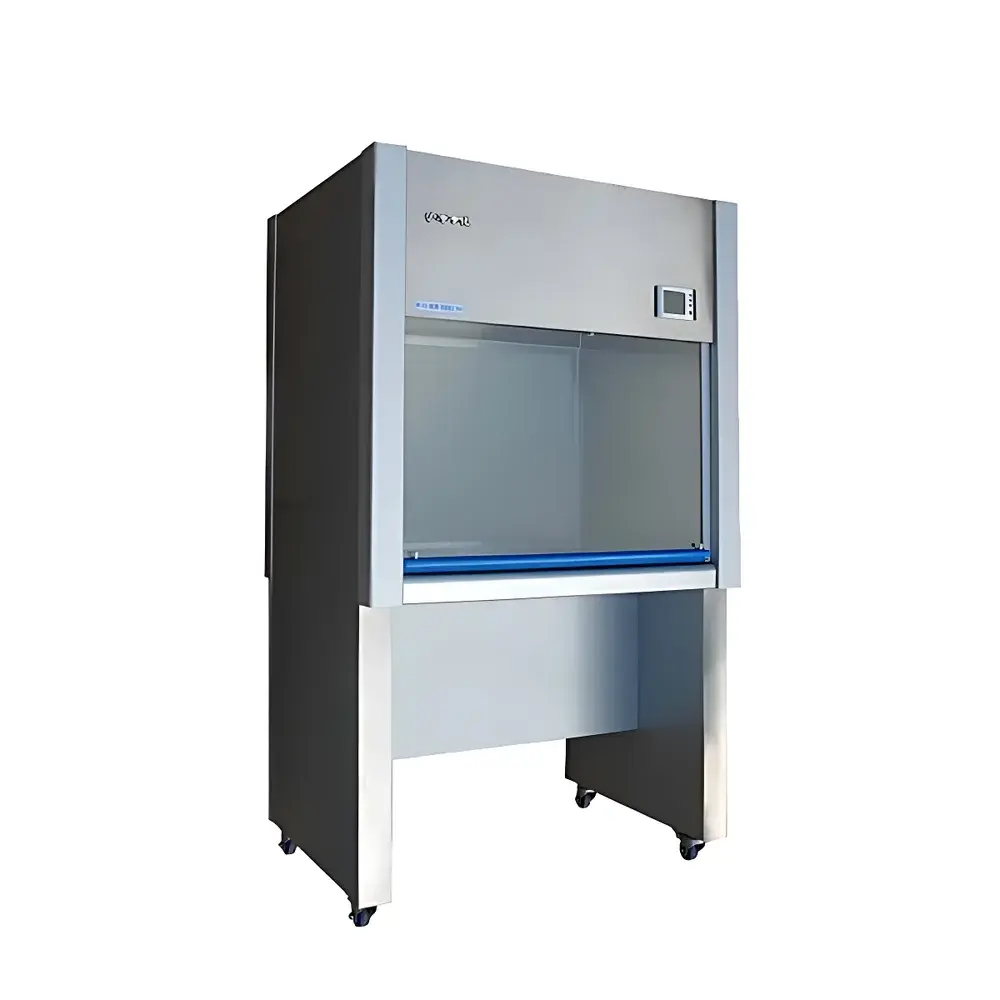
HJ SW-CJ-1B Horizontal Laminar Flow Clean Bench
| Brand | HJ |
|---|---|
| Origin | Shanghai, China |
| Manufacturer Type | Direct Manufacturer |
| Product Category | Domestic |
| Model | SW-CJ-1B |
| Instrument Type | Horizontal Laminar Flow Clean Bench |
| Cleanliness Class | ISO Class 5 (equivalent to Fed. Std. 209E Class 100 @ ≥0.5 µm) |
| Noise Level | ≤62 dB(A) |
| Occupancy | Single User |
| Airflow Pattern | Horizontal Laminar Flow |
| Average Air Velocity | 0.25–0.45 m/s (dual-speed control) |
| Microbial Contamination | ≤0.5 CFU/plate·hour (Φ90 mm settle plate) |
| Vibration | ≤5 µm peak-to-peak (X/Y/Z axes) |
| Illumination | ≥300 lux |
| Power Supply | AC 220 V, 50 Hz |
| Max. Power Consumption | 400 W |
| Net Weight | 100 kg |
| Work Area Dimensions (W×D×H) | 870 × 540 × 515 mm |
| Overall Dimensions (W×D×H) | 1030 × 715 × 1600 mm |
| HEPA Filter Specification | 865 × 600 × 38 mm, single unit |
| Lighting | 20 W fluorescent lamp × 1 |
| UV Lamp | 20 W × 1 |
Overview
The HJ SW-CJ-1B Horizontal Laminar Flow Clean Bench is an ISO Class 5-certified (Fed. Std. 209E Class 100) unidirectional airflow workstation engineered for contamination-sensitive tasks in microbiological laboratories, pharmaceutical QC environments, and academic research settings. Unlike vertical flow hoods, this bench delivers horizontal laminar airflow—air drawn through a prefilter, then forced across the work surface by a variable-speed centrifugal blower, and exhausted forward through a high-efficiency particulate air (HEPA) filter rated at ≥99.99% efficiency for particles ≥0.3 µm. The airflow profile ensures consistent velocity (0.25–0.45 m/s), minimal turbulence, and uninterrupted protection of samples from ambient airborne contaminants—including viable microorganisms, dust, and aerosolized particulates. Its design complies with core principles outlined in ISO 14644-1 for cleanroom performance validation and supports routine environmental monitoring per ISO 14698-1 for biocontamination control.
Key Features
- Horizontal laminar airflow architecture with adjustable dual-speed fan control via LCD interface—enabling precise optimization of air velocity for diverse procedural requirements (e.g., cell culture vs. sterile media preparation).
- Ultra-slim aluminum-framed, non-partitioned HEPA filter (865 × 600 × 38 mm) integrated into a minimized plenum chamber—reducing cabinet footprint while maximizing usable work area (870 × 540 × 515 mm).
- Quasi-enclosed tempered glass sash with smooth vertical travel—providing ergonomic access, operator visibility, and physical barrier integrity without compromising laminar continuity.
- Dual lighting system: 20 W cool-white fluorescent lamp for task illumination (≥300 lux at work surface), plus 20 W germicidal UV-C lamp (254 nm) with safety interlock switch to prevent accidental exposure during operation.
- Low-noise operation (≤62 dB[A]) and mechanical vibration control (≤5 µm peak-to-peak across all three axes), critical for sensitive instrumentation integration or long-duration aseptic manipulations.
- Robust stainless steel work surface and powder-coated steel enclosure—designed for chemical resistance, ease of decontamination, and compliance with laboratory hygiene protocols.
Sample Compatibility & Compliance
The SW-CJ-1B accommodates standard Petri dishes, flasks, pipette racks, and small-scale bioreactors within its defined work envelope. It is not intended for handling hazardous biological agents (BSL-2+), volatile chemicals, or radioactive materials—consistent with its classification as a clean bench (not a biosafety cabinet). The unit meets structural and performance criteria aligned with ISO 14644-1 (cleanroom classification), ISO 14698-1 (biocontamination control), and Chinese national standard GB/T 25215-2010 for laminar flow clean benches. Routine verification of airflow uniformity, filter integrity (via DOP/PAO testing), and microbial recovery (settle plate method per ISO 14698-2) is recommended for GLP/GMP-aligned workflows.
Software & Data Management
As a manually operated, non-networked bench, the SW-CJ-1B does not incorporate embedded software or digital data logging. All operational parameters—including fan speed selection, UV activation, and lighting—are controlled locally via tactile LCD switches. However, its design facilitates integration into regulated environments: the dual-speed fan allows documented procedural consistency; the UV interlock provides basic hardware-level safety assurance; and the stable airflow profile supports reproducible environmental monitoring logs required under FDA 21 CFR Part 11–aligned documentation practices when paired with external calibrated anemometers and particle counters.
Applications
- Aseptic transfer of bacterial/fungal cultures and mammalian cell lines in teaching and research labs.
- Preparation of sterile culture media, buffers, and reagents for downstream analytical or diagnostic use.
- Assembly and handling of sensitive optical or microelectronic components requiring particulate-free assembly zones.
- Supporting ISO/IEC 17025-accredited testing where sample integrity depends on background particulate and microbial load control.
- Use in pharmaceutical secondary packaging areas or quality control labs performing non-viable particle counting per USP .
FAQ
Is the SW-CJ-1B suitable for working with pathogenic microorganisms?
No. This is a clean bench—not a biosafety cabinet—and provides product protection only. It does not protect the user or environment from biohazards.
What HEPA filter standard does it meet?
It uses a ≥99.99% efficient HEPA filter at 0.3 µm, compliant with EN 1822-1 H14 classification and equivalent to IEST-RP-CC001.5 specifications.
Can it be validated for GMP use?
Yes—when coupled with third-party qualification (IQ/OQ/PQ), including airflow mapping, filter leak testing, and microbial challenge studies per ISO 14644-3.
Does it require external exhaust ducting?
No. It recirculates filtered air horizontally across the work surface and discharges it forward into the lab environment.
What maintenance intervals are recommended?
Pre-filter replacement every 3–6 months; HEPA filter replacement every 18–24 months (or after integrity failure); annual calibration of anemometer and UV intensity meter.



