
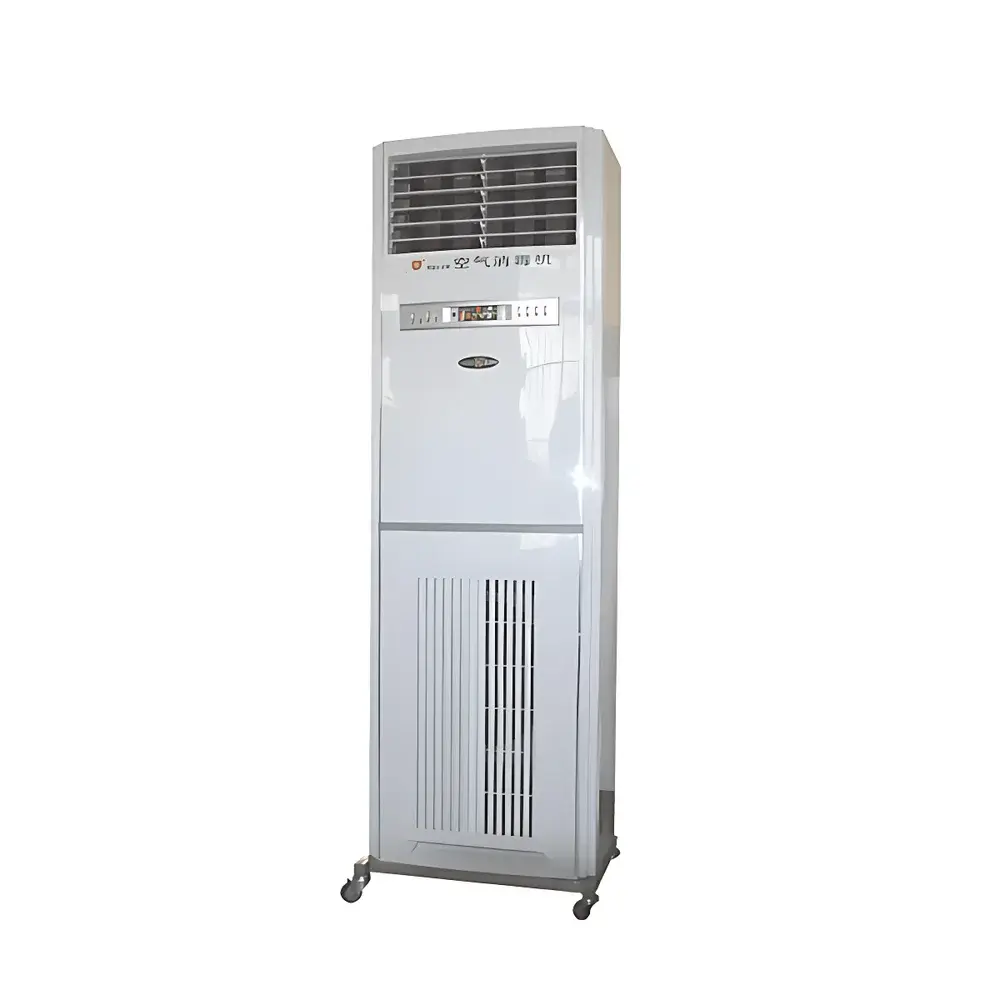
HJ ZJQ-100 Mobile Dual-Mode Air Disinfection Unit
| Brand | HJ Purification |
|---|---|
| Origin | Shanghai, China |
| Manufacturer Type | Direct Manufacturer |
| Country of Origin | China |
| Model | ZJQ-100 |
| Instrument Type | Filter-Based Air Disinfection System |
| Suitable Area | 300 m² |
| Noise Level | ≤50 dB(A) |
| Airflow Velocity | 5 m/s |
| Cleanroom Class | ISO Class 5 (100-level) |
| Dimensions (W×D×H) | 510 × 330 × 1800 mm |
| Power Supply | 220 V / 50 Hz |
| Safety Class | Class I, Type B |
| Operating Temperature | 5–40 °C |
Overview
The HJ ZJQ-100 Mobile Dual-Mode Air Disinfection Unit is an engineered solution for continuous and intermittent air decontamination in controlled environments where personnel occupancy and microbial load management must coexist. Designed for laboratory, clinical, pharmaceutical, and industrial hygiene applications, it integrates multiple physical and chemical disinfection modalities—ultraviolet germicidal irradiation (UV-C at 254 nm), ozone generation (O₃), electrostatic precipitation, activated carbon adsorption, and negative ion emission—within a single, mobile platform. Unlike single-mechanism purifiers, the ZJQ-100 supports both dynamic operation (UV-C active with occupants present) and static operation (ozone-based sterilization requiring room evacuation), enabling flexible deployment across workflow cycles without compromising safety or efficacy. Its architecture complies with core design principles outlined in GB 28235–2020 (Chinese National Standard for UV Air Disinfectors) and aligns with functional expectations for ISO Class 5 (100-level) clean air delivery in non-sterile but microbiologically controlled spaces.
Key Features
- Dual-mode disinfection control: Independent selection between UV-C-only (occupancy-permitted) and ozone-assisted (evacuation-required) protocols via front-panel interface
- Multi-stage air treatment train: Pre-filter + medium-efficiency filter + high-intensity UV-C chamber (36 W lamp, ≥10,000 µW/cm² irradiance at 1 m) + ozone generator (tubular dielectric design, rated output ≥10,000 mg/h) + electrostatic precipitator + granular activated carbon bed + negative ion emitter
- Integrated fault diagnostics: Real-time self-monitoring of UV lamp integrity, ozone tube functionality, fan performance, and cumulative runtime logging
- Mobility and ergonomics: Castor-mounted steel frame with locking brakes; height-adjustable vertical column (1800 mm total); compact footprint (0.17 m² floor area)
- Acoustic optimization: Sound-dampened housing and low-turbulence airflow path ensure ≤50 dB(A) at 1 m during full-load operation
- Material compatibility: Stainless steel primary filter housing (non-corrosive, autoclavable surface); ozone-resistant gaskets and UV-stabilized polycarbonate shielding
Sample Compatibility & Compliance
The ZJQ-100 is validated for use in environments requiring sustained airborne bioburden reduction—including clinical laboratories, QC testing rooms, aseptic processing support areas, blood bank storage zones, and pharmaceutical manufacturing ancillary spaces. It achieves ≥90% log reduction of natural airborne flora (as defined in the Chinese Ministry of Health Disinfection Technical Guidelines, 2002 edition) when operated under specified conditions: ≥30 min dynamic UV exposure (≥1.5 W/m³ UV power density) or ≥60 min static ozone exposure (≥20 mg/m³ ambient O₃ concentration). All electrical components meet IEC 60601-1 (Medical Electrical Equipment) safety requirements for Class I, Type B devices. Ozone residual decay kinetics are consistent with WHO indoor air quality guidelines (≤0.05 ppm post-cycle). The unit does not claim sterility assurance level (SAL) certification per ISO 14644 or ISO 14698, nor is it intended for use in Grade A/B cleanrooms governed by EU GMP Annex 1.
Software & Data Management
The ZJQ-100 operates via embedded microcontroller logic with no external software dependency. All operational parameters—including mode selection, timer configuration (1–24 h programmable), cycle count, and fault event timestamps—are stored in non-volatile memory. Cumulative runtime logging supports preventive maintenance scheduling (e.g., UV lamp replacement at 8,000 h; ozone tube inspection at 12 months). While the device lacks network connectivity or FDA 21 CFR Part 11-compliant audit trail functionality, its deterministic control logic and hardware-based interlocks (e.g., ozone emission disabled during door-open detection) satisfy GLP-aligned documentation requirements for routine environmental monitoring logs. Export of runtime data requires manual transcription from the LED display interface.
Applications
- Airborne pathogen mitigation in diagnostic laboratories during sample receipt and preliminary handling
- Supplemental disinfection in non-ventilated or recirculated HVAC zones of hospital outpatient departments
- Pre-use decontamination of equipment staging areas in pharmaceutical packaging lines
- Surface bioburden reduction on non-porous lab furniture and instrument casings during overnight static cycles
- Odor and VOC abatement in food-grade storage facilities using activated carbon and ozone synergism
- Emergency response deployment for post-procedural air clearance in veterinary clinics and dental operatories
FAQ
Is the ZJQ-100 certified for use in ISO Class 5 cleanrooms?
It delivers air meeting ISO 14644-1 Class 5 (100-level) particulate cleanliness under defined test conditions (ISO 21501-4), but is not classified as a cleanroom terminal filtration device. It serves as a supplemental air treatment unit—not a primary cleanroom HVAC component.
Can ozone mode be used in occupied spaces?
No. Ozone generation requires full room evacuation and post-cycle ventilation per GB/T 18202–2000. UV-C mode only may operate with personnel present.
What is the recommended UV lamp replacement interval?
Every 8,000 hours of cumulative operation, or annually under typical 8-hr/day usage—whichever occurs first. Output decay is monitored via integrated photodiode feedback.
Does the unit comply with FDA or EU MDR requirements?
It meets general electrical safety standards (IEC 60601-1) and national disinfection device regulations (GB 28235), but is not CE-marked as a medical device nor FDA-listed. Intended use is environmental hygiene—not patient treatment.
How is ozone concentration verified during static cycles?
Users must deploy a calibrated ozone analyzer (e.g., UV absorption type, ±5% accuracy) to confirm attainment of ≥20 mg/m³ prior to initiating timed exposure. The ZJQ-100 does not include built-in ozone sensing.



