
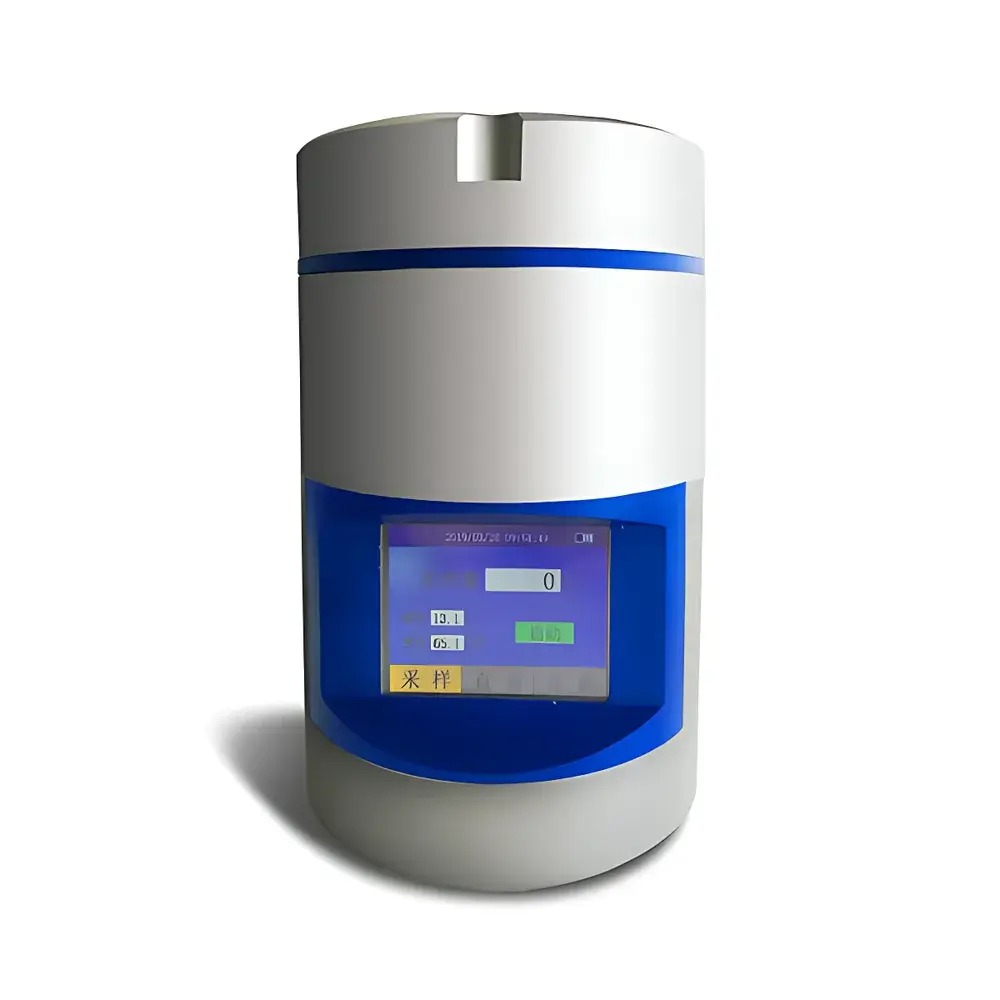
Hujing FX-100ST Airborne Microbial Sampler
| Brand | Hujing Purification (HJ) |
|---|---|
| Origin | Shanghai, China |
| Manufacturer Type | Direct Manufacturer |
| Country of Origin | China |
| Model | FX-100ST |
| Flow Rate | 100 L/min |
| Flow Accuracy | ±2.5% |
| Sampling Volume Range | 1–9999 L (adjustable) |
| Sampling Delay | 0–255 s (adjustable) |
| Impact Velocity | 10.8 m/s |
| Operating Temperature | 10–60 °C |
| Operating Relative Humidity | 10–75 %RH |
| Dimensions (W×D×H) | 120 × 120 × 175 mm |
| Weight | 2.1 kg |
| Power Supply | 100–240 VAC, 50–60 Hz or rechargeable battery (≥5 h runtime) |
| Sampling Head Material | Anodized aluminum |
| Petri Dish Compatibility | 90–100 mm diameter |
| Compliance | ISO 14698-1/2, GB/T 16293–2010, GMP Annex 1 |
Overview
The Hujing FX-100ST Airborne Microbial Sampler is a precision-engineered active air sampler designed for quantitative assessment of viable airborne microorganisms in controlled environments. It operates on the principle of inertial impaction—drawing ambient air through a precisely engineered 465-hole aluminum sampling head (0.6 mm aperture diameter), accelerating microbial particles to an impact velocity of 10.8 m/s onto the surface of standard agar-filled Petri dishes (90–100 mm). This velocity corresponds to Andersen cascade impactor Stage 5 performance, ensuring efficient collection of particles ≥0.65 µm aerodynamic diameter with high reproducibility and minimal desiccation artifact. The instrument is explicitly validated for use in Grade A–D cleanrooms per EU GMP Annex 1 and ISO 14698-1/2, supporting environmental monitoring programs required under pharmaceutical, biotechnology, and medical device manufacturing quality systems.
Key Features
- Adjustable sampling volume from 1 to 9999 liters—enabling compliance with ISO 14698-2-defined sampling plans for different cleanroom classifications and risk-based monitoring strategies.
- Integrated flow calibration capability with traceable verification (requires optional HJ Calibration Kit)—ensuring continuous adherence to ±2.5% volumetric accuracy across operational temperature and humidity ranges (10–60 °C / 10–75 %RH).
- Anodized aluminum sampling head—chemically resistant to common disinfectants (e.g., 70% isopropyl alcohol, hydrogen peroxide vapor, sodium hypochlorite), supporting routine decontamination without degradation.
- USB-host interface and Bluetooth-enabled thermal printer—providing real-time, tamper-evident documentation of sampling parameters including start/stop time, ambient temperature & RH, total sampled volume, and operator ID (when integrated with LIMS-compatible software).
- Motor-driven, low-vibration sampling mechanism—minimizing agar surface disturbance during high-flow operation (100 L/min), preserving colony isolation integrity for subsequent identification and enumeration.
- Universal Petri dish support clamp—mechanically adjustable to accommodate industry-standard 90 mm and 100 mm agar plates without proprietary consumables, reducing long-term operational cost and supply chain dependency.
- Dual-power architecture—supports uninterrupted operation via AC mains (100–240 VAC, 50–60 Hz) or internal rechargeable battery (>5 hours continuous runtime), enabling flexible deployment in remote or mobile cleanroom validation scenarios.
Sample Compatibility & Compliance
The FX-100ST is validated for use with conventional tryptic soy agar (TSA), sabouraud dextrose agar (SDA), and other microbiologically defined media cast in standard 90–100 mm Petri dishes. Its impact velocity and nozzle geometry meet the particle size cut-off requirements specified in ISO 14698-2 for viable particle sampling in nonviable-particle-monitored environments. Regulatory alignment includes full technical conformance with Chinese Pharmacopoeia (ChP) and GB/T 16293–2010 for cleanroom environmental monitoring, as well as foundational principles of EU GMP Annex 1 (2022 revision) regarding aseptic process simulation and routine environmental control. While not inherently 21 CFR Part 11 compliant, the instrument’s data export architecture supports integration into validated electronic data capture systems when paired with audit-trail-enabled software (e.g., HJ DataLink v3.2).
Software & Data Management
HJ DataLink software provides secure, structured export of all sampling records in .xlsx format—including timestamped metadata, environmental conditions, user-assigned batch IDs, and calibrated flow logs. Each exported file contains embedded digital signatures and checksums to ensure data integrity. The software supports batch-level reporting aligned with ISO/IEC 17025 documentation requirements and enables automated generation of trend charts for microbial load over time (e.g., weekly/monthly excursions, seasonal variation analysis). Raw USB-transmitted datasets retain native instrument firmware timestamps synchronized to NTP servers when connected to networked workstations—critical for GLP/GMP audit readiness.
Applications
- Routine environmental monitoring (EM) in Grade A laminar airflow workstations and isolators.
- Media fill simulation support—positioned at critical intervention points to quantify bioburden exposure during aseptic manipulations.
- Cleanroom qualification (IQ/OQ/PQ) and requalification per ISO 14644-3 protocols.
- Investigation of microbial contamination events—including source tracking via comparative sampling across zones and HVAC ducts.
- Pharmaceutical stability chamber and cold room environmental surveillance.
- Academic and contract research laboratory studies requiring standardized, reproducible airborne microbe quantification.
FAQ
Does the FX-100ST require annual recalibration by an accredited lab?
No—its built-in flow calibration function allows on-site verification using the HJ Flow Calibration Kit (NIST-traceable rotameter). Full recalibration is recommended every 12 months or after mechanical impact, per ISO/IEC 17025 Clause 6.5.
Can the FX-100ST be used in ISO Class 5 environments without introducing contamination?
Yes—the anodized aluminum housing and smooth-surface sampling head are compatible with VHP decontamination cycles (≤1000 ppm, 60 min). Surface bioburden post-decon must be verified per ISO 14644-1 before deployment.
Is the 10.8 m/s impact velocity adjustable?
No—this velocity is fixed by the physical geometry of the 465-hole plate and nominal 100 L/min flow rate, ensuring consistent aerodynamic cutoff and comparability with Andersen Stage 5 reference data.
What is the maximum allowable particulate loading before agar surface clogging occurs?
Under typical cleanroom conditions (<3,520 particles/m³ ≥0.5 µm), clogging is not observed within 1,000 L sampling. In high-bioburden environments (e.g., fermentation suite returns), limit sampling to ≤500 L per plate to maintain colony isolation fidelity.
Does the instrument log ambient pressure?
No—ambient pressure is not measured; however, flow accuracy remains within ±2.5% across 80–106 kPa absolute pressure (equivalent to elevations up to 2,000 m ASL), as validated per GB/T 16293–2010 Annex C.
Related Products







