
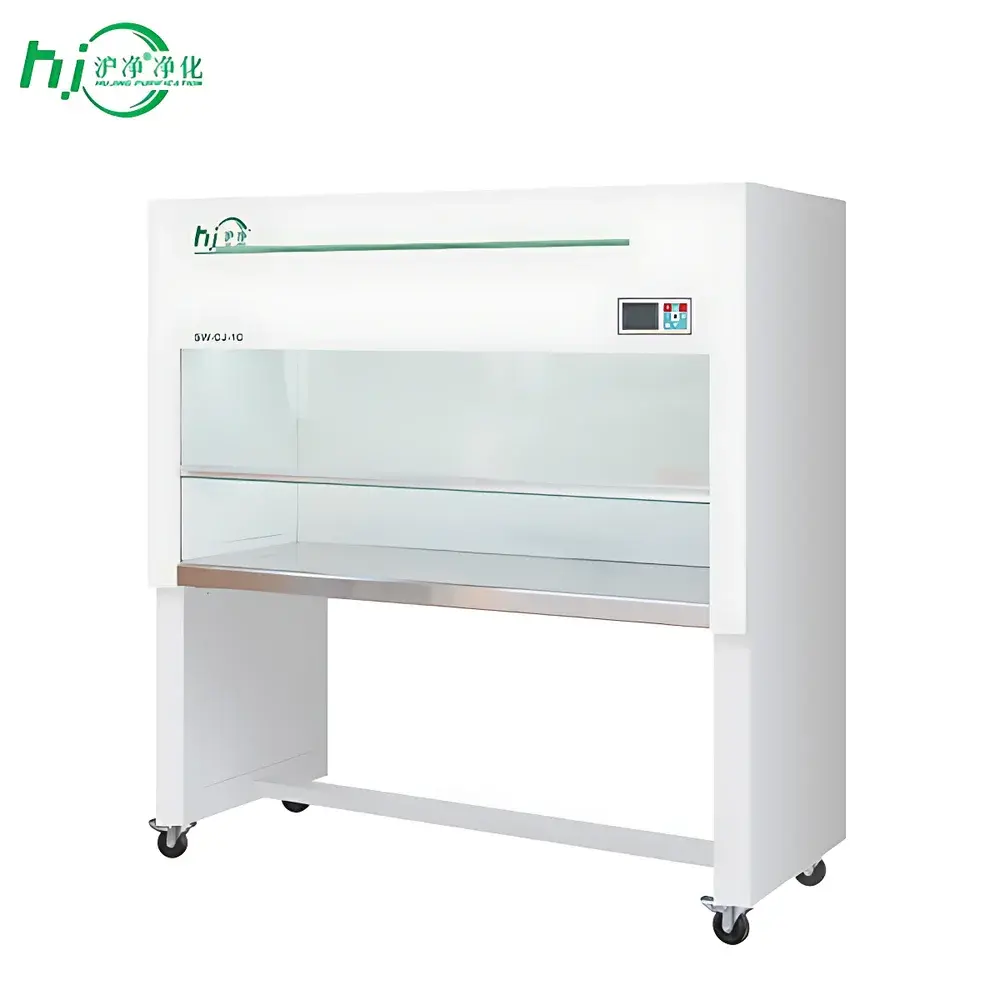
Hujing SWCJ-1C Stainless Steel Horizontal Laminar Flow Clean Bench
| Brand | Hujing Purification (HJ) |
|---|---|
| Origin | Shanghai, China |
| Manufacturer Type | Direct Manufacturer |
| Product Category | Domestic |
| Model | SWCJ-1C |
| Instrument Type | Horizontal Laminar Flow Clean Bench |
| Cleanliness Class | ISO Class 5 (equivalent to Fed. Std. 209E Class 100 @ ≥0.5 µm) |
| Noise Level | ≤62 dB(A) |
| User Capacity | Dual-operator, single-front configuration |
| Airflow Pattern | Horizontal laminar flow |
| Filter Configuration | Pre-filter + HEPA filter (H14, EN 1822) |
| Average Air Velocity | 0.25–0.45 m/s |
| Illumination | ≥300 lx |
| Vibration | ≤5 µm (peak-to-peak, XYZ axes) |
| Power Supply | AC 220 V, 50 Hz |
| Max. Power Consumption | 640 W |
| Net Weight | 140 kg |
| Work Area Dimensions (W×D×H) | 1370 × 510 × 580 mm |
| Overall Dimensions (W×D×H) | 1530 × 690 × 1600 mm |
| Lighting & UV | 30 W fluorescent lamp × 1, 20 W UV-C lamp × 1 |
| Control Interface | Digital LCD panel with UV timer and safety interlock |
Overview
The Hujing SWCJ-1C Stainless Steel Horizontal Laminar Flow Clean Bench is an ISO Class 5-certified containment workstation engineered for personnel-protected, particle-free sample handling in microbiological, pharmaceutical, and cell culture applications. Unlike vertical-flow hoods, this unit delivers unidirectional horizontal airflow—generated by a low-turbulence centrifugal blower—across the work surface at a controlled velocity of 0.25–0.45 m/s. Air is drawn through a G4-grade pre-filter to capture coarse particulates, then passes through an H14-class HEPA filter (EN 1822 compliant, ≥99.995% efficiency at 0.3 µm), ensuring consistent delivery of <3.5 particles per cubic meter ≥0.5 µm. The bench meets U.S. Federal Standard 209E Class 100 requirements and supports GLP-compliant workflows where ambient particulate ingress must be minimized during aseptic manipulation.
Key Features
- Full stainless steel construction: Cold-rolled carbon steel outer casing with electrostatic epoxy coating; work surface fabricated from brushed AISI 304 stainless steel for corrosion resistance, non-porosity, and ease of decontamination.
- Horizontal laminar airflow design: Optimized aerodynamic chamber geometry ensures uniform velocity distribution across the full 1370 mm work width, eliminating turbulence-induced cross-contamination.
- Integrated safety interlock system: UV germicidal lamp (254 nm, 20 W) automatically deactivates when sash is opened or lighting is engaged—preventing operator exposure and enabling timed sterilization cycles (adjustable up to 60 min).
- Digital LCD control panel: Real-time display of operational status, UV timer countdown, and fault indicators; supports manual override for lighting, UV, and blower activation.
- Adjustable vertical sash: Counterbalanced, friction-damped sliding front window allows precise height positioning while maintaining laminar integrity and ergonomic access.
- Low-noise operation: Acoustic enclosure and vibration-dampened blower mount limit sound pressure to ≤62 dB(A) at 1 m distance—suitable for shared laboratory environments.
Sample Compatibility & Compliance
The SWCJ-1C accommodates standard Petri dishes (Φ90 mm), multi-well plates, flasks, and open vessels without airflow obstruction. Its horizontal flow architecture prevents direct impingement on heat-sensitive or volatile samples—a critical advantage over vertical-flow systems in molecular biology and media preparation. The unit complies with ISO 14644-1:2015 (cleanroom classification), EN 12464-1:2021 (lighting requirements), and supports validation protocols aligned with USP , EU GMP Annex 1, and ISO 13485. Routine performance verification—including particle count, airflow velocity mapping, and UV irradiance measurement—is facilitated via standardized test ports and documented SOPs.
Software & Data Management
While the SWCJ-1C operates as a standalone mechanical system without embedded software, its digital control interface logs operational timestamps for UV cycles and blower runtime—data accessible via manual review for internal audit trails. For laboratories requiring electronic records under FDA 21 CFR Part 11, integration with external environmental monitoring systems (EMS) is supported via optional analog voltage output (0–10 V) for airflow velocity and digital I/O for status signals. All firmware updates and calibration certificates are traceable to manufacturer’s quality management system (ISO 9001 certified).
Applications
- Aseptic transfer of microbial cultures and mammalian cell lines in academic and industrial biosafety level 1 (BSL-1) labs.
- Preparation of sterile pharmaceutical compounding agents, including ophthalmic solutions and parenteral admixtures.
- Handling of sensitive reagents in analytical chemistry workflows where airborne particulates compromise assay reproducibility.
- Assembly and inspection of microfluidic devices and optical components requiring sub-100-particle/m³ environments.
- Supporting ISO/IEC 17025-accredited testing laboratories for particulate contamination benchmarking and method validation.
FAQ
What cleanroom classification does the SWCJ-1C meet?
It achieves ISO Class 5 (formerly Fed. Std. 209E Class 100) for particles ≥0.5 µm, verified per ISO 14644-1:2015 Annex B.
Is the HEPA filter replaceable in the field?
Yes—the H14 filter module is tool-free accessible from the rear service panel and designed for replacement without recalibration.
Can the unit be installed in a room without dedicated HVAC?
It recirculates filtered room air and requires ambient temperature between 15–30°C and relative humidity ≤70% RH; no external ducting is needed.
Does it comply with FDA 21 CFR Part 11 for electronic records?
The base unit lacks electronic signature capability, but optional analog/digital interfaces enable integration with validated EMS platforms meeting Part 11 requirements.
What maintenance intervals are recommended?
Pre-filter cleaning every 2 weeks; HEPA integrity testing annually or after filter replacement; UV lamp output verification every 6 months per IEC 62471.



