
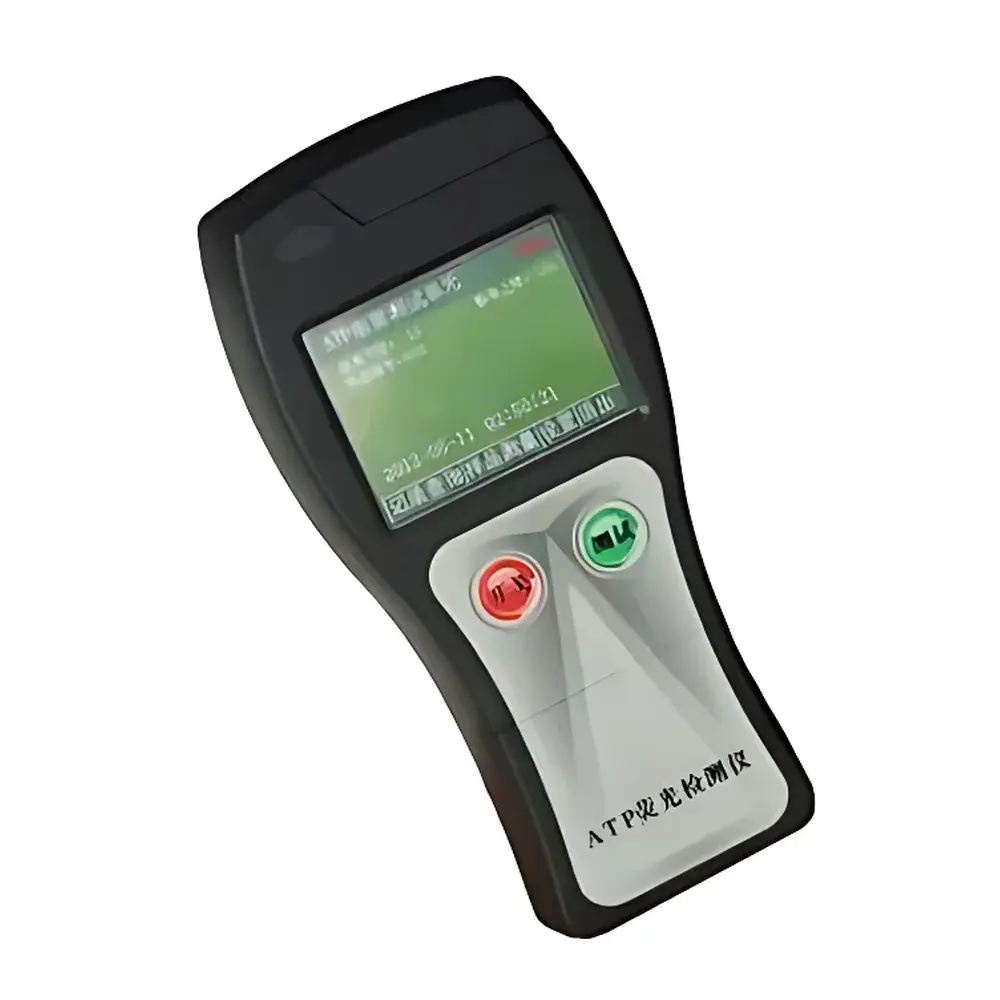
HJ FX-10ATP ATP Bioluminescence Detector
| Brand | HJ |
|---|---|
| Origin | Shanghai, China |
| Manufacturer Type | Manufacturer |
| Region Category | Domestic (China) |
| Model | FX-10ATP |
| Price | ¥13,000 |
| Detection Range | 0–99,999 RLU |
| Sensitivity | 1×10⁻¹⁶ mol ATP |
| Repeatability | ≤1% CV |
| Display | ≥3.5-inch color TFT touchscreen with Chinese UI |
| Configurable Limits | Up to 300 threshold values |
| Data Storage | ≥30,000 test records |
| Assay Time | 10 seconds per measurement |
| Detection Limit | 1.4 CFU (equivalent, based on ATP-to-microbial-correlation) |
| Rated Voltage | 3.3 V DC |
| Power Source | Rechargeable lithium-ion battery |
| Continuous Operation Capacity | ≥2,000 consecutive measurements |
| Upgrade Path | Optional modules for food additives, preservatives, colorants, and toxic contaminants (e.g., H₂O₂, formaldehyde, methanol) |
| Optical System | Dual-cuvette design with solid-state LED excitation source |
| Built-in Auto-Calibration | Self-calibrating light source |
Overview
The HJ FX-10ATP ATP Bioluminescence Detector is a handheld, field-deployable luminometer engineered for rapid, quantitative assessment of adenosine triphosphate (ATP) in food safety, hygiene monitoring, and environmental sanitation applications. It operates on the principle of bioluminescent enzymatic reaction: ATP extracted from microbial cells or organic residues reacts with luciferin and luciferase (supplied in single-use ATP swabs), producing visible light proportional to ATP concentration. Light intensity is measured in relative light units (RLU) and converted to microbiological load estimates via validated correlation curves. Designed for use in production lines, catering facilities, dairy processing units, and regulatory inspection workflows, the FX-10ATP delivers laboratory-grade reproducibility in a portable format compliant with ISO 22000, HACCP, and FDA Food Code Chapter 4 hygiene verification protocols.
Key Features
- High-sensitivity photodetection system with solid-state LED excitation and optimized optical path geometry, enabling detection down to 1×10⁻¹⁶ mol ATP — sufficient to resolve low-level contamination on stainless steel, glass, or polymer surfaces.
- Dual-cuvette configuration supports parallel analysis or internal reference validation, reducing operator-induced variability and enhancing method robustness.
- Integrated auto-calibration module featuring a stable onboard light source; initiates automatically at power-up and completes within 15 seconds, eliminating manual zeroing and ensuring traceable instrument readiness before each assay batch.
- ≥3.5-inch color TFT touchscreen with intuitive Chinese-language interface — designed for glove-compatible operation in cold rooms, wet environments, and high-noise production zones.
- On-device data management supporting ≥30,000 stored results with time/date stamp, operator ID, location tag, and pass/fail status against up to 300 user-defined RLU thresholds.
- Rechargeable lithium-ion battery rated for ≥2,000 consecutive 10-second assays per charge — verified under ISO/IEC 17025-accredited performance testing at 25 °C ambient.
Sample Compatibility & Compliance
The FX-10ATP is validated for direct analysis of swab-eluate samples (e.g., Hygiena UltraSnap™ or 3M Clean-Trace™ compatible formats), liquid food matrices (milk, juice, brine), and rinse water from food contact surfaces. It supports quantification of total ATP (microbial + residual organic matter) and, when coupled with differential extraction protocols (e.g., detergent-based vs. enzymatic lysis), enables semi-quantitative discrimination between microbial ATP and non-microbial ATP sources. The instrument meets functional requirements outlined in ISO 22000:2018 Annex A.7.2 (hygiene monitoring), ASTM E2631-21 (standard guide for ATP bioluminescence hygiene monitoring), and aligns with USP recommendations for bioburden indicator methods. All firmware and calibration logs are timestamped and immutable, satisfying basic audit-trail requirements for GLP-aligned operations.
Software & Data Management
Data export is supported via USB-C interface to standard FAT32-formatted drives; CSV-formatted reports include RLU value, calculated CFU-equivalent (where calibrated), assay duration, temperature (if external probe connected), and pass/fail classification. No proprietary software installation is required — raw files open directly in Excel or LIMS-compatible platforms. Firmware updates are delivered as signed binary packages via encrypted manufacturer portal; version history and checksums are logged internally. While not natively 21 CFR Part 11 compliant, the device supports integration into validated enterprise systems through configurable audit-log export and role-based access control when deployed with companion middleware (e.g., LabVantage or Thermo Fisher SampleManager).
Applications
- Routine hygiene verification of food contact surfaces (conveyor belts, cutting boards, filler nozzles) pre- and post-sanitization.
- Raw milk quality screening for alkaline phosphatase activity surrogate (via ATP–enzyme correlation models).
- Validation of cleaning-in-place (CIP) efficacy in beverage and dairy processing lines.
- Field-based environmental monitoring of retail kitchens, hospital cafeterias, and airline catering units.
- Supplemental verification for allergen residue testing (e.g., peanut, gluten) when combined with ATP-specific immunoaffinity enrichment workflows.
- Extended capability modules enable semi-quantitative detection of hydrogen peroxide, formaldehyde, and methanol residuals — critical for validating no-rinse sanitizer removal in aseptic packaging environments.
FAQ
What does RLU mean, and how is it related to microbial count?
RLU (Relative Light Unit) is a dimensionless output from the photomultiplier circuit, proportional to photon flux generated by the luciferase reaction. It is not a direct CFU measure but correlates empirically with viable microorganisms via calibration curves established per substrate type (e.g., stainless steel vs. plastic). Conversion factors must be validated in-house per ISO 22000 Annex H guidelines.
Can the FX-10ATP differentiate between bacterial ATP and food debris ATP?
Not inherently — total ATP includes both microbial and non-microbial sources. However, using sequential swabbing (e.g., first with neutral buffer, then with lytic agent) and comparative RLU interpretation allows experienced users to estimate microbial contribution, consistent with ASTM E2871-22 practice.
Is the instrument suitable for ISO/IEC 17025 accredited laboratories?
Yes — when operated within documented SOPs, with regular inter-laboratory verification and traceable calibration standards (e.g., NIST-traceable ATP solutions), the FX-10ATP meets technical requirements for routine hygiene monitoring under ISO/IEC 17025:2017 clause 7.2.2.
How often does the built-in calibration require verification?
The internal calibration source is stable for ≥12 months under normal use. Verification against a certified ATP standard (e.g., Sigma-Aldrich A7699) is recommended quarterly or per internal QA schedule.
Does the device support multi-language firmware beyond Chinese?
Current firmware supports Chinese only. English-language UI is available in the FX-10ATP-E variant; contact HJ Technical Support for upgrade path documentation and validation packages.






