
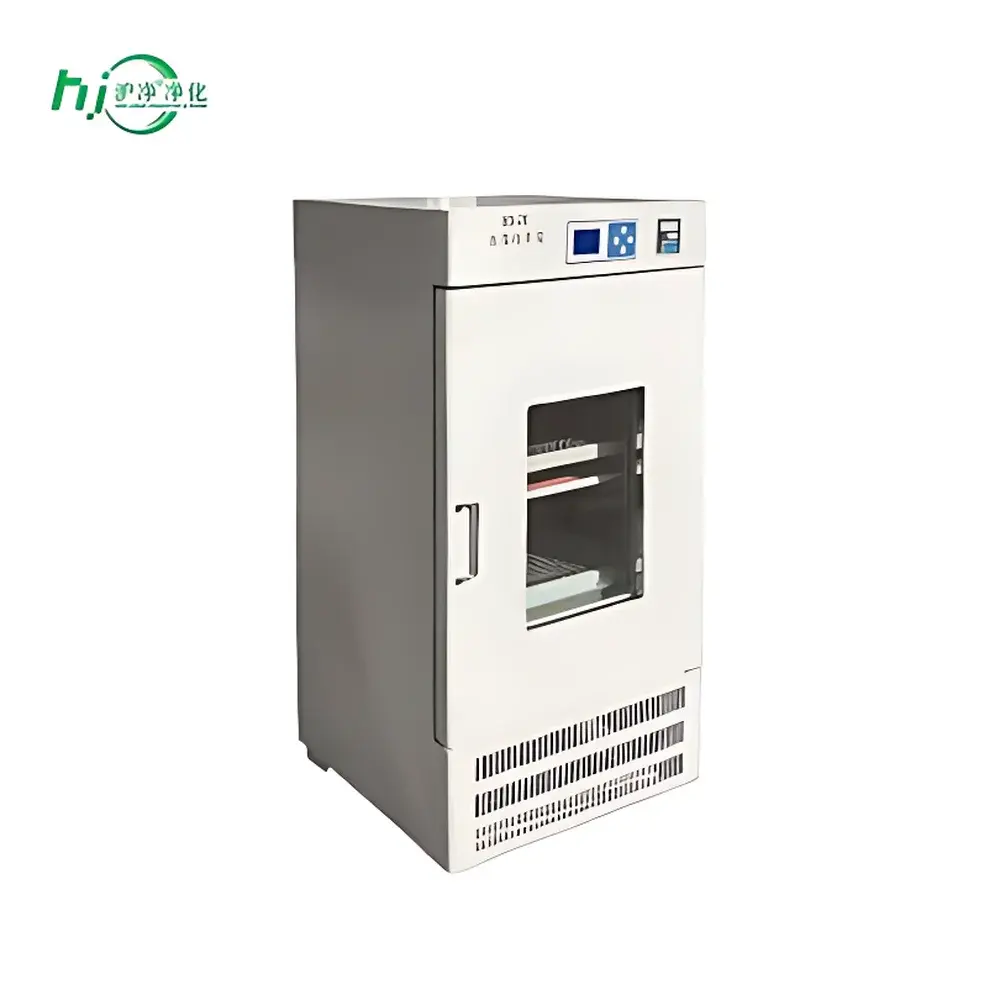
HJ BS-Series Shaking Incubator
| Brand | HJ |
|---|---|
| Origin | Shanghai, China |
| Manufacturer Type | Direct Manufacturer |
| Region Category | Domestic (China) |
| Model | BS-Series |
| Pricing | Available Upon Request |
| Capacity | 140–420 L |
| Temperature Range | 5–60 °C |
| Temperature Accuracy | ±1 °C |
| Shaking Speed | 0–300 rpm (infinitely variable) |
| Orbit Diameter | 20 mm (circular) |
| Amplitude Type | Rotary |
| Number of Shaking Decks | 1–4 (model-dependent) |
| Deck Dimensions | 440 × 330 mm per tray |
| Heating Power | 300–600 W |
| Compressor Power | 300–480 W |
| Power Supply | AC 220 V, 50 Hz |
| External Dimensions (W×D×H) | 610×610×1150 mm to 1440×710×1770 mm |
| Construction | Stainless Steel Interior |
| Insulation | Polyurethane Foam (in-situ foamed) |
| Air Circulation | Internal Forced-Air Duct System |
| Bottle Capacity (per deck) | 50 mL × 35 / 100 mL × 30 / 250 mL × 15 / 500 mL × 12 / 1000 mL × 6 |
Overview
The HJ BS-Series Shaking Incubator is a precision-engineered, dual-mode (heating and refrigeration) environmental chamber integrating controlled temperature regulation with uniform orbital shaking. Designed for rigorous life science applications, it operates on the principle of forced-air convection combined with mechanically balanced rotary motion—enabling simultaneous thermal stability and suspension-based culture agitation. This architecture supports aerobic microbial growth, suspension cell propagation, enzyme reaction kinetics, and biochemical assay development where both temperature fidelity and mechanical mixing are critical. The unit maintains operational integrity across ambient conditions ranging from −5 °C to +32 °C, delivering stable setpoint control within ±1 °C across its full 5–60 °C range. Its robust polyurethane-insulated enclosure minimizes external thermal interference, while the internal ducted airflow ensures spatial temperature homogeneity (<±0.8 °C deviation across working volume), essential for reproducible biological replicates.
Key Features
- Stainless steel interior chamber (AISI 304 grade) resistant to corrosion from repeated sterilization cycles, organic solvents, and acidic/basic media.
- High-efficiency hermetic compressor system paired with optimized heat exchanger design enables reliable cooling down to 5 °C even at 32 °C ambient.
- Infinitely variable speed control (0–300 rpm) with digital feedback loop ensures consistent rotational torque and minimal speed drift over extended operation (>72 h continuous).
- Modular deck configuration: BS-1E (1 deck), BS-2E (2 independently controllable decks), BS-2F (2 decks, dual-speed per deck), BS-4G (4 decks)—supporting parallel multi-condition experiments.
- Universal spring-loaded clamping rack accommodates standard Erlenmeyer flasks (50–1000 mL), test tubes, and custom vessels without tooling or adapter kits.
- Digital PID temperature controller with real-time display, programmable ramp-soak profiles, and hardware-based over-temperature cutoff (independent of main controller).
- Low-noise brushless DC motor drive reduces mechanical vibration transmission to adjacent instrumentation and improves long-term bearing reliability.
Sample Compatibility & Compliance
The BS-Series accommodates standard laboratory glassware and disposable bioreactor vessels up to 1 L capacity per position, with verified compatibility for bacterial cultures (E. coli, Bacillus spp.), mammalian suspension lines (CHO, Sf9), yeast fermentations (S. cerevisiae), and algal photobioreactors (when used with optional light modules). All models comply with IEC 61010-1:2010 for electrical safety in laboratory equipment and meet EMC requirements per CISPR 11 Group 1, Class B. While not certified to ISO/IEC 17025 or GLP Annexes by default, the system’s traceable calibration points (temperature sensor, tachometer), audit-ready parameter logging, and password-protected configuration mode support integration into GLP/GMP workflows when paired with validated SOPs and external calibration records.
Software & Data Management
The embedded microcontroller logs temperature setpoint, actual chamber temperature, shaking speed, and runtime continuously at 10-second intervals to internal non-volatile memory (retains ≥30 days of data). Optional RS-485 Modbus RTU interface enables integration with SCADA systems or centralized lab monitoring platforms (e.g., LabVantage, Thermo Fisher SampleManager). Data export is supported via USB flash drive in CSV format, compatible with Excel, Python pandas, and MATLAB for statistical analysis. Audit trail functionality includes operator ID tagging (via optional RFID badge reader), timestamped parameter changes, and tamper-evident log file hashing—aligning with FDA 21 CFR Part 11 principles when deployed with appropriate access controls and electronic signature protocols.
Applications
- Microbial growth curve analysis under defined temperature-shake regimes for antibiotic susceptibility testing (AST) and bioprocess optimization.
- Suspension culture expansion of insect and mammalian cells prior to transfection or bioreactor inoculation.
- Enzyme kinetics assays requiring homogeneous mixing and precise thermal control (e.g., lipase activity in emulsified substrates).
- Environmental microbiology studies—including soil slurry respiration, wastewater nitrification rate determination, and hydrocarbon biodegradation screening.
- Pharmaceutical excipient solubility testing across temperature gradients with continuous agitation to simulate gastrointestinal motility.
- Standardized ASTM D5524-17 compliant shake flask fermentation for strain evaluation and media development.
FAQ
What is the maximum load capacity per deck?
Each 440 × 330 mm deck supports up to 6 × 1000 mL flasks (or equivalent mass ≤12 kg), with dynamic balance maintained across the full 0–300 rpm range.
Can the incubator operate unattended overnight?
Yes—equipped with auto-restart after power interruption, over-temperature/over-speed hardware cutouts, and thermal runaway protection independent of firmware.
Is remote monitoring supported out-of-the-box?
No native Ethernet or Wi-Fi; however, RS-485 Modbus RTU allows connection to industrial gateways for cloud telemetry via MQTT or OPC UA bridges.
Are calibration certificates included?
Factory calibration reports (temperature sensor and speed encoder) are provided with shipment; NIST-traceable third-party calibration is available as an add-on service.
Does the unit meet CE marking requirements?
CE marking is not applied, as the device is manufactured for domestic Chinese regulatory compliance (CCC); export configurations require regional certification (e.g., UKCA, UL 61010-1) per destination market.





