
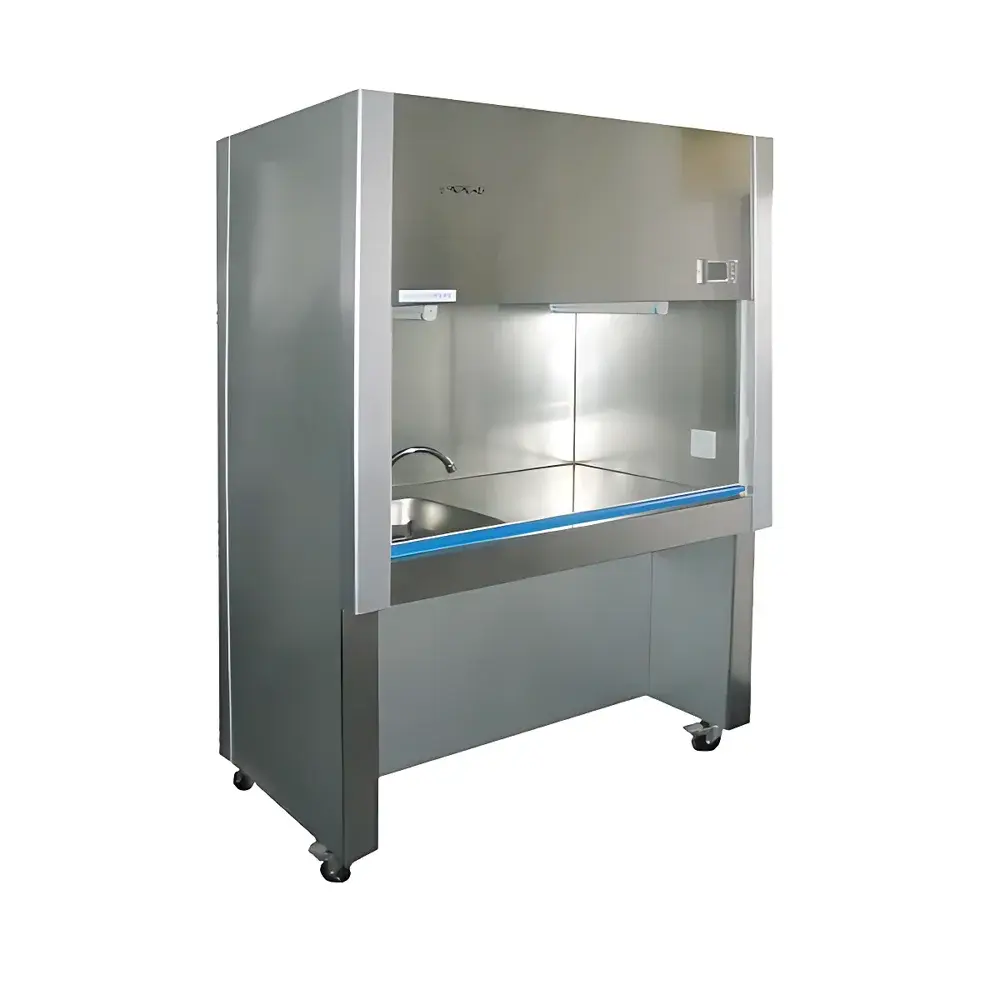
HJ SW-TFG-12 Steel-and-Wood Single-Face Laboratory Fume Hood
| Brand | HJ Purification |
|---|---|
| Origin | Shanghai, China |
| Manufacturer Type | Direct Manufacturer |
| Country of Origin | China |
| Model | SW-TFG-12 |
| Construction | Steel-and-Wood Frame |
| Configuration | Single-Face (Front-Access) Fume Hood |
| Face Velocity Range | 0.25–0.45 m/s (adjustable) |
| Supply Pressure Requirement | >0.5 Pa |
| Electrical Supply | AC 220 V, 50 Hz |
| Power Consumption | 400 W |
| Net Weight | <150 kg |
| Work Surface Dimensions (W×D×H) | 1030 × 695 × 580 mm |
| Overall Dimensions (W×D×H) | 1185 × 760 × 1950 mm |
| Lighting | One 20 W fluorescent lamp |
Overview
The HJ SW-TFG-12 is a single-face, steel-and-wood laboratory fume hood engineered for reliable containment and safe handling of low-to-moderate volatility chemical vapors, aerosols, and particulates in academic, industrial, and quality control laboratories. Designed in accordance with fundamental principles of aerodynamic containment, the unit operates on a constant-volume or manually adjustable face velocity principle—maintaining a stable inflow of 0.25–0.45 m/s across the sash opening to prevent lateral escape of hazardous effluents. Its structural integrity derives from a hybrid frame combining load-bearing steel uprights with laminated wood cabinetry, offering mechanical robustness while minimizing thermal bridging and long-term corrosion susceptibility. The hood integrates utility services—including electrical, water, and exhaust ducting—within a unified vertical column, enabling seamless installation and adherence to ISO 10648-1 (fume hood performance classification) and ANSI/ASHRAE 110-2016 (test methods for hood containment efficiency).
Key Features
- Adjustable vertical sash made of tempered safety glass, providing unobstructed operator visibility and physical barrier against splashes and minor over-pressurization events.
- Integrated low-speed centrifugal exhaust fan mounted at the roof-level plenum, optimized for quiet operation (<65 dB(A)) and consistent static pressure compensation across variable duct lengths.
- Dedicated utility column housing one 20 W fluorescent lamp (IEC 60598-compliant), dual-purpose GFCI-protected 220 V/50 Hz power outlets, quick-connect water valve (rated for >0.5 Pa inlet pressure), and auxiliary gas line ports (optional).
- Stainless steel (AISI 304) sink basin recessed into the work surface, sloped toward a centralized drain with P-trap configuration compliant with local plumbing codes and compatible with neutralizing agents or enzymatic decontamination solutions.
- Front airfoil design and rear baffle system calibrated to promote laminar inward airflow, minimizing turbulence-induced eddy formation within the breathing zone—validated per ASHRAE 110 tracer gas testing protocol.
Sample Compatibility & Compliance
The SW-TFG-12 is intended for use with non-radioactive, non-explosive, and non-pyrophoric substances generating vapors, dusts, or mists under standard ambient conditions. It is not rated for perchloric acid, hydrogen fluoride, or organic peroxides without supplemental wash-down systems. The unit complies with GB/T 24819–2009 (Chinese national standard for laboratory fume hoods) and incorporates design elements aligned with EN 14175-3:2017 (performance requirements for ducted fume hoods). Structural materials meet fire resistance Class B1 (GB 8624–2012), and electrical components conform to IEC 61000-6-3 (EMC emission limits). Optional upgrades include digital face velocity monitoring with data logging and alarm relay outputs for integration into facility-wide environmental health and safety (EHS) dashboards.
Software & Data Management
As a mechanically controlled, non-automated fume hood, the SW-TFG-12 does not incorporate embedded firmware or proprietary software. However, its utility interface supports third-party building management system (BMS) integration via dry-contact relays for fan status, sash position sensing (with optional linear potentiometer), and power consumption monitoring. All operational parameters—including measured face velocity, runtime hours, and maintenance intervals—are documented in the included GLP-aligned logbook template, supporting audit readiness under ISO/IEC 17025:2017 and FDA 21 CFR Part 11 (when paired with validated electronic record systems).
Applications
- Routine chemical synthesis and reagent dispensing in teaching laboratories and R&D settings.
- Sample preparation for chromatography (HPLC, GC), spectroscopy (UV-Vis, FTIR), and elemental analysis (ICP-OES, AAS).
- Handling of formaldehyde-based fixatives, ethanol-based solvents, dilute mineral acids (e.g., HCl, HNO₃), and aqueous base solutions.
- Microbiological work involving disinfectants (e.g., sodium hypochlorite, 70% isopropanol) where vapor control—not sterility—is the primary objective.
- Pre-analytical processing in clinical labs requiring volatile organic compound (VOC) mitigation during specimen homogenization or extraction.
FAQ
What is the recommended minimum face velocity for optimal containment?
The ASHRAE 110-recommended operational range is 0.3–0.4 m/s; the SW-TFG-12 is factory-set to 0.35 m/s at full sash height and remains effective down to 0.25 m/s when sash is lowered.
Can this fume hood be connected to an external variable-air-volume (VAV) exhaust system?
Yes—its passive duct collar accepts standard 250 mm diameter rigid ducting and is compatible with VAV boxes equipped with pressure-independent airflow control valves.
Is the stainless steel sink NSF-certified for food-grade applications?
No—the sink meets ASTM A240 for material grade but is not NSF/ANSI 51 certified; it is intended solely for laboratory wastewater conveyance.
Does the unit include ductwork or exhaust fan assembly?
No—ducting, roof-mounted exhaust fans, and balancing dampers must be specified and installed separately per site-specific static pressure calculations.
What maintenance schedule is advised for sustained performance?
Biannual inspection of sash counterweights, gasket integrity, baffle alignment, and electrical grounding; annual calibration of face velocity using a certified hot-wire anemometer traceable to NIST standards.



