
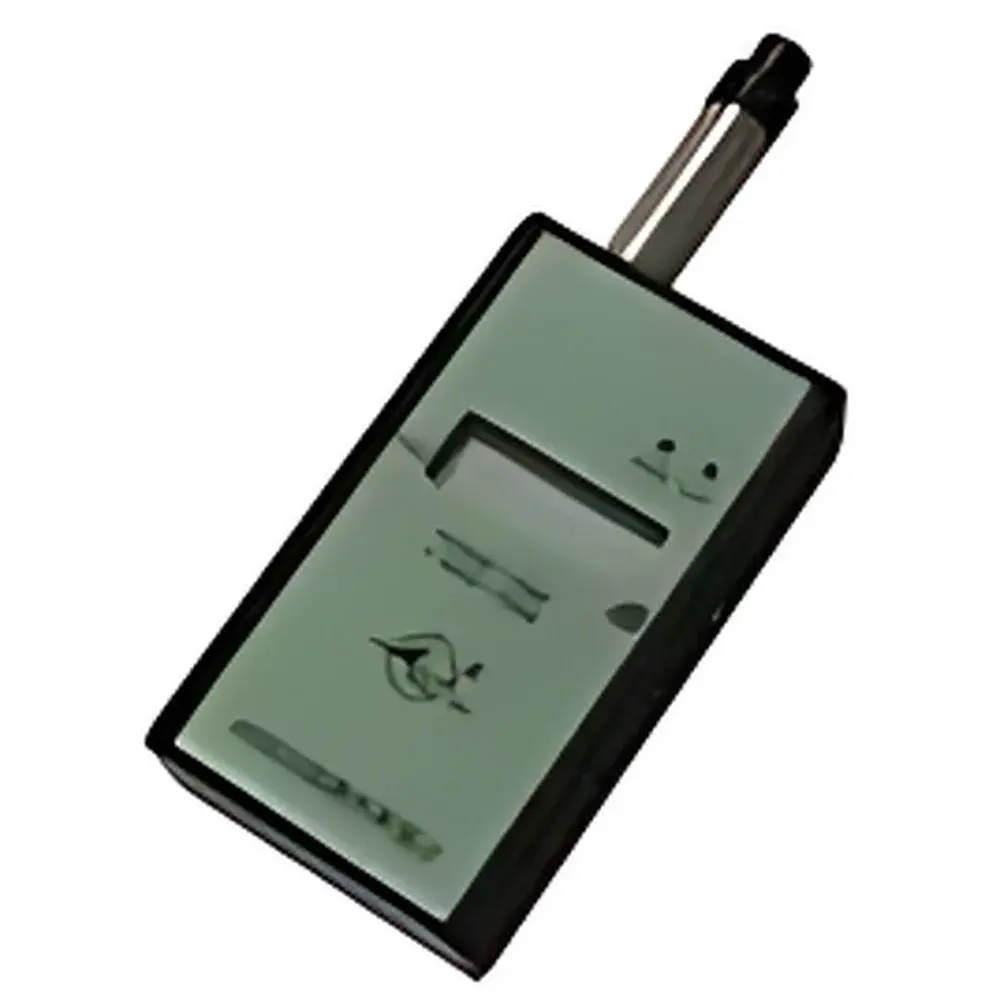
Hujing HS5633 Sound Level Meter
| Brand | Hujing Purification (HJ) |
|---|---|
| Origin | Jiangsu, China |
| Manufacturer Type | Direct Manufacturer |
| Product Origin | Domestic (China) |
| Model | HS5633 |
| Price | USD 370 (FOB) |
| Frequency Range | 31.5 Hz to 8 kHz |
| Measurement Ranges | A-Weighted LO: 35–100 dB |
| A-Weighted HI | 65–130 dB |
| C-Weighted LO | 35–100 dB |
| C-Weighted HI | 65–130 dB |
| Accuracy | ±2 dB |
| Resolution | 0.1 dB |
| Integration Time | User-selectable from 1 min to 99 min |
| Dynamic Range | 65 dB |
| Weighting Networks | A and C |
| Time Weighting | Fast & Slow |
| Max Hold Decay Rate | <1 dB/3 min |
| Microphone Type | Polarized Electret Condenser |
| Calibration | Internal 94.0 dB @ 1 kHz reference |
| AC Output | ~0.65 Vrms per range, 600 Ω impedance |
| DC Output | ~10 mV/dB (nominal), 100 Ω impedance |
| Operating Temp/Humidity | 0 °C to 40 °C, <80% RH |
| Storage Temp/Humidity | −10 °C to 60 °C, <70% RH |
| Display | 3½-digit LCD |
| Power Supply | One 9 V alkaline battery |
| Dimensions | 240 mm (L) × 68 mm (W) × 25 mm (H) |
| Weight | 215 g |
| Compliance | IEC 651 Type 2 |
Overview
The Hujing HS5633 Sound Level Meter is a portable, general-purpose acoustic measurement instrument engineered for field-based environmental noise assessment, occupational health monitoring, and basic industrial noise surveys. It operates on the principle of sound pressure level (SPL) quantification using a polarized electret condenser microphone coupled with analog signal conditioning and digital display processing. The device conforms to IEC 651 Type 2 specifications—establishing its suitability for routine measurements where moderate accuracy and repeatability are required, but not for laboratory-grade or regulatory compliance-critical applications (e.g., ISO 9612 or ANSI S1.43 Class 1). Its dual-range architecture (LO/HI) and selectable A- and C-weighting networks enable differentiated evaluation of low-level ambient noise and higher-intensity industrial or traffic sources, while Fast/Slow time weighting supports both transient peak capture and stabilized averaging.
Key Features
- High-resolution 3½-digit LCD display with 0.1 dB resolution for precise visual readout
- User-configurable integration time (1–99 minutes) supporting long-term noise logging without external controllers
- Dual-range operation (LO: 35–100 dB; HI: 65–130 dB) with automatic range switching to prevent overload
- Comprehensive frequency response (31.5 Hz–8 kHz) aligned with human hearing sensitivity and common environmental noise spectra
- Internal 94.0 dB @ 1 kHz calibration source enabling quick functional verification prior to field deployment
- Simultaneous AC and DC analog outputs (0.65 Vrms and 10 mV/dB respectively) compatible with strip-chart recorders, data loggers, and oscilloscopes
- Robust mechanical design: compact housing (240 × 68 × 25 mm), lightweight (215 g), and powered by a single 9 V battery for extended field autonomy
- Integrated Max Hold function with controlled decay (<1 dB/3 min) for capturing and retaining peak SPL events during unattended monitoring
Sample Compatibility & Compliance
The HS5633 is designed for airborne sound pressure measurements in open-air environments, indoor workspaces, and semi-enclosed industrial zones. It accommodates standard 1/2-inch electret microphone configurations and includes accessories such as a windscreen ball, test rod, and protective carrying case to mitigate wind-induced turbulence and handling noise. While not certified to ISO 80000-8 or IEC 61672-1 (the successor standard to IEC 651), its Type 2 classification under IEC 651 indicates performance tolerances appropriate for non-critical environmental screening—e.g., preliminary site assessments, community noise mapping, or internal EHS audits. It does not support impulse or peak C-weighted measurements, nor does it provide Leq, Lmax, or statistical percentile (LN) analysis natively. Users requiring traceable calibration must perform periodic external verification using accredited acoustic calibrators (e.g., Class 1 pistonphones).
Software & Data Management
The HS5633 operates as a standalone analog-digital hybrid meter with no embedded firmware-based data storage or USB connectivity. All measurement data must be recorded externally via its analog outputs. The DC output (~10 mV/dB) allows direct interfacing with programmable logic controllers (PLCs), analog-input DAQ systems (e.g., National Instruments USB-6009), or custom-built microcontroller-based loggers. For regulatory documentation, users are responsible for implementing manual logging protocols compliant with local occupational safety frameworks (e.g., OSHA 29 CFR 1910.95 or EU Directive 2003/10/EC). Though the device lacks FDA 21 CFR Part 11-compliant audit trails or electronic signatures, its stable analog output enables integration into validated GxP-aligned monitoring systems when paired with qualified third-party acquisition hardware and SOP-controlled procedures.
Applications
- Pre-commissioning noise surveys around HVAC systems, generators, and compressors
- Workplace noise exposure screening per national occupational exposure limits (e.g., 85 dBA TWA in the US)
- Community noise baseline studies near construction sites, roadways, or rail corridors
- Educational demonstrations of sound propagation, weighting filters, and time-domain averaging
- Verification of acoustic enclosure or barrier effectiveness in manufacturing facilities
- Field validation of noise mitigation measures during environmental impact assessments (EIA)
FAQ
Does the HS5633 support real-time spectral analysis or octave-band filtering?
No. It provides only broadband A- and C-weighted measurements with Fast/Slow time constants. Spectral decomposition requires external FFT analyzers or dedicated class 1 instrumentation.
Can the HS5633 be used for legal noise complaints or regulatory enforcement?
Not without supplementary metrological validation. Its IEC 651 Type 2 rating meets general survey requirements but falls short of the accuracy, stability, and documentation rigor mandated for evidentiary use under most national noise ordinances.
What is the recommended recalibration interval?
Annual external calibration against a traceable reference source is advised for continuity of measurement integrity, especially when used in quality-critical or audited processes.
Is the microphone replaceable or field-serviceable?
The integrated electret condenser microphone is not user-replaceable; replacement requires factory service to preserve acoustic alignment and calibration integrity.
Does the device meet IP rating requirements for outdoor use?
It has no formal IP rating. The included windscreen and operating humidity limit (<80% RH) permit short-duration outdoor use, but prolonged exposure to rain or dust is not supported.







