
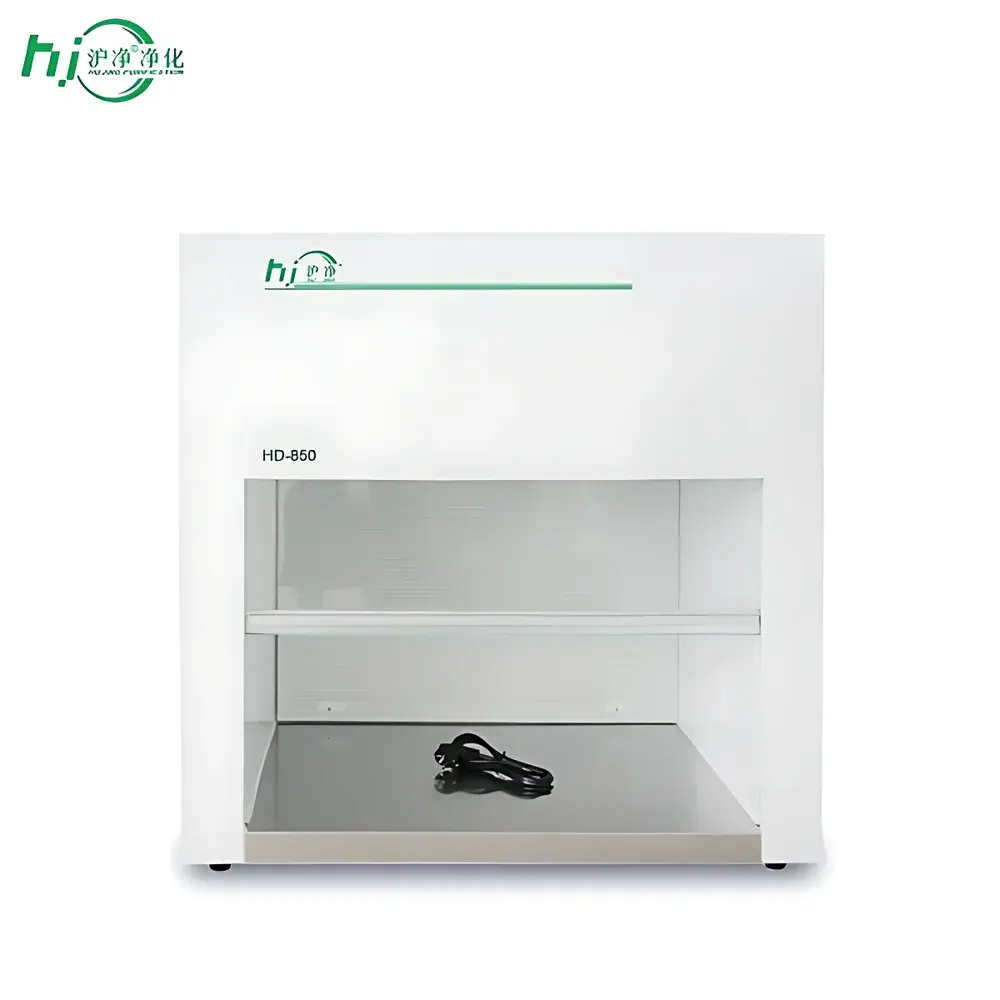
HJ HD-850 Horizontal Laminar Flow Clean Bench
| Brand | HJ Purification |
|---|---|
| Origin | Shanghai, China |
| Manufacturer Type | Direct Manufacturer |
| Regional Classification | Domestic (China) |
| Model | HD-850 |
| Instrument Category | Horizontal Flow Clean Bench |
| Cleanliness Class | ISO Class 5 (equivalent to Fed. Std. 209E Class 100 @ ≥0.5 µm) |
| Noise Level | ≤62 dB(A) |
| User Capacity | Single-operator |
| Airflow Pattern | Horizontal unidirectional laminar flow |
| Construction Material | Cold-rolled steel with electrostatic powder coating |
| Work Area Dimensions (W×D×H) | 690 × 490 × 490 mm |
| Overall Dimensions (W×D×H) | 850 × 530 × 850 mm |
| HEPA Filter Specification | 675 × 410 × 38 mm × 1 unit |
| Illumination | 12 W fluorescent lamp × 1 |
| UV Lamp | 20 W × 1 |
| Average Air Velocity | 0.25–0.45 m/s (dual-speed control) |
| Colony Count | ≤0.5 CFU/plate·hour (90 mm Petri dish) |
| Vibration | ≤5 µm peak-to-peak (X/Y/Z axes) |
| Lighting Intensity | ≥300 lux |
| Power Supply | AC 220 V, 50 Hz, single-phase |
Overview
The HJ HD-850 Horizontal Laminar Flow Clean Bench is an ISO Class 5-certified local exhaust ventilation system engineered for applications requiring particle-free air in microbiological, pharmaceutical, and life science laboratories. It operates on the principle of horizontal unidirectional laminar airflow—air drawn through a pre-filter is conditioned, passed through a single high-efficiency particulate air (HEPA) filter (tested per EN 1822-1, minimum efficiency ≥99.995% at 0.3 µm), and delivered across the work surface at a controlled velocity of 0.25–0.45 m/s. This airflow pattern sweeps airborne contaminants—including viable microorganisms and non-viable particles ≥0.5 µm—away from the operator and out of the work zone, maintaining a sterile field without recirculation. Unlike vertical flow hoods, the HD-850 directs filtered air horizontally toward the user-facing sash, minimizing turbulence near critical samples and enabling safe handling of non-hazardous biological materials under aseptic conditions.
Key Features
- Robust cold-rolled steel chassis with electrostatic powder-coated finish for corrosion resistance and structural stability.
- Manually adjustable, semi-enclosed acrylic sash with ergonomic height positioning—optimized for operator comfort and containment integrity during extended use.
- Dual-speed fan control via remote switch, allowing precise regulation of face velocity to match procedural requirements while maintaining ISO Class 5 compliance.
- Integrated 12 W fluorescent lamp (≥300 lux at work surface) and 20 W germicidal UV lamp (254 nm), both independently switchable and interlocked with sash position for safety.
- Compact footprint (850 × 530 × 850 mm) designed for benchtop deployment—requires no dedicated floor space or ducting; suitable for small labs, QC rooms, and teaching facilities.
- Low-noise operation (≤62 dB[A]) achieved via optimized aerodynamic duct design and vibration-damped fan assembly, supporting focused experimental workflows.
Sample Compatibility & Compliance
The HD-850 is intended for non-hazardous sample manipulation where personnel protection is not required but product protection is critical—e.g., media preparation, cell culture passaging, sterile packaging, and analytical weighing. It meets U.S. Federal Standard 209E Class 100 and ISO 14644-1 Class 5 performance criteria for airborne particulate concentration. While not certified for chemical or biological hazard containment (i.e., it lacks negative pressure, ducted exhaust, or BSL-2 certification), its design supports adherence to Good Laboratory Practice (GLP) and current Good Manufacturing Practice (cGMP) environmental controls when used within validated cleanroom support zones. Routine filter integrity testing (e.g., DOP/PAO scanning) and annual performance qualification per ISO 14644-3 are recommended to maintain traceable compliance.
Software & Data Management
As a standalone mechanical system, the HD-850 does not incorporate embedded software or digital data logging. However, its dual-speed fan interface is compatible with external analog monitoring systems (e.g., velocity sensors, particle counters, or building management interfaces) via optional 4–20 mA or 0–10 V signal outputs (available upon request). All operational parameters—including airflow velocity, UV exposure duration, and lamp usage hours—must be recorded manually in lab notebooks or electronic quality records aligned with FDA 21 CFR Part 11 requirements when used in regulated environments. Calibration certificates for HEPA filter testing and airflow verification are provided with each unit shipment.
Applications
- Aseptic preparation of microbial growth media and reagents in clinical and research microbiology labs.
- Handling of primary cell cultures, hybridoma lines, and sensitive transfection reagents where cross-contamination must be minimized.
- Quality control testing of sterile pharmaceutical products, including filter integrity checks and container-closure inspections.
- Electronics assembly and optical component handling where electrostatic discharge (ESD)-safe variants can be specified.
- Teaching laboratories requiring reproducible, low-cost laminar flow environments for undergraduate biotechnology instruction.
FAQ
Is the HD-850 suitable for working with pathogenic organisms?
No. This unit provides only product protection—not personnel or environmental protection—and must not be used for BSL-2 or higher agents.
What HEPA filter standard does the HD-850 meet?
It uses a single EN 1822-1 H14 grade HEPA filter (≥99.995% efficiency at 0.3 µm particle size), tested and certified prior to installation.
Can the unit be installed in a non-ventilated room?
Yes—the HD-850 recirculates filtered air internally and requires no external exhaust ducting or make-up air supply.
How often should the HEPA filter be replaced?
Typical service life is 3–5 years under normal use; replacement interval must be determined by scheduled integrity testing and pressure drop monitoring.
Does the HD-850 comply with ISO 14644-1 for cleanroom classification?
Yes—it achieves and sustains ISO Class 5 (≤3,520 particles/m³ ≥0.5 µm) in the work area when operated per manufacturer specifications and maintained per ISO 14644-3 protocols.



