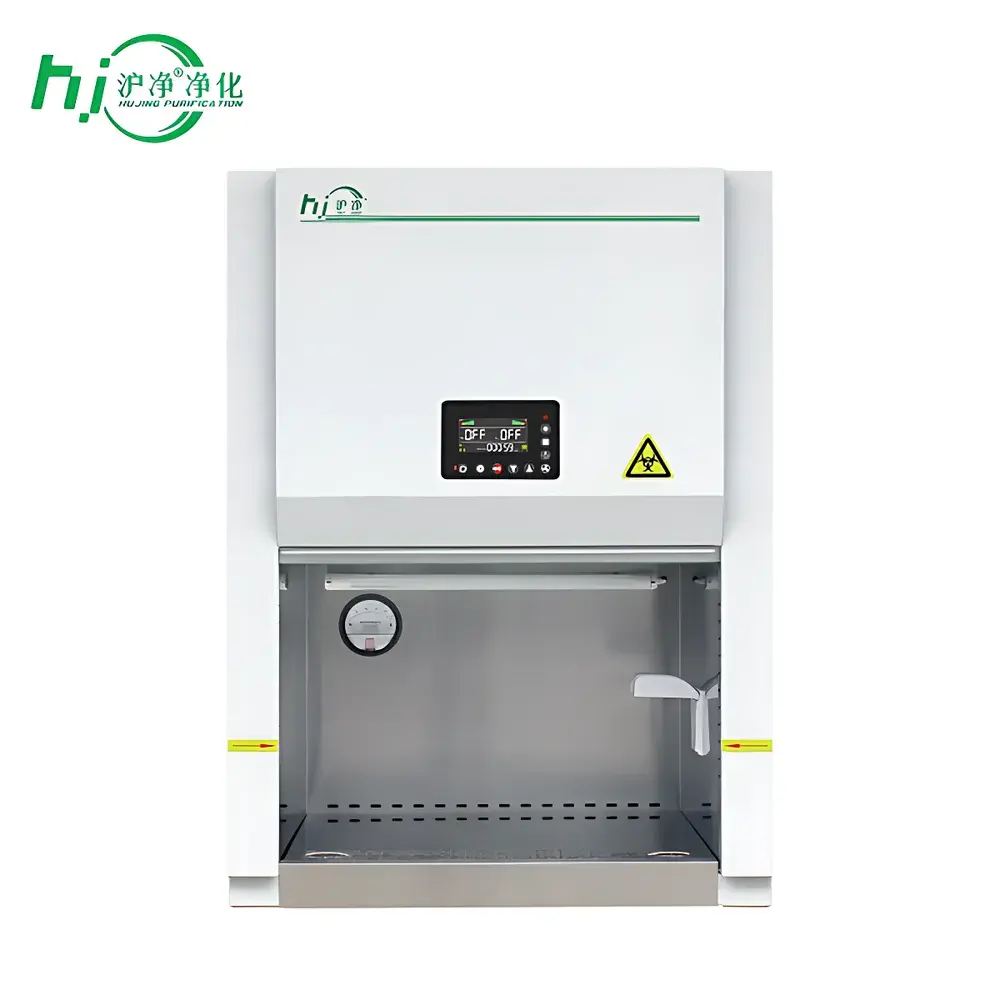
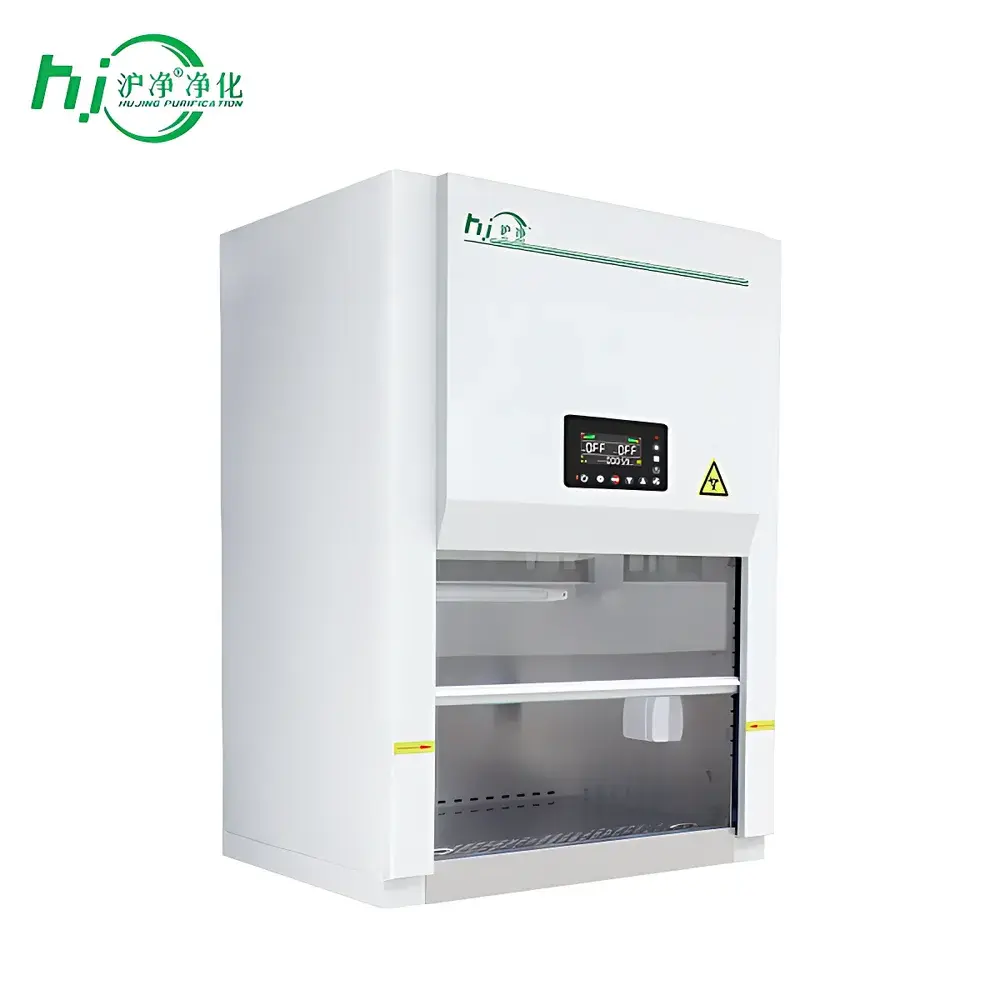
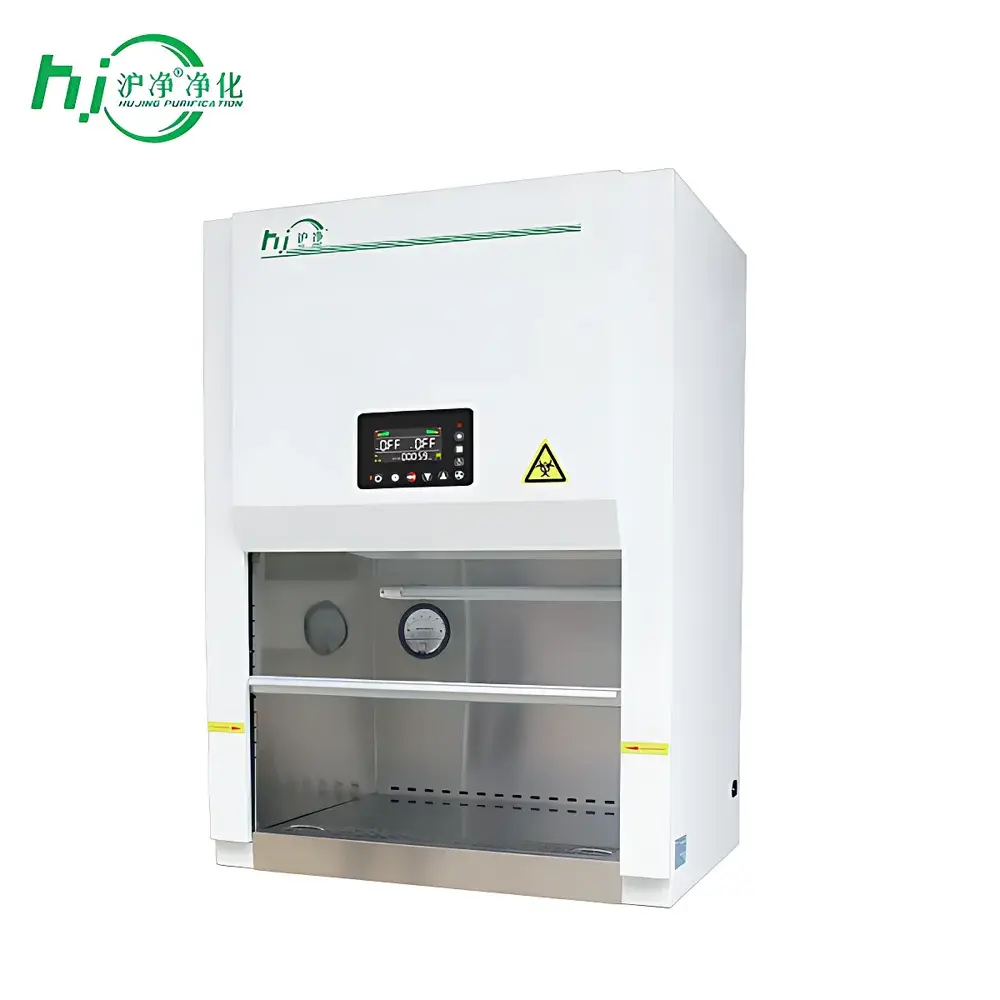
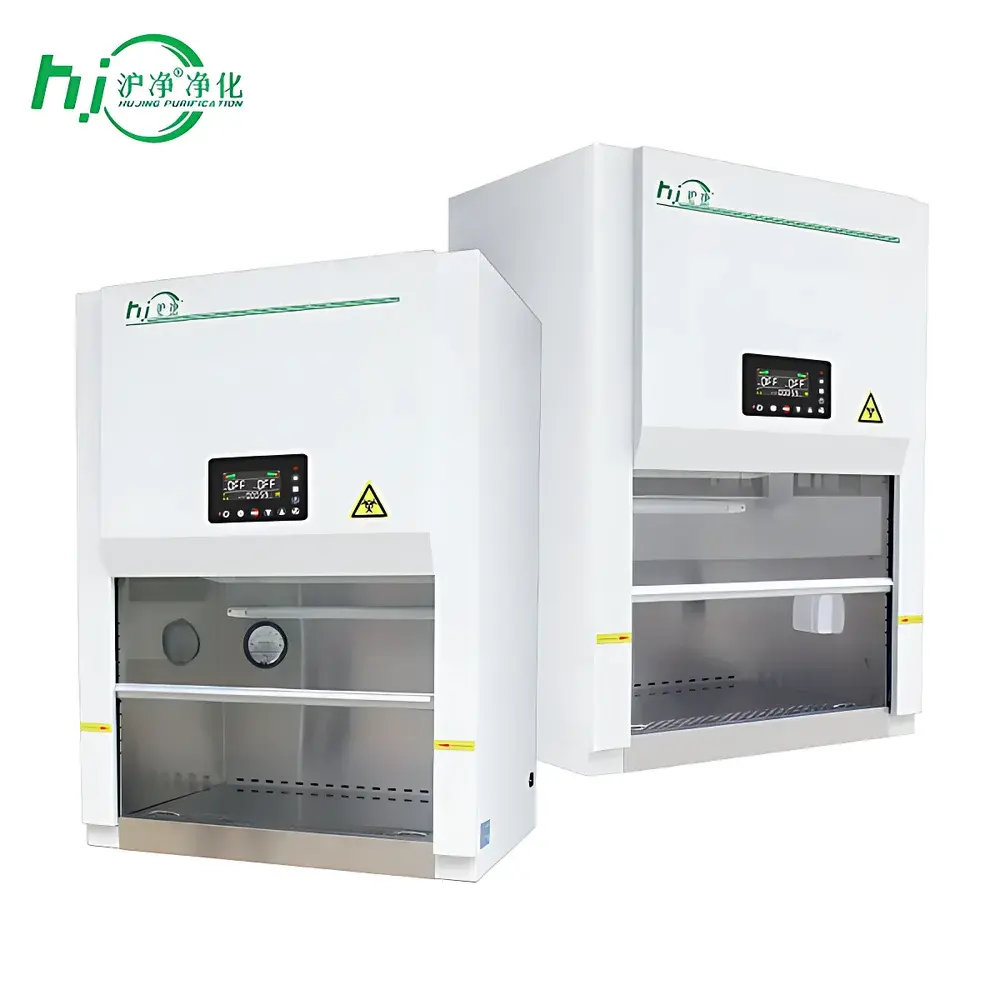
HJ BSC-700IIA2-EP Class II A2 Biological Safety Cabinet
| Brand | HJ Purification |
|---|---|
| Origin | Shanghai, China |
| Manufacturer Type | Direct Manufacturer |
| Country of Origin | China |
| Model | BSC-700IIA2-EP |
| External Dimensions (L×W×H) | 760×650×1230 mm |
| Internal Work Area Dimensions (L×W×H) | 600×500×520 mm |
| Filter Efficiency (Particle Capture) | ≥98% @ ≥0.3 µm (DOP-tested) |
| Airflow Configuration | 30% Exhaust / 70% Recirculation |
| Inflow Velocity | 0.55 ± 0.025 m/s |
| Downflow Velocity (Center) | 0.26 ± 0.025 m/s |
| Noise Level | ≤65 dB(A) |
| Power Supply | AC 220 V, 50 Hz |
| Max. Power Consumption | 600 W |
| Net Weight | 140 kg |
| Work Surface Material | 304 Stainless Steel |
| Lighting | 8 W LED (general), 20 W UV-C lamp (interlocked) |
| Compliance | Meets NSF/ANSI 49–2022 Class II A2 requirements for personnel, product, and environmental protection |
Overview
The HJ BSC-700IIA2-EP is a certified Class II Type A2 biological safety cabinet engineered for reliable containment of low-to-moderate risk biological agents (BSL-2) in academic laboratories, pharmaceutical QC facilities, and biotechnology R&D environments. It operates on the principle of inward airflow (personnel protection), downward laminar flow (product protection), and filtered exhaust (environmental protection), conforming to the structural and performance criteria defined in NSF/ANSI 49–2022. Its dual-fan system maintains stable inflow and downflow velocities under variable ambient conditions, while the negative-pressure work chamber—sealed with seamless 304 stainless steel—ensures consistent decontamination efficacy and resistance to common laboratory disinfectants including 70% ethanol, sodium hypochlorite, and hydrogen peroxide vapor. The cabinet requires no dedicated ductwork, making it suitable for modular lab setups or temporary installations where external venting is impractical.
Key Features
- Air curtain isolation design with real-time velocity monitoring: Inflow velocity maintained at 0.55 ± 0.025 m/s; downflow velocities calibrated across three zones (center: 0.26 ± 0.025 m/s; rear: 0.27 ± 0.025 m/s; side: 0.38 ± 0.025 m/s) to ensure uniform particle removal and laminar integrity.
- Motorized or manual vertical sash window with positional memory and audible/visual height-limit alarm—fully sealable for UV decontamination cycles.
- Dual HEPA filtration: Pre-filter + primary 560 × 440 × 50 mm HEPA (≥99.99% @ 0.3 µm) for recirculated air; secondary 380 × 380 × 50 mm HEPA for exhaust stream. All filters are DOP-tested and individually certified.
- Integrated differential pressure gauge and dedicated DOP test port for routine filter integrity verification per ISO 14644-3 and EU GMP Annex 1 protocols.
- Interlocked UV-C lamp (20 W) with automatic cutoff when sash is raised >5 cm—prevents operator exposure and complies with IEC 62471 photobiological safety standards.
- LED touch-control panel with real-time display of airflow status, sash position, UV timer, and fault diagnostics—including filter saturation alerts and motor failure indicators.
Sample Compatibility & Compliance
The BSC-700IIA2-EP accommodates standard microbiological workflows involving cell culture, sterile media preparation, antibiotic susceptibility testing, and recombinant DNA handling. Its 600 × 500 × 520 mm work area supports dual-user operation with ergonomic reach depth and unobstructed front access. All internal surfaces are electropolished 304 stainless steel—non-porous, non-shedding, and validated for repeated autoclave-compatible wipe-downs and vapor-phase hydrogen peroxide (VHP) decontamination. The unit meets NSF/ANSI 49–2022 Class II A2 certification for simultaneous personnel, product, and environmental protection. It also supports GLP-compliant documentation via optional audit-trail-enabled firmware (upgradable to FDA 21 CFR Part 11–compliant data logging upon request).
Software & Data Management
The embedded control system records operational parameters—including sash position history, UV exposure duration, filter runtime hours, and airflow deviations—for traceability. Data export is supported via USB interface in CSV format. Optional Ethernet module enables integration into centralized lab infrastructure management platforms (e.g., LabVantage, Thermo Fisher SampleManager). Firmware updates are delivered through secure authenticated channels, and all configuration changes are timestamped with operator ID for regulatory review. Calibration logs and DOP test reports may be archived locally or synced to network drives per institutional SOPs.
Applications
- Primary and continuous cell line maintenance under aseptic conditions
- Preparation of sterile pharmaceutical intermediates and excipients (USP compliant when operated per facility SOPs)
- Molecular cloning, plasmid transformation, and CRISPR-Cas9 editing workflows
- Environmental monitoring sampling in cleanrooms (ISO 14644-1 Class 5 environments)
- Diagnostic assay development requiring biosafety containment for clinical isolates (e.g., MRSA, influenza A)
- Teaching laboratories requiring robust, entry-level BSL-2 containment with intuitive interface and low maintenance overhead
FAQ
Does this cabinet require external ducting?
No—its recirculating airflow design eliminates the need for hard-ducted exhaust. However, an optional canopy adapter is available for connection to building exhaust if local ventilation codes mandate 100% external discharge.
What validation documentation is provided with shipment?
Each unit ships with a Certificate of Conformance, factory-assembled DOP test report (per ISO 14644-3), airflow calibration certificate, and NSF/ANSI 49–2022 compliance summary.
Can the UV lamp be used while the sash is partially open?
No—the UV interlock circuit disables irradiation whenever the sash exceeds 50 mm opening height, ensuring ALARA-compliant operation per IEC 62471.
Is the cabinet compatible with volatile organic solvents?
Yes—when used with optional explosion-proof lighting and spark-resistant fan motors (model variant BSC-700IIA2-EP-EX), it supports limited use of ethanol, acetone, and isopropanol within defined concentration thresholds per NFPA 45.
How often should HEPA filters be replaced?
Under typical BSL-2 usage (8 hrs/day, 5 days/week), primary recirculation HEPA filters last 3–5 years; exhaust HEPA filters require replacement every 2–3 years or after documented DOP failure—whichever occurs first.