
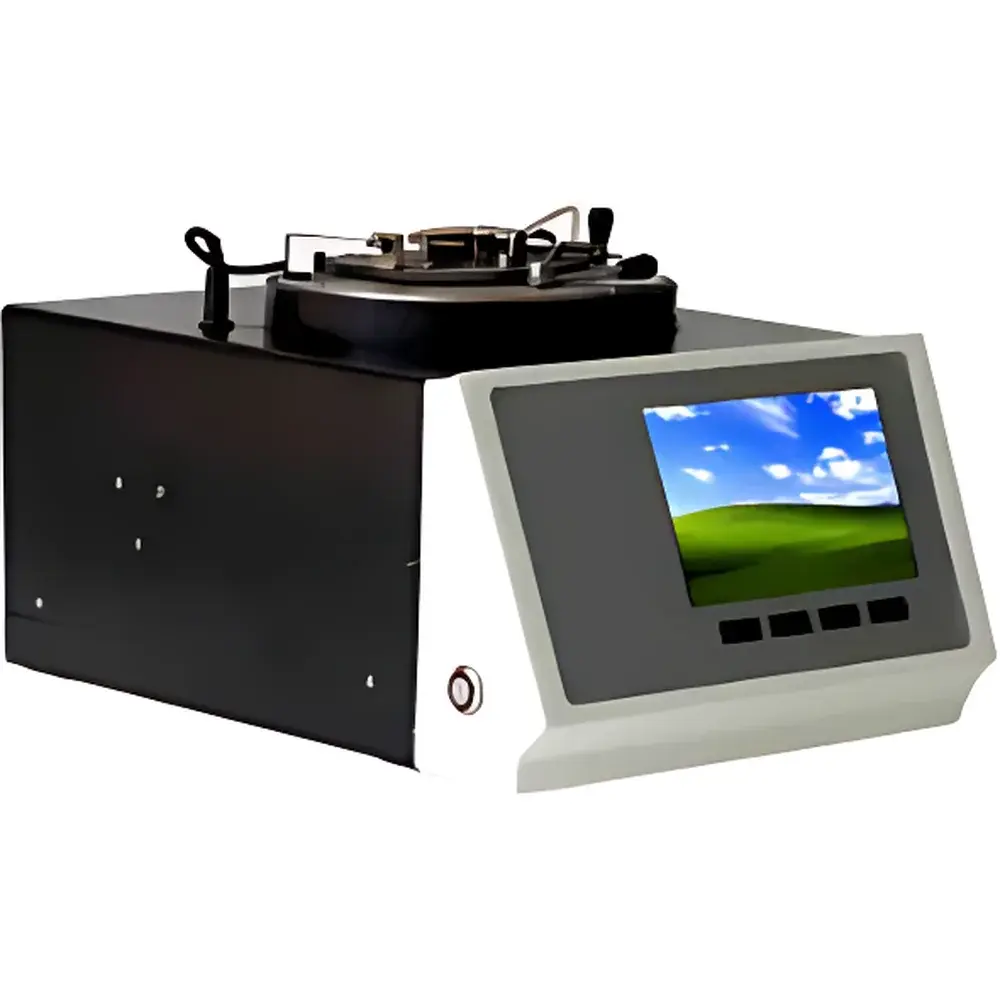
KARRIE EFP310B Automated Closed-Cup Flash Point Analyzer
| Brand | KARRIE |
|---|---|
| Model | EFP310B |
| Origin | Shenzhen, China |
| Detection Method | Closed-Cup (ASTM D3278/D3828, ISO 3679/3680/1516, GB/T 5208-2008/21790-2008) |
| Temperature Range | −35 °C to +105 °C |
| Sample Volume | 2 mL |
| Temperature Accuracy | ±0.5 °C |
| Heating Rate | Programmable up to 5 °C/min (max duration: 99 min, max temp: 100 °C) |
| Cooling | Integrated Peltier cooling module with external water supply |
| Interface | RS232 serial port |
| Dimensions | 400 × 220 × 170 mm |
| Weight | 6 kg |
Overview
The KARRIE EFP310B Automated Closed-Cup Flash Point Analyzer is an engineered solution for precise and repeatable flash point determination of volatile liquid and semi-viscous petroleum products, solvents, coatings, biofuels (e.g., FAME), chemical reagents, and fragrance materials. It operates on the closed-cup equilibrium method—compliant with internationally recognized standards including ASTM D3278 and D3828, ISO 3679, ISO 3680, ISO 1516, and Chinese national standards GB/T 5208–2008 and GB/T 21790–2008. Unlike open-cup instruments, the EFP310B isolates the sample in a sealed test cup during heating and ignition, minimizing vapor loss and enhancing measurement reproducibility—particularly critical for low-flash-point or high-volatility samples. The instrument employs a thermoelectric (Peltier) cooling module coupled with external water circulation to accelerate thermal equilibration between tests, reducing turnaround time without compromising thermal stability or sensor fidelity.
Key Features
- Automated closed-cup flash point detection using a calibrated flame probe with real-time spark timing control
- Programmable temperature ramping: user-defined heating rates (0.5–5 °C/min), adjustable hold times, and dual-mode operation (rapid equilibrium or linear ramp)
- Integrated Peltier-based cooling system with external water interface—enables sub-ambient start temperatures down to −35 °C and rapid cooldown to baseline between analyses
- Dual atmospheric pressure compensation via built-in barometric sensor; automatic correction applied to all flash point results
- Intuitive membrane keypad interface with backlit LCD display; audible feedback for key actions and test completion
- Flexible ignition source: compatible with laboratory-grade LPG or portable butane canisters (regulator included)
- RS232 serial communication port for data export to LIMS or QC software; optional thermal printer support
Sample Compatibility & Compliance
The EFP310B accommodates a broad spectrum of sample types—including aqueous coatings, solvent-based resins, aviation turbine fuels, lubricating oil distillates, fatty acid methyl esters (FAME), and viscous adhesives—provided they meet viscosity limits for reliable 2 mL pipetting and cup sealing. Its design conforms to regulatory frameworks governing flammability classification in industrial safety (OSHA 29 CFR 1910.1200), transportation (UN TDG, IMDG Code), and quality assurance (ISO/IEC 17025). Instrument validation supports GLP-compliant workflows: all parameter changes, test logs, operator IDs, and environmental metadata (ambient T/P) are timestamped and stored internally. Calibration traceability aligns with NIST-traceable reference oils (e.g., certified 49.7 °C standard), and routine verification follows ASTM E202 or ISO 17034 protocols.
Software & Data Management
While the EFP310B operates as a standalone unit, its RS232 interface enables bidirectional communication with host PCs running proprietary or third-party lab software. Raw data output includes test ID, start/end time, ambient pressure, final flash temperature, heating rate profile, and pass/fail status per selected standard. Audit trails record every user action—including parameter edits, calibration events, and firmware updates—in non-erasable memory. For regulated environments, integration with 21 CFR Part 11–compliant systems is achievable via middleware that enforces electronic signatures, role-based access control, and immutable log archiving. Optional accessories include a certified thermometer calibrator (with ISO/IEC 17025 certificate) and viscosity-adapted sampling syringes for high-solids formulations.
Applications
- Quality control of jet fuel (Jet A-1, JP-8) and diesel blends per ASTM D93 and military specifications
- Batch release testing of industrial solvents (acetone, xylene, MEK) in paint and ink manufacturing
- Regulatory compliance verification for biobased fuels under EN 14214 and ASTM D6751
- Stability assessment of reactive monomers and oligomers in polymer synthesis R&D
- Safety screening of fragrance compounds and essential oils prior to formulation and transport
- Technical service labs performing third-party flash point certification for SDS authoring
FAQ
Does the EFP310B comply with ASTM D3828 for low-flash-point liquids?
Yes—it implements the mini-method variant of ASTM D3828 (Test Method B), optimized for samples with flash points below 93 °C and requiring only 2 mL volume.
Can it test viscous or waxy samples?
With optional viscous-sample syringes and preheated cup accessories, it handles materials up to ~500 cSt at 40 °C; however, pour point and wax content must allow complete cup filling and sealing.
Is barometric correction applied automatically?
Yes—the internal pressure sensor continuously monitors ambient conditions and adjusts flash temperature calculations in real time per ISO 3679 Annex A.
What maintenance is required for long-term accuracy?
Annual verification using certified reference oils, quarterly cleaning of the flash probe and cup seal, and biannual calibration of the Pt100 temperature sensor against traceable standards.
Is remote diagnostics supported?
Not natively—but RS232 logs can be parsed by external diagnostic tools; firmware updates require local USB-to-serial connection.





