
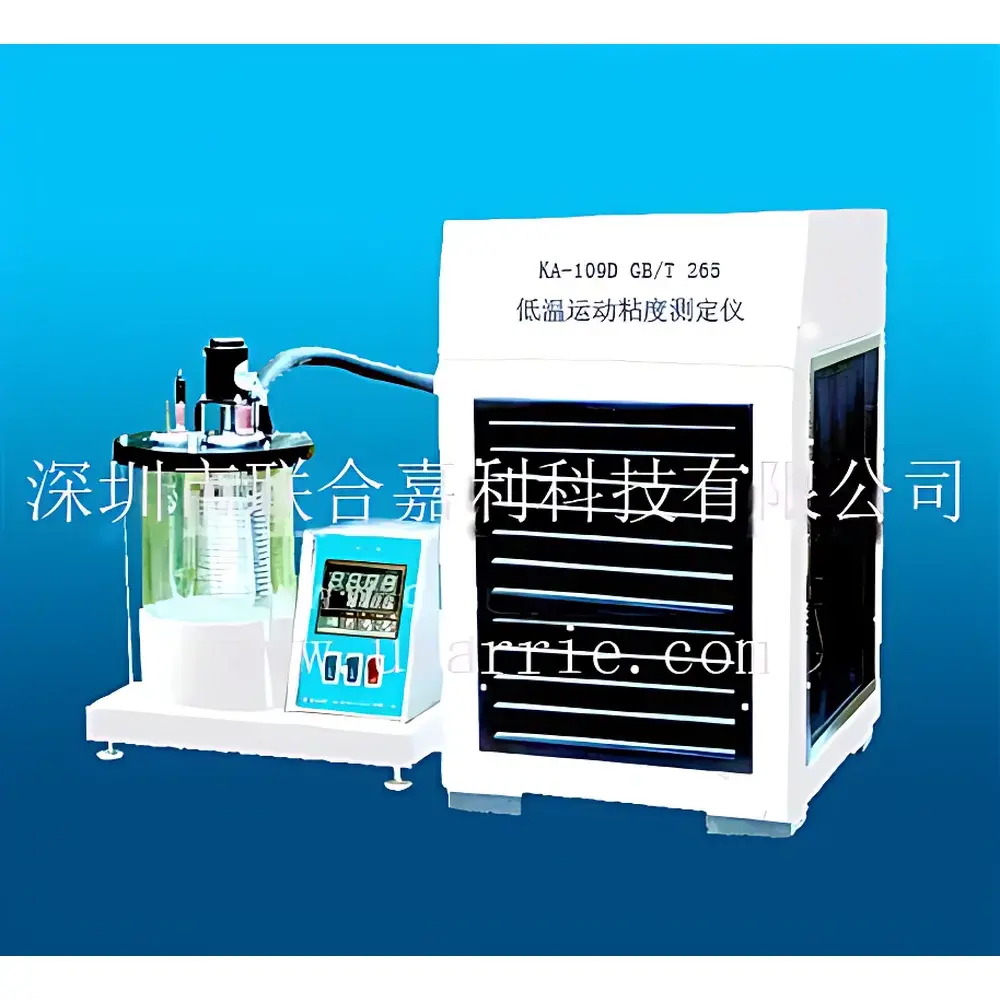
Karrie KA-109D Low-Temperature Kinematic Viscosity Tester for Petroleum Products
| Brand | Karrie |
|---|---|
| Model | KA-109D |
| Application | Kinematic viscosity measurement of Newtonian liquid petroleum products |
| Standards Compliance | GB/T 265, ASTM D445 |
| Temperature Range | Ambient to –60 °C |
| Temperature Stability | ±0.1 °C |
| Bath Display Resolution | 0.1 °C |
| Cooling System | Dual-stage imported compressor |
| Bath Configuration | Dual-capillary holder (2 positions) |
| Stirring | Motor-driven bath circulation |
| Power Supply | AC 220 V ±10%, 1500 W |
| Dimensions (W×D×H) | 450 × 530 × 720 mm |
| Weight | ~71 kg |
| Environmental Operating Condition | 20 °C ambient |
Overview
The Karrie KA-109D Low-Temperature Kinematic Viscosity Tester is an engineered laboratory instrument designed for precise determination of kinematic viscosity in liquid petroleum products under sub-ambient conditions. It operates on the capillary viscometer principle defined in GB/T 265 and ASTM D445—standards that specify the use of calibrated glass capillaries immersed in a thermally stabilized bath, where viscosity is derived from the efflux time of a fixed volume of sample under gravity. The system is optimized for Newtonian fluids, including base oils, diesel fuels, jet fuels, lubricants, and other transparent or opaque petroleum distillates whose flow behavior conforms to Newtonian assumptions within the test temperature range. Its primary function extends beyond routine viscosity reporting: the unit serves as a stable, high-precision cold source for ancillary low-temperature physicochemical testing, such as pour point pre-conditioning or wax crystallization studies.
Key Features
- Two-position capillary holder enabling parallel or sequential analysis—improving throughput while maintaining inter-test consistency.
- Dual-stage imported refrigeration system delivering rapid cooldown from ambient to –60 °C with minimal thermal overshoot and high energy efficiency.
- Motor-driven bath circulation ensures uniform temperature distribution across both capillary immersion zones, critical for repeatability per ASTM D445 Section 7.2.
- Intelligent digital temperature controller with ±0.1 °C stability and 0.1 °C display resolution—meeting the stringent thermal control requirements of GB/T 265 Clause 5.3.
- Modular split-body architecture separates the refrigeration unit from the viscometer bath, reducing mechanical vibration transfer and simplifying maintenance access.
- Robust stainless-steel bath construction with insulated housing minimizes ambient heat ingress and supports long-duration stability at ultra-low temperatures.
Sample Compatibility & Compliance
The KA-109D accommodates standard Ubbelohde, Cannon-Fenske, or Ostwald-type capillaries (not included), supporting nominal viscometer constants from 0.2 to 1.0 mm²/s². It is validated for use with petroleum products meeting the Newtonian flow criterion per ASTM D445 Annex A1—i.e., samples exhibiting linear shear stress–shear rate response across the operational shear rate range imposed by gravity-driven capillary flow. Non-Newtonian or highly viscous samples (e.g., heavy fuel oils above 1000 mm²/s at 40 °C) require prior dilution or alternative methodology. The instrument complies with national and international regulatory frameworks governing petroleum testing laboratories, including GB/T 265–2022, ASTM D445–23, and ISO 3104:2022. Its thermal performance and mechanical design support GLP-compliant operation when integrated into documented SOPs with periodic verification using NIST-traceable reference oils.
Software & Data Management
The KA-109D is a benchtop hardware platform requiring external timing instrumentation (e.g., manual stopwatch or automated viscometer timer) for efflux measurement. While it does not embed proprietary software, its analog/digital interface architecture enables seamless integration with third-party laboratory information management systems (LIMS) via RS-232 or optional USB-to-serial adapters. Temperature setpoints, actual bath readings, and runtime logs are accessible through the front-panel controller’s non-volatile memory—supporting audit trails required under FDA 21 CFR Part 11 when paired with compliant data capture workflows. Users may configure calibration schedules, instrument qualification records (IQ/OQ), and preventive maintenance logs in alignment with ISO/IEC 17025:2017 clause 6.4.3 for equipment management.
Applications
- Determination of kinematic viscosity at –10 °C, –20 °C, –30 °C, and –50 °C for aviation turbine fuels (Jet A-1, JP-8) per ASTM D1655 Annex A2.
- Low-temperature viscosity profiling of engine oils during formulation development and OEM specification validation (e.g., SAE J300 low-temperature pumping criteria).
- Quality control of winter-grade diesel fuels (EN 590, ASTM D975) where cold-flow properties directly correlate with operability.
- Supporting pour point and cloud point testing by providing stabilized sub-zero conditioning baths per ASTM D97 and ASTM D2500.
- Research applications in fuel additives evaluation, biofuel blending behavior, and low-temperature rheological modeling of hydrocarbon mixtures.
FAQ
What capillary viscometers are compatible with the KA-109D bath?
Standard Ubbelohde, Cannon-Fenske Routine, and Ostwald viscometers with standardized dimensions and certified calibration constants may be used. Capillary selection must align with expected viscosity range and test temperature per ASTM D445 Table 1.
Does the instrument include timing functionality?
No—the KA-109D provides only thermal and mechanical infrastructure. Efflux time measurement requires external timing devices, either manual or automated, per GB/T 265 Section 6.2.
Can the bath maintain –65 °C as stated in some documentation?
The verified operational range is ambient to –60 °C per factory calibration and thermal load testing. Sustained operation below –60 °C is not recommended due to diminishing refrigeration efficiency and potential condensation-related instability.
Is the unit suitable for GMP-regulated environments?
Yes—when deployed with documented procedures, periodic verification using certified reference oils (e.g., NIST SRM 2786), and electronic data capture systems compliant with 21 CFR Part 11, it meets core equipment requirements for pharmaceutical-adjacent fuel excipient testing.
What maintenance intervals are recommended?
Compressor oil inspection every 12 months; bath fluid replacement (low-freezing-point silicone oil) every 24 months or after 500 operational hours at ≤–40 °C; annual verification of temperature sensor accuracy against traceable standards.





