
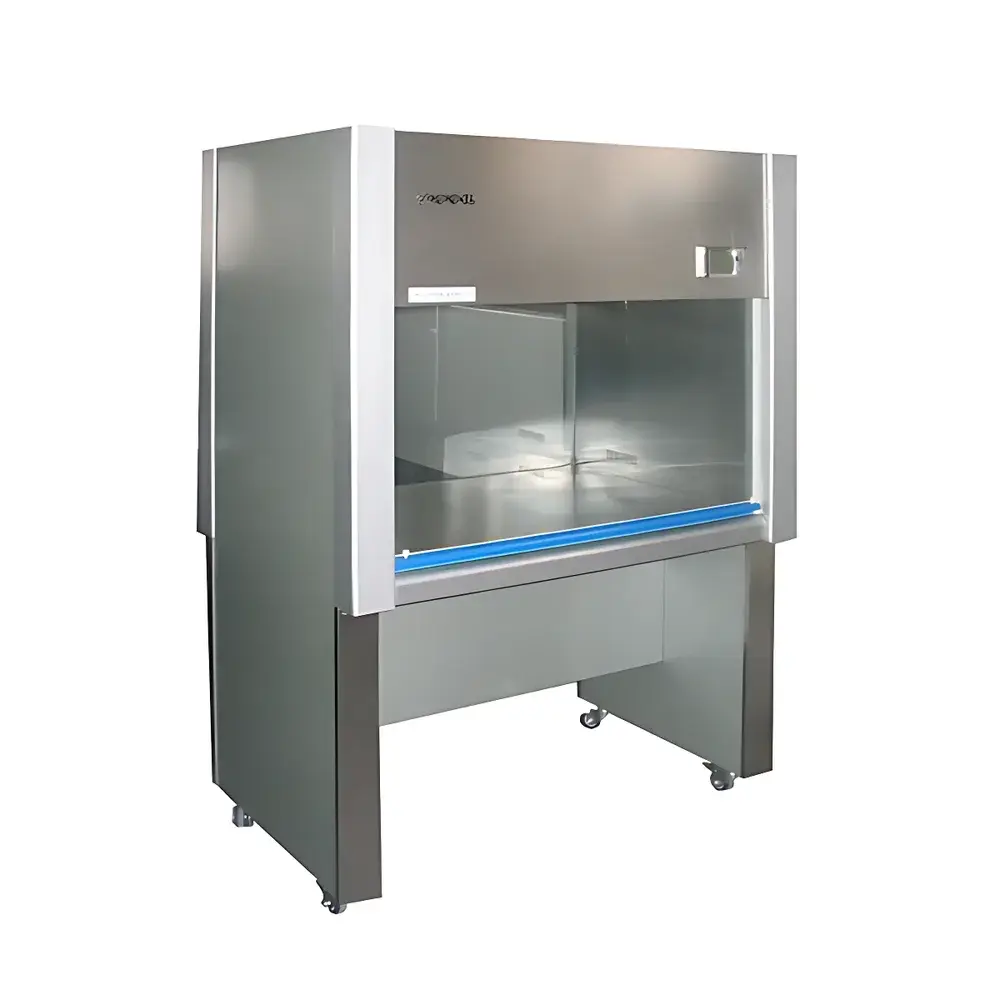
HJ SW-CJ-1FD Single-Person Vertical Laminar Flow Clean Bench
| Brand | HJ Purification |
|---|---|
| Origin | Shanghai, China |
| Manufacturer Type | Direct Manufacturer |
| Product Category | Vertical Laminar Flow Clean Bench |
| Model | SW-CJ-1FD |
| Cleanliness Class | ISO Class 5 (100 @ ≥0.5 µm, Fed. Std. 209E) |
| Noise Level | ≤62 dB(A) |
| User Capacity | Single Operator, Front-Facing Work Area |
| Airflow Pattern | Vertical Downflow |
| Average Air Velocity | 0.25–0.45 m/s |
| Illumination | ≥300 lx |
| Vibration | ≤5 µm (peak-to-peak, XYZ axes) |
| Power Supply | AC 220 V / 50 Hz |
| Max. Power Consumption | 400 W |
| Net Weight | 100 kg |
| Work Area Dimensions (W×D×H) | 870×580×515 mm |
| Overall Dimensions (W×D×H) | 1030×650×1600 mm |
| Lighting | 20 W Fluorescent Lamp ×1 + 20 W UV Lamp ×1 |
| Microbial Recovery | ≤0.5 CFU/plate·hour (Φ90 mm settle plate) |
Overview
The HJ SW-CJ-1FD is a vertically oriented laminar flow clean bench engineered for reliable particulate and microbial control in non-sterile but contamination-sensitive laboratory workflows. It operates on the principle of unidirectional vertical airflow—generated by a low-turbulence centrifugal blower and conditioned through a two-stage filtration system—to establish a continuous, uniform downflow across the work surface. This airflow pattern creates a protective barrier that sweeps airborne contaminants away from the operator and sample zone, minimizing cross-contamination risk during routine microbiological handling, media preparation, reagent dispensing, and aseptic transfers where full ISO Class 5 (100-level) environmental integrity is required. Designed for single-user operation, the unit complies with core safety and performance benchmarks defined in ISO 14644-1 (Cleanrooms and associated controlled environments), IEST-RP-CC002 (HEPA and ULPA Filters), and relevant sections of GB/T 16292–16294 (Chinese national standards for clean bench testing). Its structural architecture prioritizes operational stability, long-term filter service life, and ergonomic accessibility without compromising containment fidelity.
Key Features
- Vertically aligned laminar airflow with adjustable dual-speed fan control (low/high), enabling precise velocity modulation between 0.25–0.45 m/s to accommodate varying procedural demands while maintaining ISO Class 5 compliance.
- Full-height, horizontally sliding sash window with frictionless positioning mechanism—allows stable, tool-free height adjustment across the entire front aperture for optimal operator comfort and workflow flexibility.
- Monocoque enclosure fabricated from pre-painted color-coated steel panels; work surface constructed from brushed AISI 304 stainless steel—resistant to corrosion, chemical exposure, and repeated disinfection cycles.
- Dual-stage air filtration: G4-grade pre-filter captures coarse particulates (>5 µm), significantly extending the service interval of the primary HEPA filter (865 × 555 × 380 mm, ≥99.995% @ 0.3 µm).
- Integrated lighting system comprising one 20 W fluorescent lamp (≥300 lx at work surface) and one 20 W germicidal UV-C lamp (254 nm), both independently switchable and interlocked with sash position for safety.
- Structural vibration isolation achieves ≤5 µm peak-to-peak displacement across X/Y/Z axes, ensuring compatibility with sensitive instrumentation such as analytical balances or micro-pipetting stations placed adjacent to or within the work area.
Sample Compatibility & Compliance
The SW-CJ-1FD supports open-container handling of non-hazardous biological samples, pharmaceutical intermediates, cell culture reagents, and sterile packaging components. It is not rated for use with volatile organic solvents, radioactive materials, or biohazardous agents requiring biosafety level (BSL-2 or higher) containment. The unit meets electrical safety requirements per GB 4706.1 and electromagnetic compatibility per GB 4343.1. All internal surfaces are accessible for routine cleaning using 70% ethanol or 1% sodium hypochlorite solutions. Validation documentation—including airflow uniformity mapping, particle count verification (per ISO 14644-3 Annex B), and microbial recovery testing (using settle plates per ISO 14698-1)—is provided with each unit to support GLP-compliant lab audits.
Software & Data Management
This clean bench operates as a standalone mechanical system with no embedded microprocessor or digital interface. All operational parameters—including fan speed selection, lighting activation, and UV lamp timing—are managed via physical toggle switches located on the front control panel. No firmware, connectivity, or audit-trail functionality is included, aligning with its role as a foundational infrastructure device rather than a regulated data-generating instrument. For laboratories subject to FDA 21 CFR Part 11 or EU Annex 11 requirements, manual logbook entries documenting daily startup checks, UV exposure duration, and filter replacement dates satisfy basic traceability obligations.
Applications
- Preparation of microbiological growth media and agar plates in teaching and diagnostic labs.
- Aseptic transfer of non-pathogenic bacterial or fungal cultures in academic research settings.
- Weighing and dilution of reference standards in quality control laboratories supporting ISO/IEC 17025 accreditation.
- Assembly and inspection of precision optical or electronic components requiring low-particulate ambient conditions.
- Handling of sensitive reagents prone to oxidation or moisture absorption, including certain enzyme formulations and lyophilized peptides.
FAQ
What is the certified cleanroom classification of this unit?
It is validated to ISO Class 5 (equivalent to Federal Standard 209E Class 100) for particles ≥0.5 µm when operated under specified airflow conditions.
Can this clean bench be used for handling pathogenic organisms?
No. It provides personnel and product protection only—not environmental protection—and must not be substituted for a Class II biological safety cabinet when working with BSL-2 or higher agents.
How often should the HEPA filter be replaced?
Under typical usage (8 hrs/day, moderate ambient dust load), replacement is recommended every 18–24 months—or sooner if differential pressure across the filter exceeds 250 Pa or airflow velocity falls below 0.25 m/s.
Is UV lamp irradiation sufficient for sterilizing surfaces inside the chamber?
UV-C exposure reduces surface bioburden but does not guarantee sterility; it must be combined with validated chemical disinfection protocols prior to critical procedures.
Does the unit include calibration certification?
Yes—each shipment includes a factory-issued Certificate of Conformance listing measured airflow velocity, noise level, illumination intensity, and particle count results per ISO 14644-3 test methods.



