
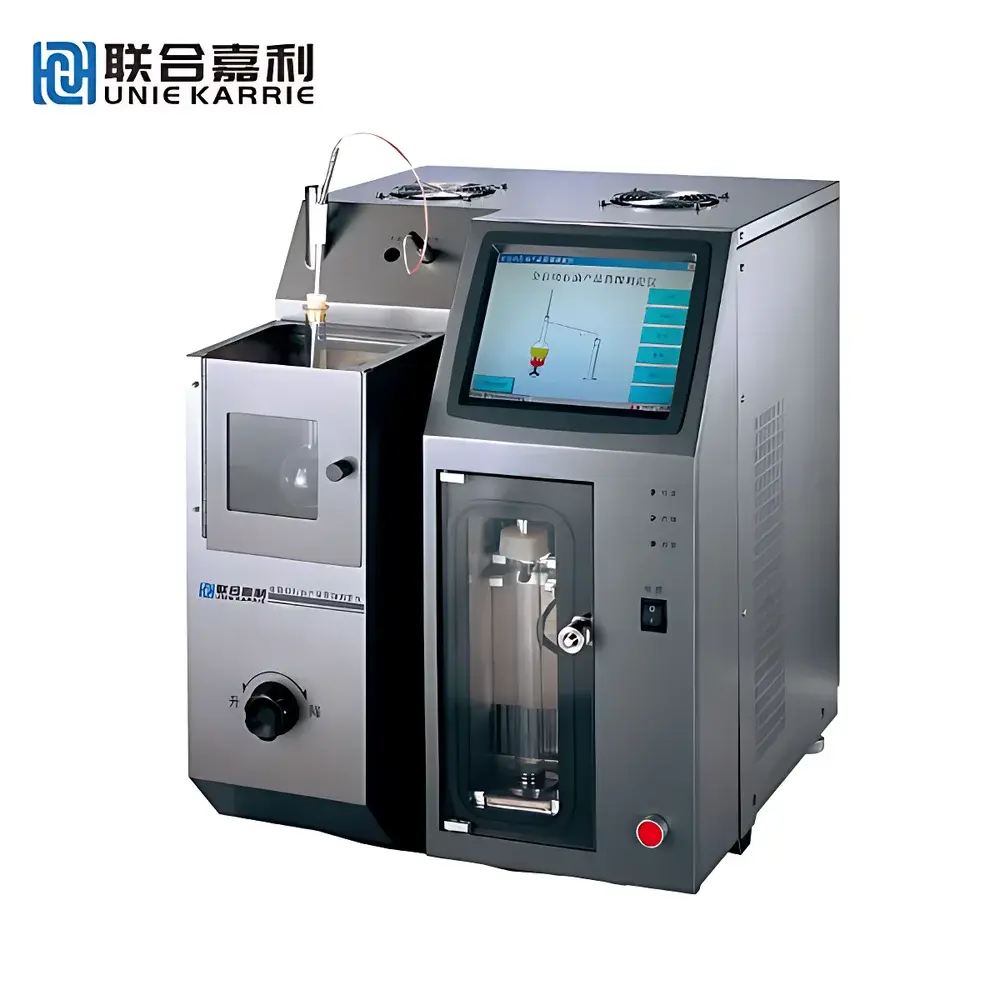
KARRIE EDS 110 Fully Automated Distillation Analyzer for Petroleum Products
| Brand | KARRIE |
|---|---|
| Model | EDS 110 |
| Compliance | ASTM D86, ASTM D850, GB/T 6536, GB/T 7534, ISO 3405 |
| Temperature Range | Ambient to 370 °C |
| Temperature Accuracy | ±0.1 °C |
| Volume Measurement Resolution | 0.1 mL |
| Liquid Level Tracking Speed | up to 12 mL/min |
| Condenser & Receiver Temperature Control | 0–60 °C (Peltier-based) |
| Power Supply | AC 220 V, 50 Hz |
| Total Power Consumption | 2500 W |
| Heating Power | 1000 W |
| Display | 10.4″ color TFT LCD (640 × 480) |
| Dimensions (L×W×H) | 565 × 515 × 660 mm |
| Weight | 55 kg |
Overview
The KARRIE EDS 110 Fully Automated Distillation Analyzer is an engineered solution for standardized distillation testing of petroleum fractions in accordance with globally recognized specifications—including ASTM D86 (Standard Test Method for Distillation of Petroleum Products at Atmospheric Pressure), ASTM D850 (for volatile solvents), GB/T 6536 (Chinese national standard equivalent to ASTM D86), GB/T 7534 (for organic solvents), and ISO 3405. It implements a controlled atmospheric-pressure batch distillation process, where vapor temperature, recovered volume, and timing are continuously monitored and recorded under precisely regulated heating, condensation, and collection conditions. The instrument is designed for routine quality control and specification compliance testing in refinery laboratories, fuel blending facilities, third-party testing labs, and petrochemical R&D centers—supporting analysis of gasoline, jet fuel, kerosene, diesel, naphtha, solvent oils, and related hydrocarbon mixtures. Its architecture integrates real-time thermometric feedback, Peltier-based thermal regulation, and high-fidelity liquid-level tracking to ensure repeatability and traceability across test runs.
Key Features
- Dual-controller architecture: A dedicated microcontroller manages real-time distillation dynamics—including heater ramp control, vapor temperature acquisition, and liquid-level detection—while an industrial-grade embedded PC (256 MB RAM, 4 GB flash storage, Windows CE 5.0 OS) handles user interface, data logging, and system coordination. This separation ensures deterministic response during critical phase transitions.
- Peltier-based dual-zone thermal management: Independent semiconductor modules regulate both condenser bath and receiver chamber temperatures from 0 °C to 60 °C with bidirectional heating/cooling capability. This eliminates refrigerants (e.g., R134a), reduces maintenance overhead, improves energy efficiency, and enables tighter thermal stability than compressor-driven systems.
- High-accuracy metrology chain: PT100 platinum resistance thermometers (four-wire configuration, certified traceable to national standards) measure vapor and ambient temperatures; infrared optical liquid-level sensors (industrial-grade, wide-temperature tolerance) track distillate volume with 0.1 mL resolution and 12 mL/min dynamic tracking capacity.
- Configurable distillation protocols: Supports both standard-defined endpoints (e.g., IBP, 10%, 50%, 90%, FB, and dry point per ASTM D86) and user-defined custom breakpoints—either volume-triggered (e.g., “record temperature at 25 mL”) or temperature-triggered (e.g., “record volume at 180 °C”). Users may define up to 15 custom points and set early termination by volume or temperature threshold.
- Comprehensive self-diagnostic suite: On power-up, the system validates sensor integrity (vapor, heater, condenser, receiver), actuator functionality (fan, level detector), and mechanical status (door interlock, flask seating). During operation, it monitors for anomalies such as unresponsive volume change (>2 min stagnation), open receiver door, or out-of-range thermal drift—and halts testing with audible alarm and on-screen fault code.
Sample Compatibility & Compliance
The EDS 110 accommodates standard 125 mL distillation flasks and 100 mL graduated cylinders conforming to ASTM E1 and GB/T 12804. It is validated for use with transparent and slightly hazy petroleum distillates having initial boiling points ≥30 °C and final boiling points ≤370 °C. All hardware and firmware comply with electromagnetic compatibility (EMC) requirements per IEC 61326-1 and electrical safety per IEC 61010-1. Data integrity mechanisms—including timestamped audit trails, operator ID tagging, and immutable result archiving—support alignment with GLP and GMP documentation expectations. While not pre-certified for FDA 21 CFR Part 11, its software architecture permits configuration of electronic signature workflows and access-controlled user roles when deployed in regulated environments.
Software & Data Management
The embedded Windows CE 5.0 platform hosts a bilingual (English/Chinese switchable) GUI with tabbed navigation, real-time distillation curve plotting (temperature vs. recovered volume), and synchronized tabular readouts. Test methods are stored as editable XML templates; results are saved in CSV and proprietary binary formats with full metadata (method ID, sample ID, operator, ambient pressure, calibration offsets). Over 10,000 test records can be retained locally and queried by date range, sample name, operator, or method type. Communication interfaces include RS-232 (for legacy printer support), USB 2.0 (for firmware updates and bulk data export), and RJ-45 Ethernet (enabling LIMS integration via TCP/IP or HTTP-based API endpoints). Optional drivers facilitate direct interfacing with laboratory information management systems compliant with ASTM E1394 or HL7 ADT standards.
Applications
- Refinery QC: Verification of gasoline volatility (RVP correlation), jet fuel flash point compliance, and diesel cold-flow properties via distillation slope analysis.
- Fuel blending optimization: Monitoring cut-point shifts during component mixing to maintain distillation band conformity (e.g., T50 for combustion efficiency, T90 for injector coking risk).
- Contract testing labs: Accredited execution of ASTM D86 for custody transfer documentation, insurance claims verification, and regulatory submissions (e.g., EPA, CNPC, Sinopec).
- Research & development: Characterizing thermal stability of bio-derived blends, evaluating additive effects on evaporation profiles, and benchmarking alternative feedstocks against conventional crudes.
- Solvent manufacturing: Assessing purity and fractionation consistency of industrial hydrocarbons (e.g., VM&P naphtha, Stoddard solvent) per ASTM D850 and GB/T 7534.
FAQ
Does the EDS 110 support automatic atmospheric pressure correction?
Yes—the system accepts manual barometric input or integrates with optional external digital barometers via RS-232 to apply real-time corrections to observed temperatures per ASTM D86 Annex A1.
Can distillation curves be exported for statistical process control (SPC)?
Yes—CSV exports contain time-stamped temperature/volume pairs, enabling import into JMP, Minitab, or Python pandas for SPC charting and multivariate regression modeling.
Is calibration verification traceable to NIST or CNAS standards?
All supplied PT100 sensors and volumetric glassware include individual calibration certificates traceable to national metrology institutes; field recalibration procedures follow ISO/IEC 17025 guidelines.
What maintenance is required for the Peltier cooling modules?
No consumables or refrigerant recharge is needed. Routine maintenance consists of periodic cleaning of heatsink fins and verification of thermal interface compound integrity every 12 months.
How does the system handle samples with high wax or asphaltene content?
The EDS 110 is not intended for residua or heavy fuel oils. For waxy distillates (e.g., some diesel blends), preheating the sample to 40–50 °C prior to loading is recommended to prevent nozzle clogging during distillation initiation.




