
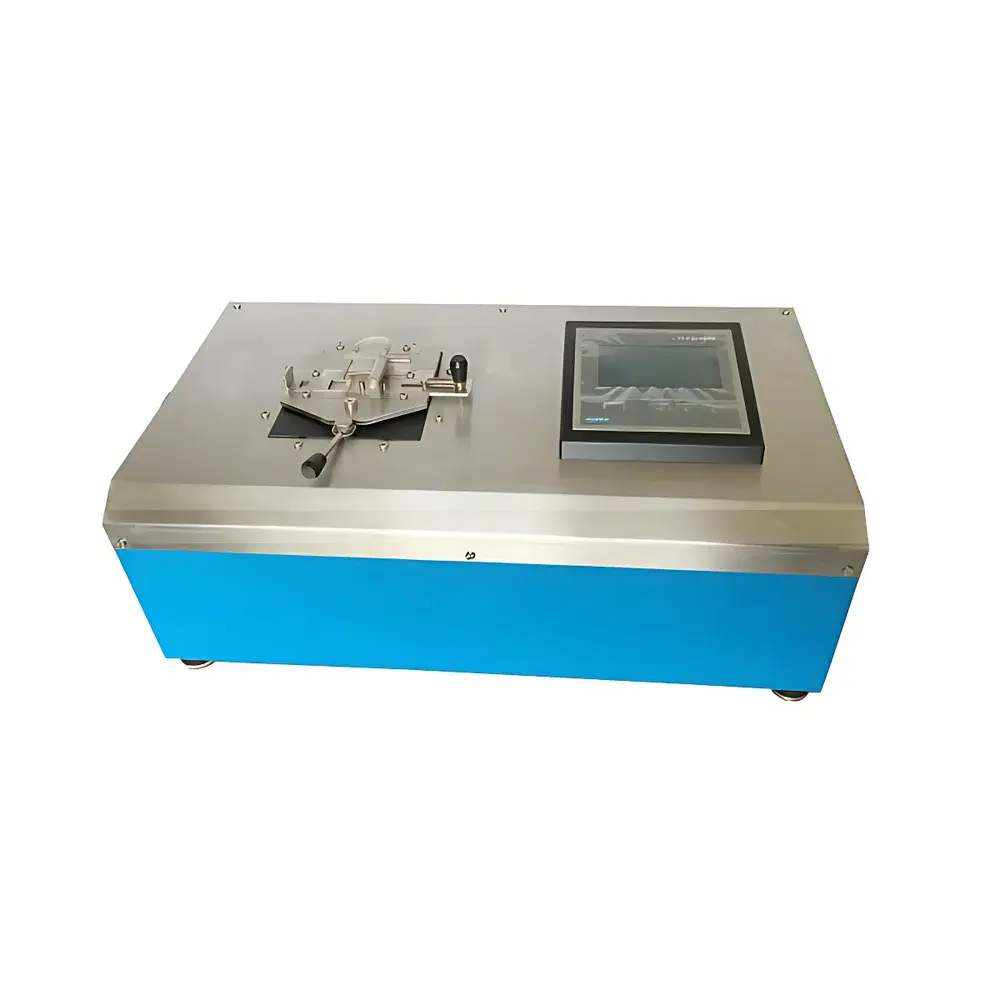
Karrie EFP310 Automated Rapid Equilibrium Closed-Cup Flash Point Tester
| Brand | Karrie |
|---|---|
| Model | EFP310 |
| Measurement Principle | ASTM D3278 / ISO 3679 Compliant Closed-Cup Equilibrium Method |
| Temperature Range | −0 °C to 100 °C (−30 °C to 300 °C optional) |
| Sample Volume | 2 mL (4 mL max) |
| Accuracy | ±0.5 °C |
| Heating Rate | Programmable, up to 5 °C/min |
| Test Modes | Rapid Equilibrium Mode & Linear Ramp Mode |
| Atmospheric Pressure Compensation | Automatic |
| Cooling System | Integrated Peltier Module |
| Power Supply | 220–240 V, 50/60 Hz |
| Dimensions | 400 × 220 × 170 mm |
| Weight | 6 kg |
| Compliance | ASTM D3278, ASTM D3828, ISO 3679, ISO 3680, ISO 1516, GB/T 5208–2008, GB/T 21790–2008, GB 7634, GB 5207 |
Overview
The Karrie EFP310 Automated Rapid Equilibrium Closed-Cup Flash Point Tester is an engineered solution for precise, repeatable flash point determination of volatile liquids and semi-volatiles in compliance with internationally recognized closed-cup equilibrium test standards. It operates on the principle of the rapid equilibrium method defined in ASTM D3278 and ISO 3679—where a small sample (2 mL) is introduced into a sealed test cup, heated to a target temperature, held for thermal equilibration, and then subjected to controlled ignition attempts until the lowest temperature at which vapour above the sample ignites is identified. This approach minimizes thermal lag and enhances reproducibility compared to traditional ramp-and-ignite methods, particularly for low-viscosity solvents, water-based coatings, and high-volatility chemical intermediates. Designed for laboratories requiring regulatory-grade data integrity, the EFP310 delivers traceable results under ambient conditions ranging from 15 °C to 35 °C, with built-in atmospheric pressure compensation ensuring accuracy across geographic elevations.
Key Features
- Automated closed-cup equilibrium testing per ASTM D3278, ISO 3679, and GB/T 5208–2008 protocols
- Programmable dual-mode operation: Rapid equilibrium mode (fixed-temperature hold) and linear ramp mode (user-defined heating rate up to 5 °C/min)
- Integrated Peltier cooling module enabling sub-2-minute cooldown between tests—no external chiller required for operation within 0–100 °C range
- Digital touchscreen interface with tactile membrane keys and audible feedback for all operational states (e.g., ignition attempt, flash detection, end-of-test)
- Self-contained ignition system compatible with either lab-supplied propane/butane or portable butane canisters; spark gap and electrode geometry optimized for consistent flame propagation
- Real-time temperature monitoring via calibrated Pt100 sensor with ±0.5 °C accuracy over full operating range
- Full parameter programmability—including hold time, ramp rate, final temperature limit (max 100 °C standard, 300 °C optional), and ignition frequency
Sample Compatibility & Compliance
The EFP310 accommodates diverse sample matrices without modification: aqueous dispersions (e.g., waterborne paints and latex emulsions), viscous resins, fatty acid methyl esters (FAME), aviation turbine fuels (Jet A-1, JP-8), halogenated solvents, fragrance oils, and solid-melt formulations (e.g., waxes and hot-melt adhesives pre-melted to liquid state). Its 2 mL sample requirement reduces hazardous waste generation and supports lean laboratory practices. All test procedures adhere to ISO/IEC 17025 documentation requirements when used with validated SOPs. Instrument firmware supports audit-ready event logging—including operator ID, timestamp, ambient pressure, calibration history, and pass/fail status per test cycle—facilitating GLP and GMP-aligned quality systems. Regulatory alignment includes full conformance with ASTM D3278 (low-flash liquids), ASTM D3828 (mini-method for rapid screening), ISO 1516 (flash point of flammable liquids), and Chinese national standards GB/T 21790–2008 and GB 7634 for occupational safety assessment.
Software & Data Management
Data output is supported via RS232 serial interface for direct integration with LIMS or custom SCADA environments. Optional thermal printer support enables hard-copy reporting compliant with internal QA workflows. While the EFP310 operates as a standalone instrument, its ASCII-formatted output protocol includes header metadata (test ID, date/time, method ID, ambient pressure), raw temperature vs. time arrays, and final flash point with uncertainty estimate. Firmware logs retain ≥1,000 test records with cyclic overwrite protection. For regulated environments, the device supports 21 CFR Part 11-compliant data handling when paired with validated third-party software—enabling electronic signatures, audit trails, and role-based access control for method editing and result review.
Applications
- Quality control of incoming solvents and thinners in paint & coating manufacturing
- Flash point verification of biodiesel blends (EN 14214, ASTM D6751) and FAME feedstocks
- Regulatory submission testing for REACH, CLP, and OSHA Hazard Communication Standard (HCS) classification
- R&D screening of novel formulation solvents where volatility profiling informs safe handling protocols
- Aviation fuel certification labs performing routine flash point checks per ASTM D1655 Annex A1
- Pharmaceutical excipient testing per USP and ICH Q5C guidelines for residual solvent safety
FAQ
What standards does the EFP310 comply with?
ASTM D3278, ASTM D3828, ISO 3679, ISO 3680, ISO 1516, GB/T 5208–2008, GB/T 21790–2008, GB 7634, and GB 5207.
Can the instrument test samples below 0 °C?
Yes—the standard configuration supports −0 °C to 100 °C; a low-temperature option extends the range to −30 °C to 300 °C.
Is external cooling required?
No—the integrated Peltier module provides active cooling for rapid thermal recovery between tests within the 0–100 °C range.
How is atmospheric pressure handled during testing?
An onboard barometric sensor automatically compensates flash point values in real time, eliminating manual correction tables.
What sample volume is required?
2 mL is standard; the cup design accommodates up to 4 mL for highly viscous or particulate-laden samples.





