
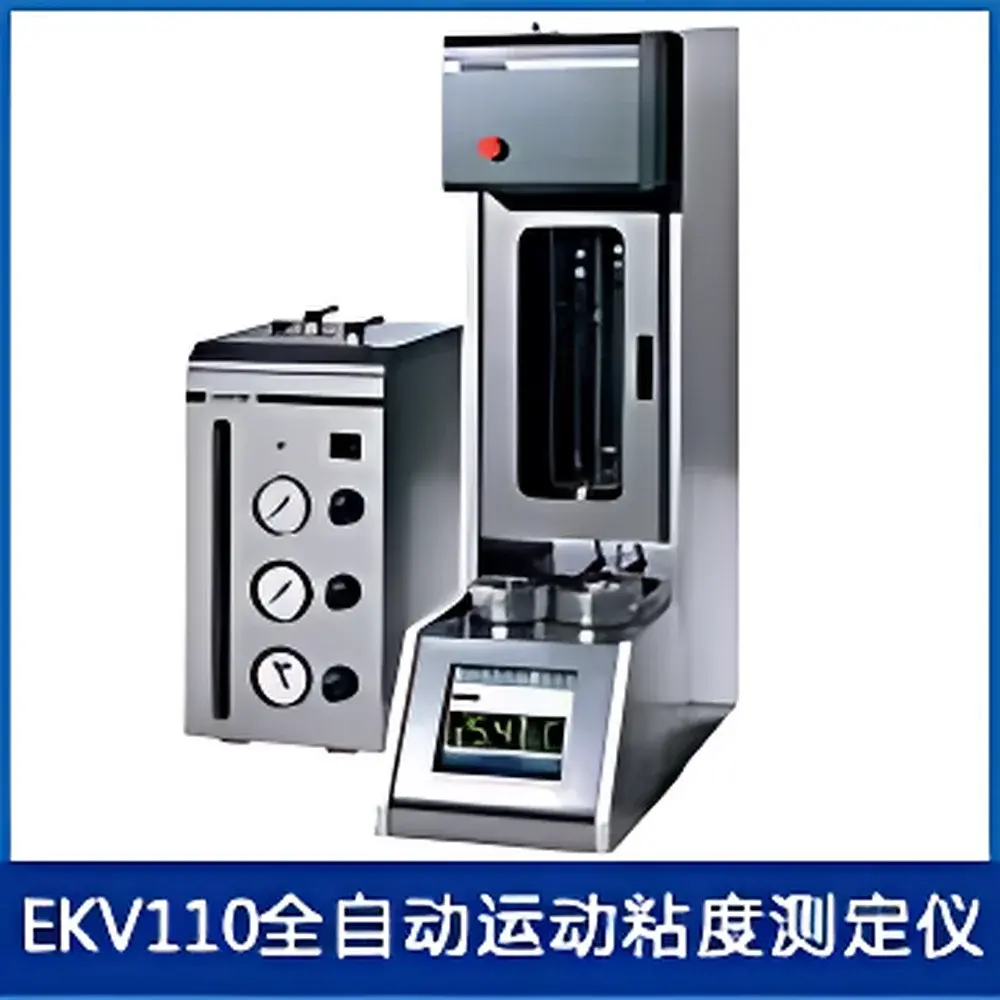
Karrie EKV110 Fully Automated Kinematic Viscosity Tester
| Brand | Karrie |
|---|---|
| Origin | Guangdong, China |
| Manufacturer Type | Authorized Distributor |
| Country of Manufacture | China |
| Model | EKV110 |
| Price Range | USD 1,400–4,200 |
| Standards Compliance | ASTM D445, ISO 3104, GB/T 265 |
| Sample Capacity | 2 × 12 positions |
| Temperature Bath Range | 20–100 °C (stability ±0.01 °C, resolution 0.01 °C) |
| Viscosity Range | 0.5–50 cSt, 10–1000 cSt, or 100–2000 cSt (dual-capillary configuration) |
| Detection Method | Dual-mode—photocell timing & thermistor timing (both with 0.01 s resolution) |
| Bath Medium | Silicone oil (long-life, non-replacement required) |
| Cooling Medium | Anhydrous ethanol |
| Power Supply | AC 220 V, 50 Hz |
| Total Power Consumption | 2000 W |
| Display | 10.4″ TFT LCD (800 × 600) with touch interface, metal waterproof keyboard & trackball |
| Dimensions (W×D×H) | 1300 × 400 × 900 mm |
| Weight | 120 kg |
| Storage Temperature | −20 to 50 °C |
| Data Interface | RS-232, USB 2.0, RJ-45 Ethernet |
| Operating System | Windows XP Embedded (English/localizable UI) |
| Memory | 1 GB DDR RAM, 4 GB industrial SSD |
| Preheating Capability | Dual sample trays, up to 70 °C |
| Cleaning System | Dual-solvent (A/B), programmable cycles & duration |
| Drying Method | Compressed air purge, user-defined cycles & dwell time |
Overview
The Karrie EKV110 Fully Automated Kinematic Viscosity Tester is an engineered solution for high-throughput, standards-compliant kinematic viscosity measurement of petroleum-based liquids—including crude oil, distillates, lubricants, fuel oils, and additives—under controlled thermal conditions. It operates on the capillary flow principle defined in ASTM D445, ISO 3104, and GB/T 265: a precisely calibrated glass capillary viscometer measures the time required for a fixed volume of liquid to flow under gravity between two etched marks at a tightly regulated bath temperature. The EKV110 implements dual independent capillary systems—one configured for low-viscosity ranges (0.5–50 cSt) and another for mid-to-high ranges (10–2000 cSt)—each equipped with triple-level detection bulbs and dual sensing modalities (photocell and thermistor), enabling broad dynamic range coverage without manual viscometer swaps. Its single-bath, dual-capillary architecture eliminates inter-bath thermal drift while maintaining ±0.01 °C temperature stability across the full 20–100 °C operating window. The system employs silicone oil as the bath medium, ensuring long-term thermal homogeneity and eliminating routine fluid replacement—a critical advantage for unattended overnight operation in QC laboratories.
Key Features
- Fully automated workflow: auto-sampling, vacuum-assisted aspiration, thermal equilibration, timed capillary efflux, solvent cleaning, and compressed-air drying—all sequenced without operator intervention after initial tray loading.
- Dual 12-position sample trays with independent preheating capability (up to 70 °C), supporting batch analysis of up to 24 samples per run.
- Redundant detection architecture: each capillary integrates both photocell and thermistor timing sensors, cross-validated at 0.01-second resolution to ensure measurement integrity across transparent and opaque samples.
- Industrial-grade control system: real-time microcontroller handles capillary timing and bath PID regulation; embedded industrial PC (1 GB RAM, 4 GB SSD, Windows XP Embedded) manages sequencing, data logging, diagnostics, and network communication.
- Programmable cleaning and drying: dual-solvent (A/B) delivery with adjustable cycle count, dwell time, and purge pressure—enabling method-specific residue removal for heavy fuels or additive packages.
- Comprehensive safety and reliability: overtemperature cutoff, mains power loss recovery, self-diagnostic boot sequence, and real-time fault logging with on-screen alert codes.
Sample Compatibility & Compliance
The EKV110 accommodates both transparent and opaque petroleum liquids—including residual fuels, bitumen emulsions, and heavily dyed lubricants—without optical interference, thanks to its thermistor-based fallback detection mode. All capillaries are factory-calibrated using NIST-traceable Cannon-Manning certified standard oils (ASTM D446 Class I), with user-accessible recalibration routines embedded in firmware. The instrument meets the mechanical and procedural requirements of ASTM D445 (Standard Test Method for Kinematic Viscosity of Transparent and Opaque Liquids), ISO 3104 (Petroleum products — Determination of kinematic viscosity and calculation of dynamic viscosity), and GB/T 265 (Petroleum products — Determination of kinematic viscosity). Its hardware design supports GLP-compliant operation: audit-trail-enabled software logs all parameter changes, test starts/stops, calibration events, and error conditions with timestamp and operator ID. Optional LIMS integration via RS-232 or Ethernet enables traceable data export aligned with 21 CFR Part 11 readiness when paired with validated electronic signature modules.
Software & Data Management
The embedded Windows XP Embedded platform hosts a purpose-built, menu-driven application with bilingual UI (English default, Chinese optional). Test methods are stored as editable templates—including bath temperature, equilibration time, number of replicate runs (2–4), cleaning solvent selection, and drying parameters. All raw efflux times, calculated kinematic viscosities (cSt), dynamic viscosities (cP), and statistical summaries (mean, SD, RSD%) are stored locally with UTC timestamps. Data export supports CSV, PDF, and XML formats; network connectivity permits remote monitoring via LAN or integration into enterprise LIMS via TCP/IP or OPC UA protocols. System diagnostics include live sensor status dashboards, bath temperature trend plots, and capillary blockage detection algorithms triggered by abnormal flow profiles. Firmware updates are performed via USB stick with cryptographic signature verification to maintain configuration integrity.
Applications
The EKV110 serves quality control laboratories in refineries, lubricant blending plants, and third-party testing facilities where regulatory compliance and throughput efficiency are paramount. Typical use cases include: routine viscosity grading of diesel fuel per ASTM D975; oxidation stability assessment of turbine oils via viscosity rise monitoring; specification verification of marine residual fuels (ISO 8217); batch release testing of hydraulic fluids (ISO 3448); and research-scale screening of viscosity index improvers. Its dual-capillary flexibility allows one instrument to cover both light naphthenic fractions and heavy asphaltene-rich residuals—reducing capital expenditure and floor space requirements versus discrete low- and high-range systems. The ability to preheat viscous samples prior to aspiration significantly reduces cycle time for waxy or high-pour-point feedstocks.
FAQ
Does the EKV110 support ASTM D445 Annex A5 for opaque samples?
Yes—the thermistor detection mode satisfies Annex A5 requirements for non-optical timing, and the instrument’s dual-sensor architecture ensures automatic fallback without manual reconfiguration.
Can calibration certificates be generated per ASTM D446?
Each capillary is supplied with a factory calibration certificate referencing NIST-traceable standard oils; users may generate new certificates post-recalibration using included software tools and documented procedures.
Is the silicone oil bath medium compatible with extended unattended operation?
Yes—silicone oil exhibits negligible volatility and thermal degradation below 120 °C, enabling continuous operation for >72 hours without fluid top-up or replacement.
What maintenance intervals are recommended for the vacuum and air purge systems?
The integrated vacuum pump requires oil change every 1,000 operating hours; compressed air filters should be inspected quarterly and replaced if moisture or particulate accumulation is observed.
How is data integrity ensured during power interruption?
The system performs atomic write operations and maintains a non-volatile event log; upon restart, it resumes from the last completed step—not from the beginning—preserving intermediate results and audit trail continuity.





