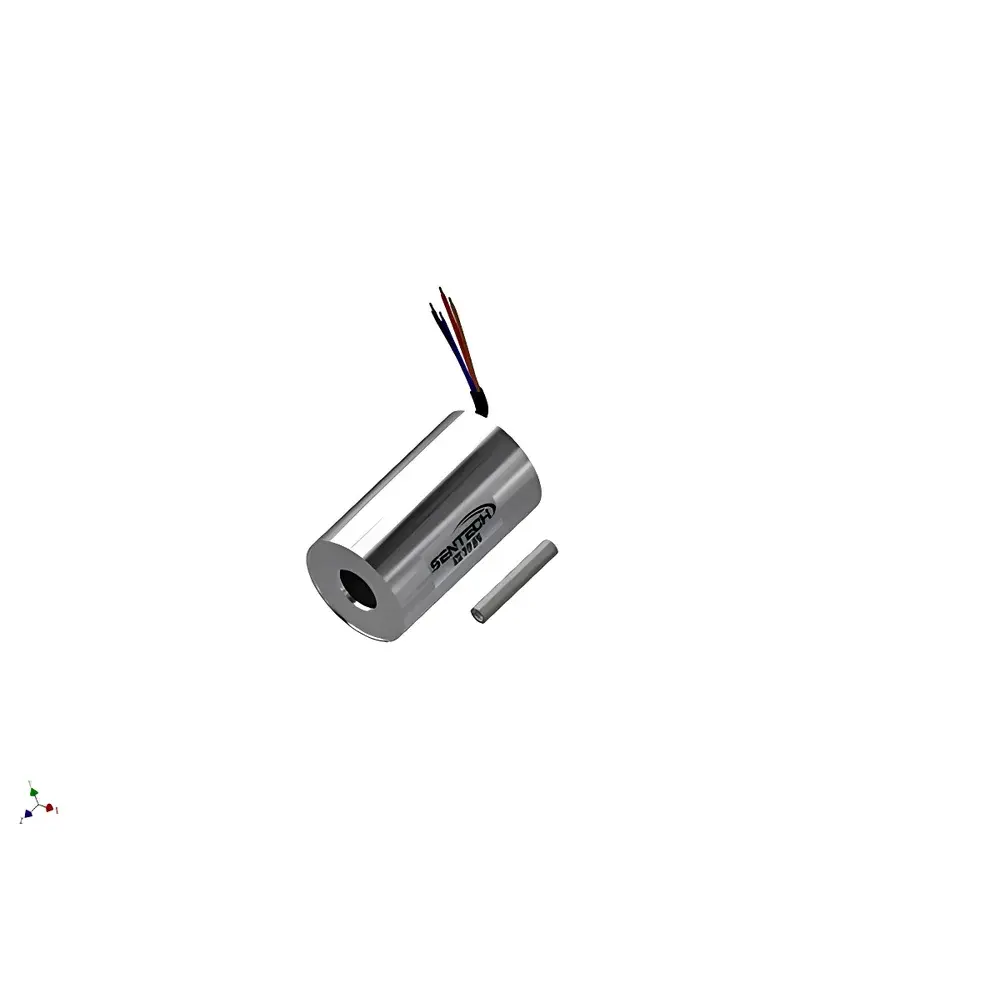
Karrie SA180 Series AC LVDT Displacement Sensor
| Brand | Karrie |
|---|---|
| Model | SA180 |
| Type | AC-operated Linear Variable Differential Transformer (LVDT) |
| Outer Diameter | 18 mm |
| Housing Material | Stainless Steel |
| Core Configuration | Separable (Split-core) Armature |
| Electrical Interface | Lead-wire Termination |
| Ingress Protection | IEC IP61 |
| Operating Temperature Range | −55 °C to +155 °C |
| Stroke Range | 0–600 mm (customizable) |
| Excitation Voltage | 3.0 V rms (nominal) |
| Excitation Frequency | 2.5–5.5 kHz |
| Linearity Error | < ±0.25 % of Full-Scale Output (FSO) |
| Repeatability Error | < 0.01 % FSO |
| Hysteresis Error | < 0.01 % FSO |
| Temperature Coefficient of Zero & Sensitivity | −0.02 %/°C (nominal) |
Overview
The Karrie SA180 Series AC LVDT Displacement Sensor is a precision electromechanical transducer engineered for high-accuracy, non-contact linear position measurement in demanding industrial and laboratory environments. Based on the well-established principle of mutual inductance, the SA180 operates using an AC-excited primary coil and two symmetrical secondary windings wound on a cylindrical bobbin. As the ferromagnetic core (armature) moves axially within the coil assembly, the differential voltage induced across the secondaries changes linearly with displacement—enabling robust, analog output proportional to position without physical contact or wear. Its split-core mechanical architecture allows flexible integration into existing hydraulic actuators, servo valves, and machine frames where space constraints or retrofit requirements preclude monolithic sensor installation. Designed for long-term stability under thermal cycling and mechanical vibration, the SA180 delivers metrological-grade performance with full-scale linearity better than ±0.25 %, repeatability below 0.01 % FSO, and hysteresis error similarly constrained—making it suitable for closed-loop control systems requiring traceable, deterministic feedback.
Key Features
- Split-core (separable armature) design enables field installation without disassembly of host equipment—ideal for retrofits in hydraulic cylinders, pneumatic actuators, and valve spools.
- Stainless steel housing (18 mm outer diameter) provides mechanical rigidity, corrosion resistance, and compatibility with harsh industrial atmospheres.
- Wide operating temperature range (−55 °C to +155 °C) supports deployment in aerospace ground support systems, engine test stands, and high-temperature manufacturing processes.
- Low-impedance winding architecture ensures stable signal-to-noise ratio even over extended cable runs (up to 10 m with standard shielded twisted-pair).
- IEC IP61-rated enclosure protects against vertically falling drips and dust ingress—meeting minimum environmental protection for factory-floor instrumentation.
- Customizable stroke lengths from 1 mm up to 600 mm, with optional calibration certificates traceable to NIST or CNAS-accredited laboratories.
Sample Compatibility & Compliance
The SA180 is compatible with all standard AC LVDT signal conditioners supporting 2.5–5.5 kHz excitation frequency and 3.0 Vrms input amplitude. It interfaces seamlessly with industrial PLCs (e.g., Siemens S7-1200/1500, Rockwell ControlLogix), data acquisition systems (NI CompactDAQ, Keysight DAQ970A), and OEM motion controllers. While not certified to ATEX or IECEx for explosive atmospheres, its passive construction and absence of semiconductor electronics make it inherently safe for use in intrinsically safe zones when paired with appropriate barrier modules. The sensor conforms to ISO 20957-4 (fitness equipment sensors), meets general-purpose EMC immunity per IEC 61000-4-2/3/4/6, and supports GLP-compliant calibration documentation upon request. No hazardous substances are used in manufacturing; RoHS 2011/65/EU compliance is verified via material declaration.
Software & Data Management
As a purely analog transducer, the SA180 requires external signal conditioning—typically via dedicated LVDT/RVDT demodulator modules (e.g., TE Connectivity DFG, Honeywell 5000 Series, or custom OEM interface boards). Output is a DC voltage (±5 V or 0–10 V) or current (4–20 mA) proportional to core displacement. When integrated into automated test systems, raw analog signals are digitized at ≥16-bit resolution and timestamped using IEEE 1588 PTP or GPS-synchronized clocks for phase-coherent multi-sensor correlation. Calibration coefficients—including zero offset, sensitivity slope, and temperature compensation terms—are stored in EEPROM or configuration files compliant with IEEE 1451.2 (STIM) templates. Audit trails for calibration events and firmware updates adhere to FDA 21 CFR Part 11 requirements when deployed in regulated pharmaceutical or medical device manufacturing lines.
Applications
- Precision feedback in electrohydraulic servo valves and proportional directional control valves for aerospace flight simulators and heavy machinery.
- Real-time stroke monitoring in CNC machine tool axis dampers, spindle preload systems, and robotic end-effector force-position coupling.
- Strain and elongation measurement in universal testing machines (UTMs) and materials tensile testers per ASTM E8/E21.
- Position verification in packaging line fill-level actuators, blister-pack sealing heads, and label placement carriages.
- Dynamic displacement tracking in industrial robot joint encoders, collaborative robot safety interlocks, and pick-and-place gantry systems.
- Condition monitoring of piston travel in diesel engine fuel injection pumps and steam turbine governor linkages.
FAQ
What excitation source is required to operate the SA180?
The SA180 requires a sinusoidal AC excitation of 3.0 Vrms at a frequency between 2.5 kHz and 5.5 kHz. Dedicated LVDT oscillator-demodulator modules or programmable signal generators with low harmonic distortion (<0.5 % THD) are recommended.
Can the SA180 be used in vacuum or pressurized environments?
Standard IP61-rated units are not rated for vacuum or high-pressure operation. Custom hermetically sealed variants with welded stainless housings and ceramic feedthroughs are available upon engineering review.
Is temperature compensation built into the sensor?
No internal compensation circuitry is included; however, the specified temperature coefficient (−0.02 %/°C) allows software-based linear correction using ambient temperature readings from an adjacent PT100 sensor.
Does Karrie provide calibration certificates with NIST traceability?
Yes—traceable calibration reports (including as-found/as-left data, linearity plots, and uncertainty budgets per ISO/IEC 17025) are available as a value-added service for all SA180 units ordered with the “CAL-TRACE” option code.
What is the maximum cable length between sensor and conditioner without signal degradation?
With standard 24 AWG shielded twisted-pair cable and proper grounding practices, reliable operation is maintained up to 10 meters. For longer runs, low-capacitance coaxial cable or remote signal conditioning is advised.