
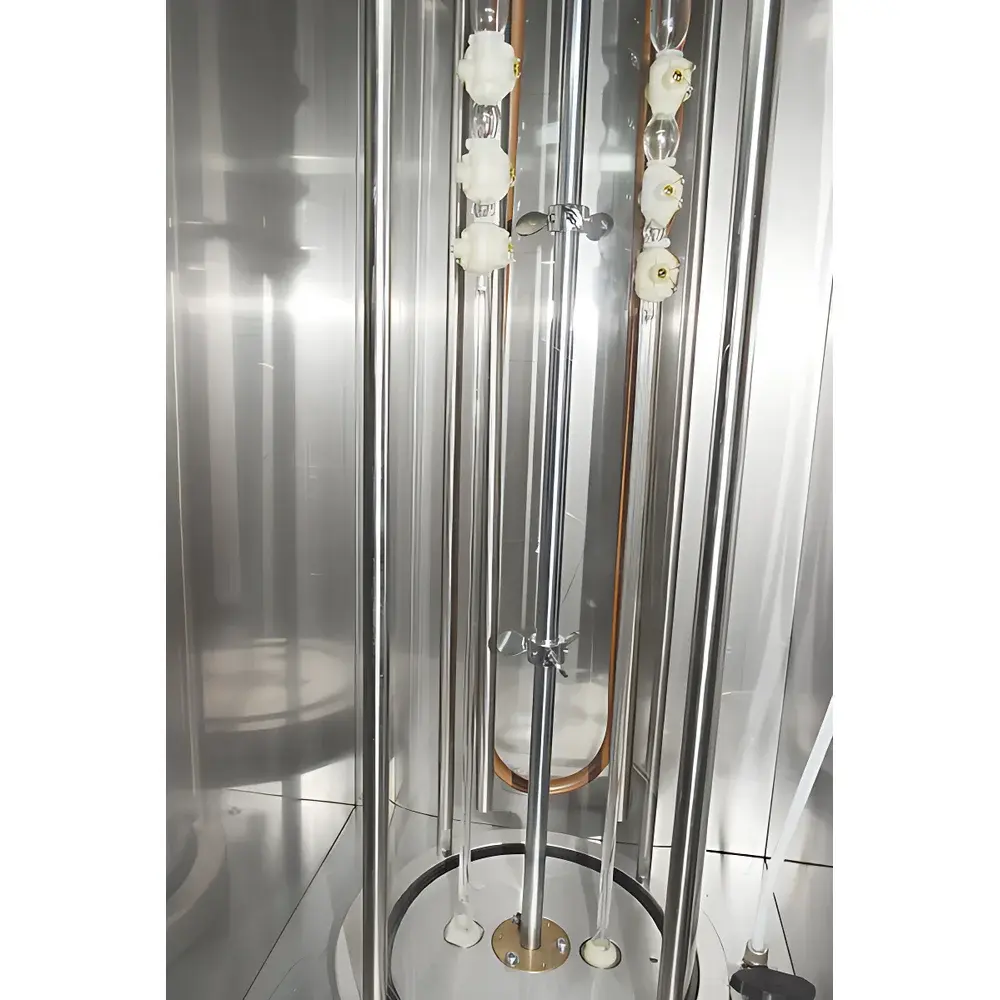
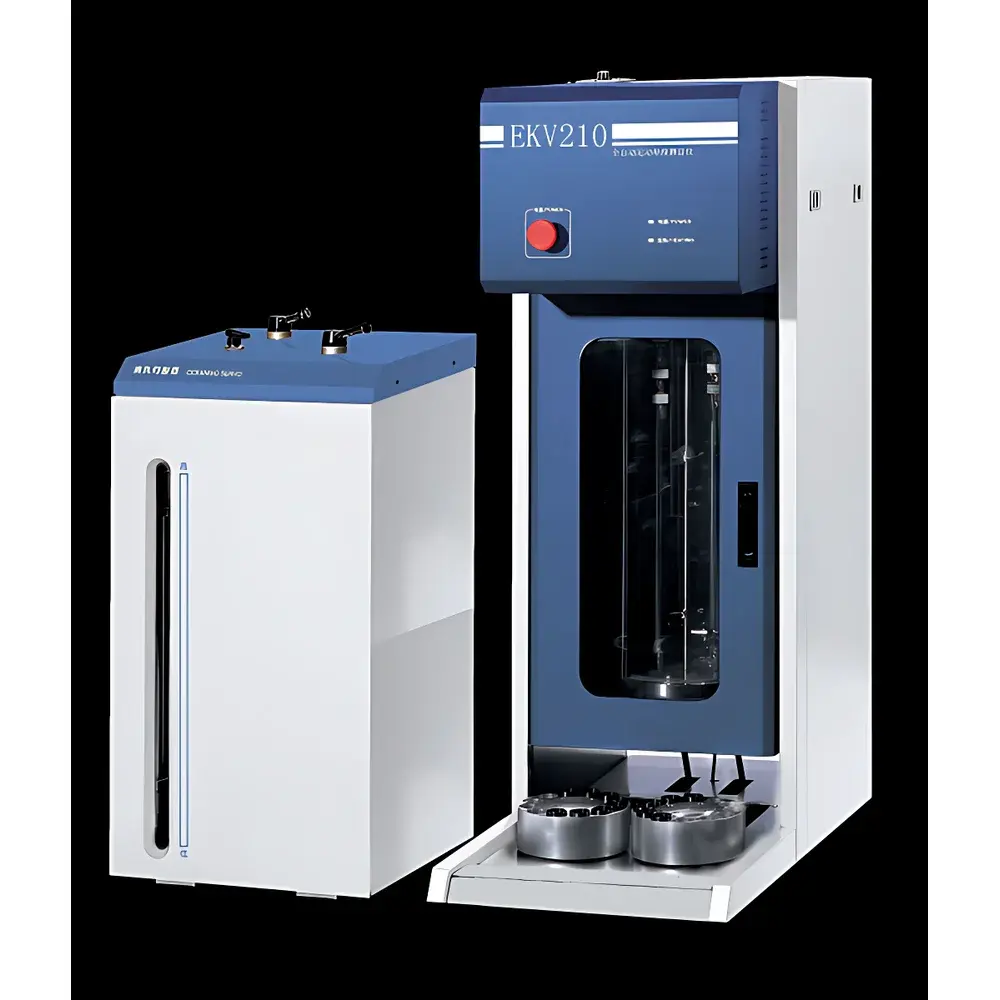
Karrie EKV210 Fully Automated Kinematic Viscosity Tester
| Brand | Karrie |
|---|---|
| Model | EKV210 |
| Standards Compliance | ASTM D445, ISO 3104, GB/T 265 |
| Temperature Range | 20–100 °C |
| Temperature Stability | ±0.01 °C |
| Temperature Resolution | 0.01 °C |
| Bath Medium | 10# methyl silicone oil |
| Detection Methods | Photocell & thermistor (dual-mode) |
| Timing Precision | ±0.01 s |
| Sample Capacity | 2 independent samples per run |
| Viscosity Measurement Range per Capillary | 100× (via triple-bulb capillary design) |
| Power Supply | AC 220 V, 50 Hz |
| Total Power Consumption | 1600 W |
| Dimensions (W×D×H) | 800 × 400 × 600 mm |
| Weight | 80 kg |
| Cooling Medium | Anhydrous ethanol |
| Temperature Sensor | PT100 platinum resistance thermometer |
| Operating Environment | –20 °C to 50 °C storage |
| Interface Options | RS-232, USB, RJ-45 (LIMS & LAN-ready) |
| Software Platform | Windows-based control with calibration traceability and audit trail support |
Overview
The Karrie EKV210 Fully Automated Kinematic Viscosity Tester is an engineered solution for precise, repeatable kinematic viscosity determination of petroleum-based liquids—spanning transparent and opaque samples including crude oil, distillates, fuel oils, lubricants, additives, and blended formulations. It operates on the principle of gravity-driven capillary flow, in strict accordance with ASTM D445, ISO 3104, and GB/T 265. The instrument implements a dual-capillary, single-bath architecture with independent photometric and thermistor-based detection channels, enabling robust measurement across wide viscosity ranges without manual intervention. Each capillary features a triple-bulb configuration, delivering a 100-fold dynamic range per tube and eliminating the need for manual capillary switching during routine QC or R&D workflows. The temperature-controlled bath utilizes high-stability 10# methyl silicone oil, ensuring long-term thermal homogeneity and minimizing maintenance frequency.
Key Features
- Fully automated workflow: auto-sampling, immersion equilibration, timed efflux measurement, solvent cleaning (dual-path A/B), and compressed-air drying—all programmable and executed without operator presence.
- Dual-mode detection system: simultaneous photocell and thermistor timing ensures cross-validated time-of-flow data, enhancing reliability for dark or particulate-laden samples where optical clarity is limited.
- High-precision thermal regulation: PT100 sensor feedback loop maintains bath stability within ±0.01 °C across the full 20–100 °C operating range; resolution is 0.01 °C, meeting stringent requirements for Grade 1 calibration laboratories.
- Modular hardware architecture: integrated test host, dedicated cleaning servo module, and industrial-grade PC controller—each subsystem employs imported critical components (e.g., precision solenoid valves, corrosion-resistant fluidic manifolds, and sealed stepper motor drives) to ensure mechanical longevity and metrological integrity.
- Configurable test protocol engine: users define immersion duration, number of replicate runs (2–4), cleaning cycles (A/B selection, duration, volume), and drying parameters—supporting method adaptation for diverse sample matrices per ASTM or internal SOPs.
- Real-time system diagnostics: embedded self-test routines monitor heater function, fluid level, pressure integrity, sensor continuity, and timing synchronization; fault codes are logged with timestamps and displayed via intuitive status icons.
Sample Compatibility & Compliance
The EKV210 accommodates both Newtonian and non-Newtonian petroleum liquids with kinematic viscosities ranging from 10⁵ mm²/s (cSt), depending on selected capillary geometry. Its dual-detection capability ensures reliable performance for black oils, asphaltene-containing fractions, and heavily dyed fuels that challenge conventional optical systems. All hardware and firmware comply with electromagnetic compatibility (EMC) standards IEC 61326-1 and safety standard IEC 61010-1. The system supports GLP/GMP-aligned operation through user-accessible audit trails, electronic signature fields (with role-based permissions), and secure data export compliant with FDA 21 CFR Part 11 requirements when deployed with validated software configurations. Calibration traceability is maintained using NIST-traceable kinematic viscosity reference oils (e.g., Cannon-Kent or Paragon standards), and each capillary is factory-calibrated with certified reference materials.
Software & Data Management
Control and analysis are managed via a Windows-based application offering bilingual UI (English/Chinese toggle), context-sensitive help, and hierarchical user roles (Operator, Supervisor, Administrator). Raw efflux times, calculated kinematic viscosities (in mm²/s or cSt), temperature logs, and system event records are stored in encrypted SQLite databases with automatic daily backups. Data export options include CSV, PDF reports (with customizable templates), and direct transmission to LIMS via TCP/IP or serial protocols. The software includes built-in statistical tools—mean, standard deviation, %RSD, and outlier detection per ASTM D6299—and supports user-defined calculation formulas for derived metrics (e.g., viscosity index, pour point correlation). All calibration events—including date, operator ID, standard oil lot number, and correction factors—are permanently recorded with digital signatures.
Applications
- Refinery QC labs: rapid batch verification of diesel, jet fuel (Jet A-1), and base oil kinematic viscosity against specification limits (e.g., ASTM D975, D1655).
- Lubricant formulation R&D: screening additive packages for shear stability and temperature-dependent viscosity behavior across multi-grade ranges (e.g., SAE 5W-30, 15W-40).
- Third-party testing laboratories: accredited viscosity certification per ISO/IEC 17025, supporting export documentation for crude blends and marine fuels (ISO 8217).
- Pipeline custody transfer: verifying viscosity compliance prior to blending or shipment, especially for heavy fuel oils (HFO) and residual fuels where pumpability and atomization depend critically on kinematic viscosity.
- Educational institutions: teaching capillary viscometry fundamentals, temperature dependence (Arrhenius modeling), and statistical treatment of replicate measurements.
FAQ
Does the EKV210 support ASTM D445 Annex A5 for opaque samples?
Yes—the thermistor detection mode satisfies Annex A5 requirements for non-transparent liquids, and the system automatically applies the appropriate timing algorithm and correction factors per standard guidelines.
Can the instrument be integrated into an existing LIMS environment?
Yes—RS-232, USB, and Ethernet (RJ-45) interfaces enable bidirectional communication; drivers and HL7/ASTM-compliant message templates are provided for seamless integration.
Is calibration traceable to national metrology institutes?
Each capillary is calibrated using NIST-traceable reference oils; calibration certificates list uncertainty budgets and are issued with serial-number-matched documentation.
What maintenance intervals are recommended for the bath fluid and cleaning system?
The 10# methyl silicone oil requires replacement only after ≥12 months of continuous operation or if viscosity drift exceeds ±0.5% of nominal value; ethanol coolant is replenished as consumed, and filters in the air-dry circuit should be inspected quarterly.
How does the system handle viscosity outliers during replicate testing?
The software flags outliers using Grubbs’ test at 95% confidence level; users may accept/reject individual runs manually or configure automatic rejection thresholds based on %RSD or absolute deviation criteria.






