
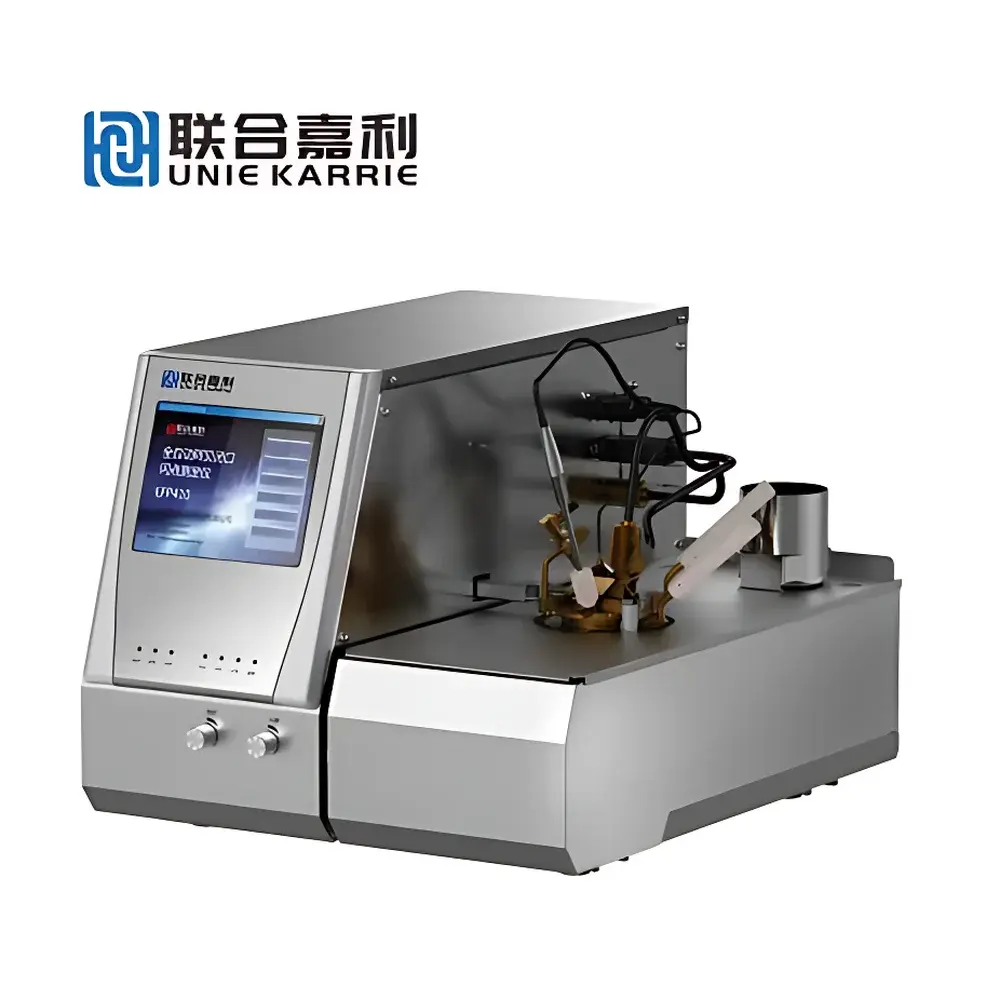
Karrie EFP410 Automatic Abel Closed-Cup Flash Point Tester
| Brand | Karrie |
|---|---|
| Model | EFP410-1 |
| Standard Compliance | ASTM D3278, ISO 13736, GB/T 21789 |
| Test Method | Abel Closed-Cup |
| Temperature Range | −30 °C to 100 °C (with external chiller below 35 °C) |
| Temperature Sensor | PT100 Platinum Resistance Thermometer |
| Display | 6.4″ TFT LCD (24-bit color, touch-enabled) |
| Heating Rate | 1.0 °C/min (programmable & real-time monitored) |
| Temperature Resolution | 0.1 °C |
| Stirring Speed | 0.5 r/s (30 r/min) |
| Ignition Options | Electronic spark or gas flame (user-selectable, metrologically equivalent) |
| Cooling | Integrated compressor-based recirculating chiller (−20 °C to +40 °C output range) |
| Power | AC 220 V ±10%, 50 Hz |
| Total System Power Consumption | ≤1850 W (main unit ≤650 W, chiller ≤1200 W) |
| Net Weight | 25 kg |
| Operating Environment | 10–40 °C, RH ≤85% |
| Data Interfaces | RS-232, USB 2.0, RJ-45 Ethernet, LPT parallel port |
| OS | Windows CE 5.0 (embedded, virus-resilient file system) |
| Data Storage | ≥10,000 test records with time/date, sample ID, operator ID, atmospheric pressure correction, and full thermal profile logging |
Overview
The Karrie EFP410 Automatic Abel Closed-Cup Flash Point Tester is an engineered solution for precise, repeatable flash point determination of petroleum products, solvents, lubricants, and other volatile liquids in accordance with internationally recognized closed-cup methodologies. Based on the fundamental principle of detecting the lowest temperature at which vapors above a contained liquid sample ignite momentarily when exposed to a standardized ignition source under controlled atmospheric conditions, the EFP410 implements the Abel closed-cup test protocol as defined in ISO 13736, ASTM D3278 (equivalent method), and Chinese national standard GB/T 21789. Its operational range spans −30 °C to 100 °C—extending low-temperature capability via integrated compressor-driven cooling, enabling reliable testing of light distillates, aviation fuels, and bio-based solvents without external cryogenic support. The instrument employs a dual-control architecture: a dedicated microcontroller governs real-time thermal regulation and sensor acquisition, while a rugged industrial PC (256 MB RAM, 4 GB flash storage) manages user interface, data integrity, and system diagnostics—ensuring metrological traceability and long-term stability in QC laboratories and refinery process control environments.
Key Features
- Dual ignition system: Electronically generated spark and adjustable gas flame ignition—both calibrated to deliver identical ignition energy per ASTM/ISO requirements; user-selectable without impact on result reproducibility.
- Gold-plated test cup and lid assembly: Enhances thermal uniformity, corrosion resistance, and long-term dimensional stability—critical for maintaining cup geometry compliance per ISO 13736 Annex A.
- Modular sensor architecture: Independent mounting of the Abel cup lid, flash detection sensor, and PT100 temperature probe enables field-replaceable component maintenance—reducing downtime and supporting GLP-mandated calibration traceability.
- Real-time thermal profiling: On-screen display of actual heating rate (digital readout + dynamic curve plot), continuously verified against the mandated 1.0 °C/min ramp—automatically pausing and resuming to correct deviations.
- Comprehensive self-diagnostic suite: Automated startup verification of flash sensor response, Pt100 linearity, electronic igniter function, stirrer motor operation, thermal fuse status, and chiller circulation—reporting failures with descriptive text and audible alert.
- Triple-stage thermal safety: Programmable warning threshold (pre-alarm), hard stop at user-defined safety limit, and absolute cutoff at 400 °C with forced-air cooling activation—meeting IEC 61010-1 requirements for laboratory electrical equipment.
Sample Compatibility & Compliance
The EFP410 accommodates samples conforming to ISO 13736’s viscosity and volatility constraints—including gasoline, kerosene, diesel, transformer oil, hydraulic fluids, and halogenated solvents—with volume requirements of 50 mL per test. It supports automatic barometric pressure correction (via optional external sensor or manual entry), essential for reporting results at standard atmospheric pressure (101.3 kPa) per ASTM D3278 Section 8. The system meets design and performance criteria outlined in ISO/IEC 17025:2017 for testing laboratories, and its embedded Windows CE 5.0 platform—lacking network stack vulnerabilities and running a read-only filesystem—facilitates alignment with FDA 21 CFR Part 11 requirements when paired with audit-trail-enabled LIMS integration via RS-232 or Ethernet.
Software & Data Management
The instrument’s native software provides full bilingual UI (English default, Chinese optional), compliant with ISO/IEC 17025 documentation requirements. All test parameters—including start/end time, ambient pressure, observed flash temperature, heating rate deviation, and operator ID—are timestamped and stored in a non-volatile database capable of retaining >10,000 records. Data export is supported via USB mass storage mode (CSV/Excel-compatible), direct Ethernet transfer to LIMS using TCP/IP protocols, or hardcopy output through IEEE 1284-compliant laser printers. Firmware updates are performed securely over USB without requiring OS-level access—preserving system integrity during regulatory audits.
Applications
- Refinery quality assurance: Monitoring flash point consistency across crude cuts, naphtha fractions, and finished fuels to ensure compliance with API RP 2510 and EN 590 specifications.
- Aviation fuel certification: Verifying Jet A-1 and JP-8 flash points per ASTM D1655 Annex A, where deviation beyond −38 °C triggers batch rejection.
- Lubricant formulation R&D: Assessing volatility limits of base oils and additive packages under controlled low-temperature conditions.
- Regulatory submissions: Generating auditable reports for EPA, ECHA REACH dossiers, and transport classification (UN GHS Category 2/3 flammables).
- Third-party testing labs: Supporting ISO/IEC 17025 accreditation with full traceability of calibration certificates, environmental logs, and preventive maintenance records.
FAQ
Does the EFP410 comply with ASTM D3278?
Yes—the instrument implements the Abel closed-cup procedure referenced in Annex A of ASTM D3278 and is validated for use with materials falling within the scope of that standard.
Can test data be exported directly to a LIMS?
Yes—via RS-232 serial communication (ASCII protocol), USB-host file transfer, or TCP/IP Ethernet connection using configurable delimiter formats.
Is external refrigeration required for tests below 35 °C?
No—the integrated compressor chiller maintains stable bath temperatures from −20 °C to +40 °C, eliminating dependency on external cold water sources.
How is temperature calibration verified?
The PT100 sensor is factory-calibrated against NIST-traceable standards; users may perform field verification using certified reference thermometers per ISO 17025 Section 6.6.
What safety certifications does the instrument hold?
It conforms to IEC 61010-1:2010 for electrical safety and includes CE marking for EMC Directive 2014/30/EU and Low Voltage Directive 2014/35/EU.



