
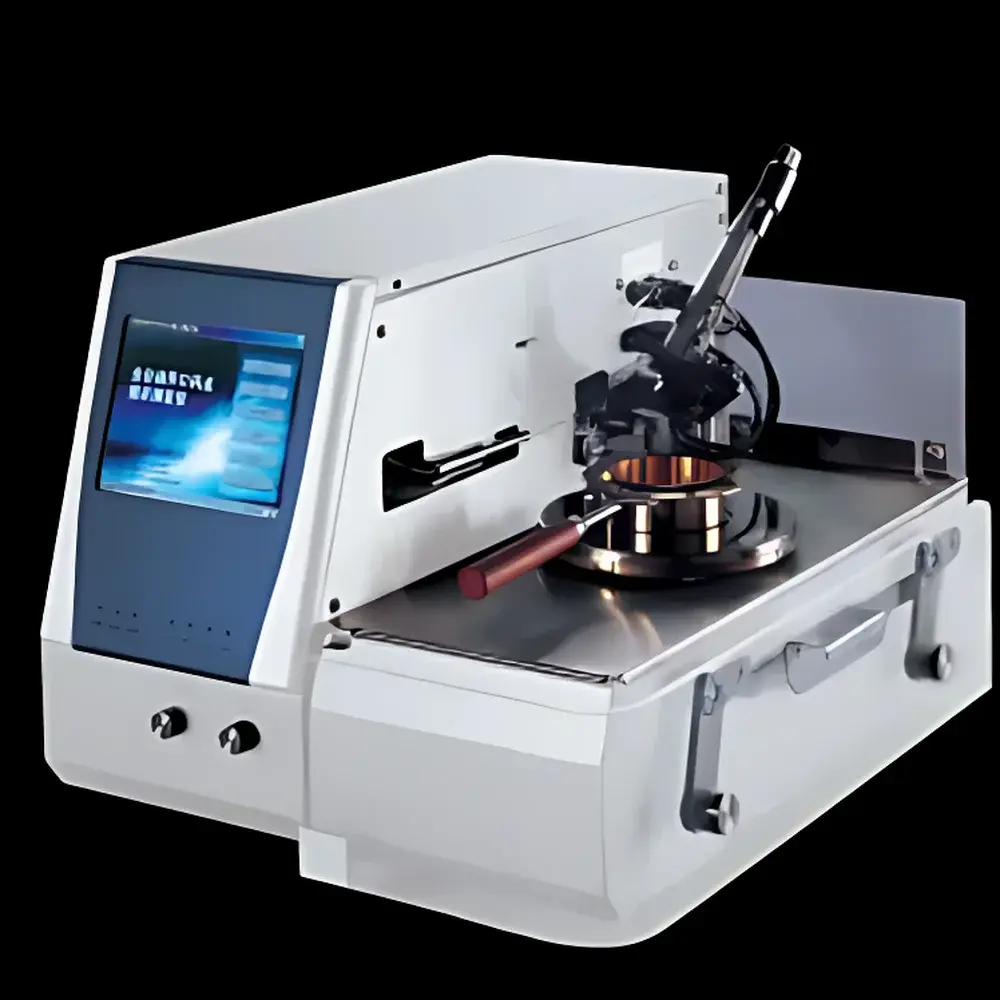
Karrie EFP210-B Automatic Cleveland Open-Cup Flash Point Tester
| Brand | Karrie |
|---|---|
| Model | EFP210-B |
| Test Method | Cleveland Open-Cup (COC) |
| Automation Level | Fully Automatic |
| Temperature Range | 79–400 °C |
| Ignition Mode | Electronic Ignition |
| Compliance Standards | GB/T 3536, ISO 2592, ASTM D92 |
| Power Supply | AC 220 V, 50 Hz |
| Total Power Consumption | 1500 W |
| Heating Power | 1300 W |
| Operating Ambient | 0–40 °C |
| Storage Temperature | −20–50 °C |
| Display | 6.4″ TFT LCD, 640×480 resolution |
| Dimensions (L×W×H) | 478×376×322 mm |
| Weight | 32 kg |
| Safety Thresholds | Pre-Alarm at EFP+10 °C, Alarm & Continue at EFP+20 °C, Auto-Shutdown & Forced Cooling at 400 °C |
| Data Storage | >10,000 test records with time/oil-sample/operator indexing |
| Interface Options | RS-232, USB 2.0, RJ-45 (LAN), LPT (parallel printer port) |
| Control Architecture | Dual-core — Industrial PC (Windows 10 Embedded, 256 MB RAM, 2 GB SSD) + Real-time MCU for thermal control and sensor acquisition |
| Sensor Type | Pt100 platinum RTD (German-sourced) |
| Cup Material | Gold-plated brass test cup |
| Self-Diagnostic Functions | Flash sensor, oil temperature sensor, electronic igniter, thermal fuse, cooling/heating actuation, ignition sweep motion |
| Fire Suppression | Motorized flame-quenching lid activated post-test |
| Configurable Protocols | Six preloaded ASTM/ISO/GB methods + user-defined method editor |
Overview
The Karrie EFP210-B Automatic Cleveland Open-Cup Flash Point Tester is an industrial-grade analytical instrument engineered for precise determination of flash point and fire point of petroleum products, lubricants, biodiesel blends, and other combustible liquids according to the Cleveland Open-Cup (COC) method. It operates on the fundamental principle that flash point is the lowest temperature at which vapors above a heated sample ignite momentarily when exposed to a standardized ignition source under controlled atmospheric conditions. The EFP210-B implements ASTM D92, ISO 2592, and GB/T 3536 protocols with full procedural fidelity—ensuring regulatory alignment for quality control laboratories in refineries, independent testing facilities, and R&D centers serving the global energy sector. Its dual-control architecture separates real-time thermal regulation (handled by a dedicated microcontroller unit) from high-level system orchestration (managed by an embedded industrial PC), delivering both measurement stability and operational robustness.
Key Features
- Dual-control hardware architecture: A real-time MCU governs heating ramp profiles, Pt100 temperature acquisition, and ignition timing; an industrial PC (Windows 10 Embedded, 256 MB RAM, 2 GB SSD) manages data logging, UI rendering, and network communication—eliminating OS-level latency and enhancing long-term reliability.
- True-color 6.4″ TFT LCD touchscreen interface with 640×480 resolution, supplemented by optional mouse and keyboard support for lab environments requiring high-throughput batch operation or accessibility compliance.
- Fully electronic ignition system with motorized sweep mechanism—no external gas supply required, reducing infrastructure dependencies and eliminating calibration drift associated with pilot flames.
- Comprehensive self-diagnostic suite: Automated verification of flash sensor response, Pt100 linearity, igniter continuity, thermal fuse integrity, cooling fan activation, and mechanical lid positioning—each failure mode triggers audible alarm and on-screen diagnostic message (e.g., “Igniter circuit open – check connection”)
- Multi-tiered thermal safety protocol: Pre-alarm at EFP+10 °C, sustained operation with visual/audible alert at EFP+20 °C, and immediate shutdown with forced-air cooling initiation upon reaching 400 °C or exceeding absolute safety threshold.
- Modular sensor design: Separately replaceable flash sensor and Pt100 temperature probe—enabling field maintenance without recalibration or downtime.
- Gold-plated brass test cup compliant with ASTM D92 dimensional tolerances and surface emissivity requirements, ensuring reproducible vapor formation kinetics across repeated analyses.
Sample Compatibility & Compliance
The EFP210-B accommodates viscous and low-volatility samples including residual fuel oils (e.g., No. 6 fuel oil), bitumen emulsions, transformer oils, hydraulic fluids, and bio-derived hydrocarbons. It meets the physical and procedural specifications defined in ASTM D92 (Standard Test Method for Flash and Fire Points by Cleveland Open Cup Tester), ISO 2592 (Petroleum products — Determination of flash and fire points — Cleveland open cup method), and GB/T 3536 (Petroleum products — Determination of flash and fire points — Cleveland open cup method). Instrument validation supports GLP-compliant audit trails when integrated into LIMS via RS-232 or TCP/IP. All firmware and software modules are designed to meet basic traceability requirements per ISO/IEC 17025:2017 Clause 7.7 (Ensuring validity of results) and align with FDA 21 CFR Part 11 principles for electronic records where local regulatory frameworks require signature-capable data export.
Software & Data Management
The embedded Windows 10 Embedded OS hosts a native application with bilingual UI (English default; Chinese toggle available). Data handling includes automatic atmospheric pressure correction using integrated barometric compensation algorithms, enabling accurate flash point reporting across elevation gradients. Over 10,000 test records are retained locally with metadata fields: date/time stamp, operator ID, sample ID, method ID, ambient pressure, observed flash/fire point, and pass/fail status against specification limits. Search functionality supports Boolean combinations (e.g., “Transformer Oil AND June 2024 AND Operator A”). Export options include CSV (via USB), PDF report generation (direct to LPT-connected laser printer), and XML-formatted datasets for LIMS ingestion. Firmware updates are performed securely via USB drive without network exposure—consistent with cybersecurity best practices for standalone lab instrumentation.
Applications
This instrument serves critical roles in refinery QC labs verifying crude distillate fractions prior to blending; in power generation facilities monitoring insulating oil degradation per IEEE C57.106; in marine fuel testing per ISO 8217 Annex B; and in regulatory compliance workflows for EPA Tier II reporting and EU REACH substance classification. Its programmable method editor allows adaptation to proprietary internal standards—for example, accelerated ramp rates for screening unknown feedstocks or modified dwell times for high-boiling esters. Routine use cases include incoming inspection of base oils, in-process monitoring of asphalt cutback formulations, and forensic analysis of contaminated lubricants in tribology investigations.
FAQ
Does the EFP210-B comply with ASTM D92 revision requirements?
Yes—the instrument implements all mandatory procedural elements of ASTM D92-23, including cup geometry, thermometer placement, heating rate control (5–6 °C/min up to 250 °C; 3–4 °C/min thereafter), and ignition sweep frequency (every 2 °C after initial approach).
Can the device operate unattended overnight?
It supports scheduled start-up and auto-shutdown but requires manual sample loading and cup cleaning between runs; continuous unattended operation is not recommended per ASTM D92 Section 7.2.2.
Is remote monitoring possible via Ethernet?
Yes—RJ-45 port enables TCP/IP connectivity for status polling and log retrieval using Modbus TCP or vendor-specific API; however, real-time video streaming or interactive remote control is not supported.
What calibration documentation is provided?
Each unit ships with NIST-traceable Pt100 calibration certificate (valid for 12 months), flash sensor linearity report, and factory verification against certified reference materials (CRM) per ISO Guide 34.
How often must the gold-plated cup be recoated?
Under normal usage (≤10 tests/day), recoating is required every 18–24 months; visual inspection for tarnish or pitting should precede each shift as part of daily verification per ISO/IEC 17025 Clause 6.4.1.




