
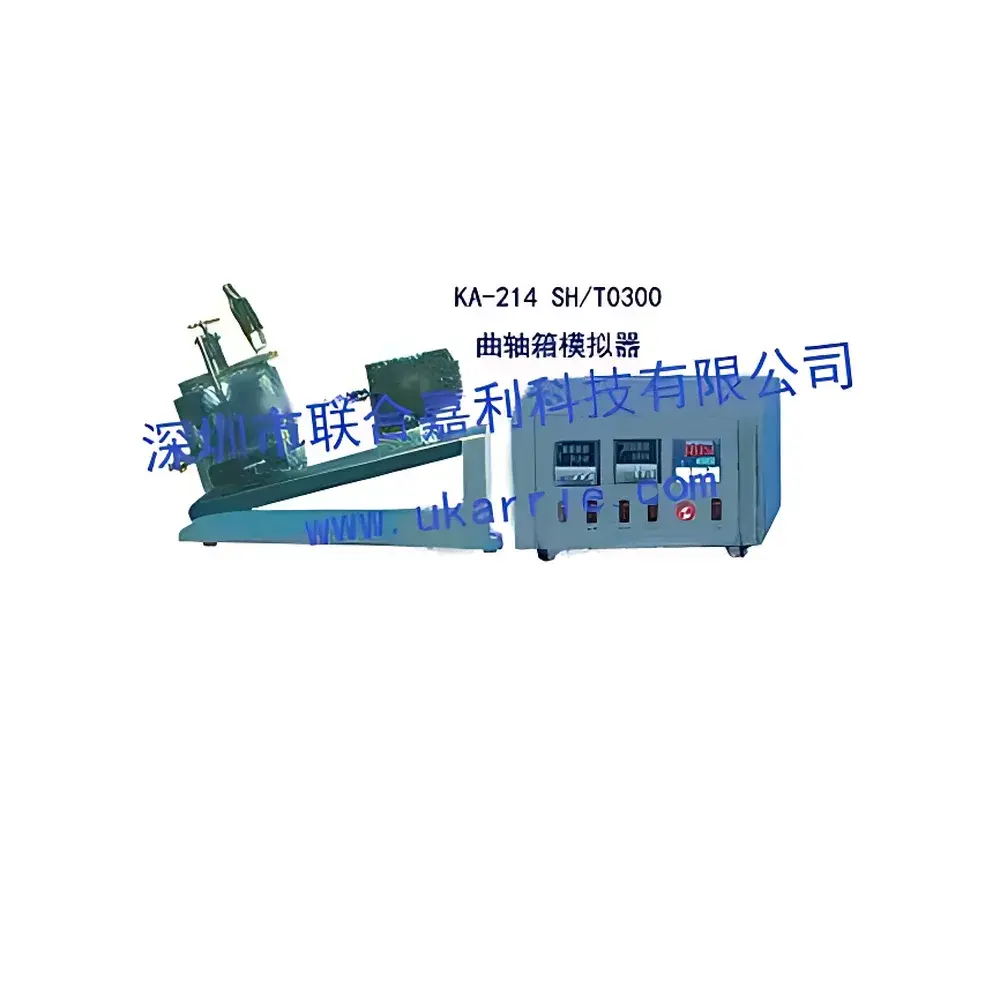
KA-214 Crankcase Simulator
| Brand | KARRIE |
|---|---|
| Origin | Shenzhen, China |
| Model | KA-214 |
| Detection Type | Total Sulfur Analysis |
| Complies With | SH/T 0300 |
| Oil Bath Temperature Setpoint | 150 °C |
| Oil Bath Temperature Stability | ±2 °C |
| Heated Aluminum Plate Setpoints | 310 °C, 320 °C, 330 °C |
| Aluminum Plate Temperature Stability | ±2 °C |
| Power Supply | AC 220 V, 50 Hz |
| Construction | Imported Sandblasted Stainless Steel Panels |
Overview
The KA-214 Crankcase Simulator is a purpose-built thermal oxidation stability testing instrument engineered for the evaluation of additive packages and formulated internal combustion engine oils under controlled high-temperature stress conditions. Designed in accordance with the Chinese petroleum industry standard SH/T 0300—“Method for Determining the Thermal Oxidation Stability of Internal Combustion Engine Oils Using a Crankcase Simulator”—this apparatus replicates accelerated aging environments typical of engine sump conditions, enabling quantitative assessment of oil degradation behavior, sludge formation tendency, and antioxidant depletion kinetics. The system operates on a dual-zone heating architecture: a precision-controlled oil bath (150 °C) simulates crankcase bulk oil temperature, while independently regulated heated aluminum plates (310–330 °C) emulate localized hot-spot surfaces such as piston rings and cylinder liners. This configuration ensures reproducible thermal gradients critical to mimicking real-world oxidative stress pathways in lubricant systems.
Key Features
- Dual independent thermal control zones: oil bath (150 °C) and aluminum heating plates (310 °C / 320 °C / 330 °C), each equipped with digital PID temperature controllers and ±2 °C stability tolerance.
- Integrated intelligent timing system featuring programmable time relays, digital elapsed-time display, audible end-of-test alarm, and automatic power cutoff upon cycle completion—ensuring operator safety and protocol adherence.
- Corrosion-resistant construction using imported sandblasted stainless steel panels, providing long-term durability in laboratory environments exposed to hydrocarbon vapors and thermal cycling.
- Low-power consumption design optimized for continuous operation during extended oxidation tests (typically 16–168 hours), minimizing energy overhead without compromising thermal uniformity.
- Modular mechanical layout facilitating routine maintenance, sample insertion/extraction, and visual monitoring of test specimens during operation.
Sample Compatibility & Compliance
The KA-214 accommodates standard SH/T 0300-compliant test vessels—including glass reaction tubes and metal sample holders—and supports both neat base oils and fully formulated engine oils containing ZDDP, phenolic, and amine-based antioxidants. Its operational parameters align with internationally recognized lubricant evaluation frameworks, including ASTM D2272 (Rotating Pressure Vessel Oxidation Test) and ISO 13702 (Petroleum products — Determination of oxidation stability). While not certified for regulatory submission under USP or FDA 21 CFR Part 11, the instrument’s deterministic thermal profiles and repeatable timing logic support GLP-aligned laboratory practices when paired with documented SOPs and manual audit trails.
Software & Data Management
The KA-214 operates via embedded hardware controls—no proprietary software interface is included. Temperature setpoints, dwell times, and alarm thresholds are configured directly via front-panel digital displays and rotary selectors. All operational parameters are manually recorded by the user; data integrity relies on standardized lab notebooks or external LIMS integration. For laboratories requiring electronic recordkeeping, the unit’s analog-compatible outputs (optional 4–20 mA or 0–10 V signal taps) permit connection to third-party data loggers compliant with ISO/IEC 17025 traceability requirements.
Applications
- Evaluation of antioxidant package efficacy in passenger car motor oils (PCMO), heavy-duty diesel engine oils (HDEO), and natural gas engine lubricants.
- Screening of base oil oxidation resistance across Group I–V classifications under simulated sump hot-spot conditions.
- Supporting OEM lubricant qualification programs where SH/T 0300 compliance is mandated for aftermarket product registration in China and Southeast Asian markets.
- Research into deposit-forming mechanisms, volatile loss kinetics, and acid number evolution during extended thermal exposure.
- Quality assurance testing for sulfur-containing additives (e.g., sulfonates, thiophosphates) where total sulfur content correlates with oxidative performance.
FAQ
Does the KA-214 provide automated data logging or USB export capability?
No. The instrument uses standalone digital controllers without built-in memory or communication ports. Data capture requires manual entry or external datalogger integration.
Is the KA-214 suitable for testing bio-based or low-SAPS engine oils?
Yes—provided samples meet SH/T 0300 physical form and volume specifications. Thermal oxidation behavior of low-ash formulations may require extended observation periods due to altered degradation onset temperatures.
Can the aluminum plate temperature be set to values outside the factory-defined 310/320/330 °C increments?
No. The heating plate controller is fixed to these three discrete setpoints per SH/T 0300 protocol requirements.
What maintenance intervals are recommended for sustained accuracy?
Calibration of temperature sensors is advised every 6 months or after 200 operational hours, using NIST-traceable reference thermometers. Visual inspection of stainless steel surfaces and electrical connections should occur prior to each test series.
Does the instrument include provisions for exhaust gas or volatile condensate collection?
No. The KA-214 is a closed-system thermal simulator; off-gas management and condensate recovery must be implemented externally per laboratory safety protocols.
Related Products






