
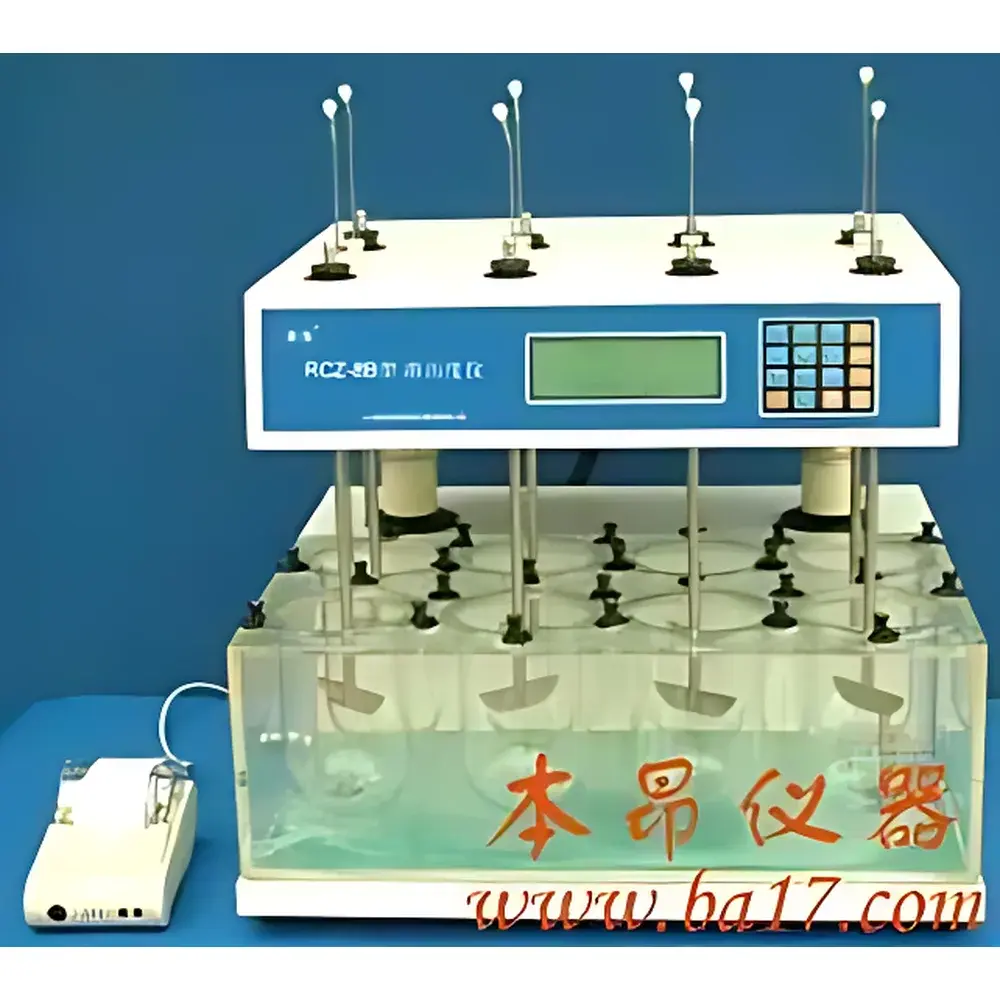
RCZ-8B Eight-Vessel Intelligent Pharmaceutical Dissolution Tester
| Origin | Shanghai, China |
|---|---|
| Manufacturer Type | Authorized Distributor |
| Origin Category | Domestic (PRC) |
| Model | RCZ-8B |
| Price | USD 5,500 (FOB Shanghai) |
| Power Supply | AC 220 V ±10%, 50 Hz, 1000 W |
| Operating Environment | 5–40 °C, ≤80% RH |
| Stirring Shaft Runout | ≤0.5 mm |
| Basket Runout | ≤1.0 mm |
| Speed Range | 25–250 rpm |
| Speed Resolution | 1 rpm |
| Speed Accuracy | ≤±1% |
| Temperature Range | Ambient (≥10 °C) to 45 °C |
| Temperature Resolution | 0.01 °C |
| Temperature Uniformity & Stability | ≤±0.05 °C (PID-controlled water bath with integrated PT1000 sensor) |
| Timing Capacity | 0–5999 min (cumulative & countdown modes) |
| Sampling Cycles | Up to 10 programmable intervals |
| Data Export | Thermal printer output + USB flash drive storage |
Overview
The RCZ-8B Eight-Vessel Intelligent Pharmaceutical Dissolution Tester is a GMP-aligned, benchtop dissolution apparatus engineered for compliance with the United States Pharmacopeia (USP) General Chapter <711>, European Pharmacopoeia (Ph. Eur.) 2.9.3, and Chinese Pharmacopoeia (ChP) 2020 Edition General Monograph 0931. It implements the paddle (USP Apparatus 2) and basket (USP Apparatus 1) dissolution methods under precisely controlled hydrodynamic and thermal conditions. The system utilizes a dual-sensor PID temperature regulation architecture with an embedded PT1000 resistance thermometer, enabling rapid thermal equilibration and exceptional bath uniformity (≤±0.05 °C) across all eight vessels. Its core mechanical design—featuring low-runout shafts (≤0.5 mm for paddles, ≤1.0 mm for baskets), microstepping motor-driven speed control, and vibration-damped base structure—ensures high reproducibility of hydrodynamic profiles essential for method transfer and regulatory submission.
Key Features
- Eight independent dissolution stations supporting simultaneous paddle or basket configurations per USP Apparatus 1 and 2 standards.
- Precision speed control via细分 (microstepping) stepper motor driver: adjustable range 25–250 rpm, resolution 1 rpm, accuracy ≤±1% of setpoint.
- High-fidelity temperature management: digitally regulated water bath (10 °C [minimum ambient] to 45 °C), 0.01 °C resolution, ≤±0.05 °C stability at setpoint.
- Automated sampling needle lift mechanism compatible with ZQY-1 series autosamplers for synchronized, contamination-minimized sample withdrawal.
- Onboard method memory: stores up to 10 pre-programmed dissolution protocols including speed, temperature, timing, and sampling schedules; retains settings after power cycle.
- Comprehensive timing system: supports cumulative runtime (0–5999 min), countdown timers per stage, and up to 10 discrete sampling intervals with individual duration assignment.
- Integrated diagnostics and fail-safe logic: real-time monitoring of motor load, temperature deviation, vessel cover status, and water level; automatic shutdown and fault code display on LCD interface.
- Data integrity support: thermal printer output for immediate hardcopy reporting; USB 2.0 port for encrypted export of time-stamped dissolution profiles (timestamp, rpm, temperature, elapsed time, sampling event markers) to FAT32-formatted USB drives.
Sample Compatibility & Compliance
The RCZ-8B accommodates standard USP-compliant 1000 mL dissolution vessels with interchangeable 12.7 mm diameter paddles or 22.6 mm diameter baskets. Vessel geometry and clearance dimensions adhere strictly to ChP 2020 and USP dimensional tolerances. All wetted parts—including shafts, vessels, and thermowell housings—are constructed from 316L stainless steel and borosilicate glass to ensure chemical inertness during prolonged exposure to acidic, basic, or organic dissolution media (e.g., 0.1 N HCl, pH 4.5 acetate buffer, pH 6.8 phosphate buffer, simulated gastric/intestinal fluids). The instrument meets electromagnetic compatibility (EMC) requirements per IEC 61326-1 and electrical safety standards per IEC 61010-1. It is validated for use in GLP and GMP environments where audit trails, electronic record retention, and operational qualification (OQ) are required.
Software & Data Management
The RCZ-8B operates via an embedded real-time control firmware with a 4.3-inch capacitive touchscreen interface. No external PC is required for basic operation; however, exported USB data files conform to CSV format with ISO 8601 timestamps and column headers traceable to USP-defined parameters (e.g., “Time_min”, “Temp_C”, “RPM”, “Sample_Event”). Files include metadata such as operator ID (manually entered), method name, vessel ID, and calibration date. While the device itself does not implement FDA 21 CFR Part 11 electronic signature functionality, its deterministic logging behavior, immutable timestamping, and absence of post-hoc data editing capability align with ALCOA+ principles (Attributable, Legible, Contemporaneous, Original, Accurate, Complete, Consistent, Enduring, Available). Routine calibration verification—per USP Analytical Instrument Qualification—is supported via built-in speed and temperature validation routines.
Applications
- Quality control release testing of immediate-release (IR), extended-release (ER), and modified-release (MR) solid oral dosage forms (tablets, capsules, pellets).
- Dissolution profile comparison (f1/f2 analysis) for generic drug bioequivalence studies per ICH Q5A(R2) and Q5C guidelines.
- Stability-indicating method development and robustness assessment under varying agitation intensity and medium composition.
- In vitro–in vivo correlation (IVIVC) modeling input generation using multi-timepoint sampling across physiological pH gradients.
- Excipient interaction screening during formulation development, particularly for pH-dependent solubility or polymer-mediated release kinetics.
- Regulatory filing support for ANDA, NDA, and DMF submissions requiring dissolution data compliant with ChP, USP, Ph. Eur., and JP standards.
FAQ
Does the RCZ-8B comply with USP <711> mechanical calibration requirements?
Yes—the system meets USP specifications for rotational speed accuracy (±1%), shaft runout (≤0.5 mm for paddles), basket runout (≤1.0 mm), and temperature uniformity (±0.2 °C across vessels at 37 °C), verified via manufacturer-provided calibration certificates traceable to NIM (National Institute of Metrology, China).
Can the RCZ-8B be integrated into a fully automated dissolution workflow?
Yes—it features TTL-level digital I/O ports and RS-232 serial communication for synchronization with third-party autosamplers (e.g., ZQY-1, SOTAX AT7/AT8) and fraction collectors. Trigger signals align with sampling event timestamps stored in exported data files.
Is temperature calibration performed per USP <724>?
The built-in PT1000 sensor is factory-calibrated against NIM-certified reference thermometers. Users may perform field verification using a calibrated NIST-traceable probe inserted into designated calibration wells adjacent to each vessel—procedures documented in the IQ/OQ protocol supplied with the instrument.
What data security measures are implemented for USB exports?
Files are written in append-only mode with no overwrite capability; filename includes instrument serial number and datestamp. USB storage requires FAT32 formatting and does not support encryption, but file integrity is ensured via CRC-32 checksums generated during write operations.
How often is preventive maintenance recommended?
Biannual inspection of drive belts, shaft couplings, and bath circulation pump filters is advised. Annual recalibration of speed and temperature subsystems is recommended for GMP-regulated laboratories, with documentation aligned to ISO/IEC 17025 internal audit requirements.
Related Products






