
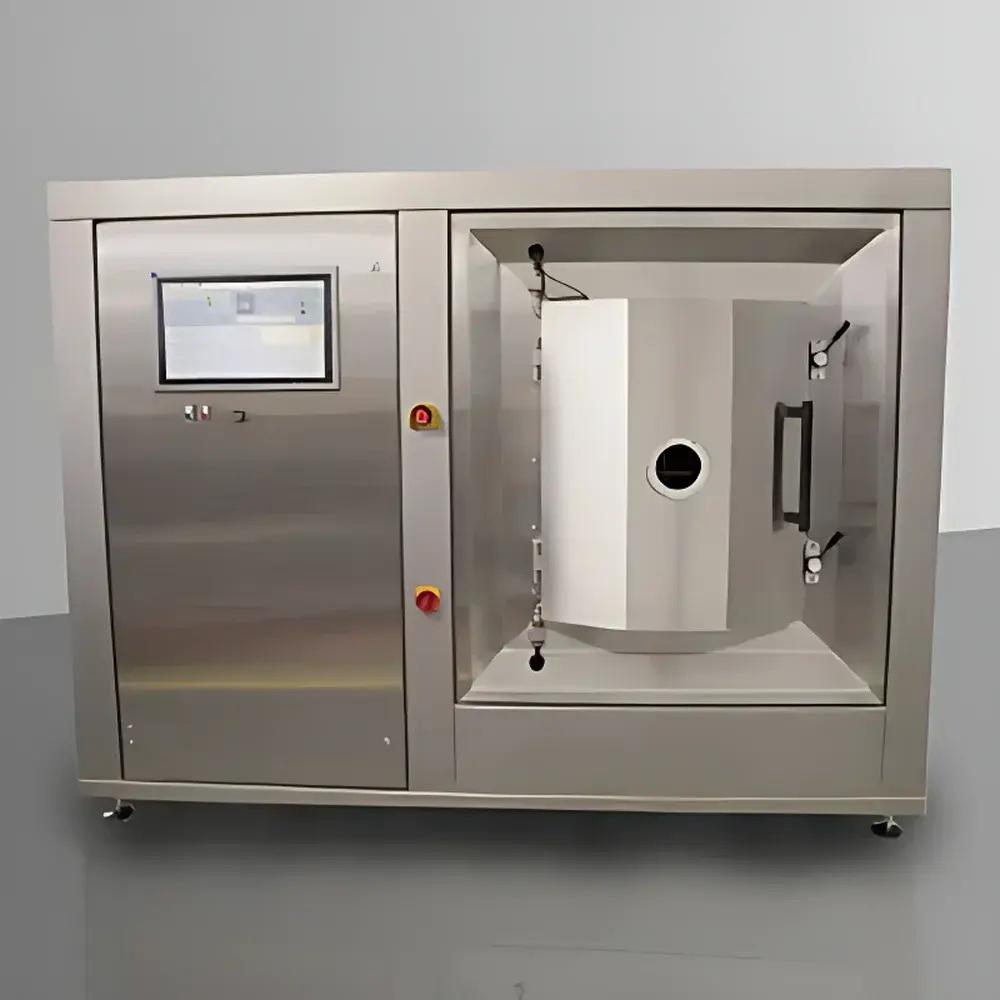
Diener P260 Parylene Coating System
| Brand | Diener |
|---|---|
| Origin | Germany |
| Model | P260 |
| Deposition Materials | Parylene N, C, D, F-VT4, F-AF4 |
| Coating Thickness Range | 0.05–100 µm |
| Chamber Dimensions | Ø640 × H800 mm |
| Carousel Dimensions | Ø560 × H650 mm |
| Carousel Orientation | Vertical |
| Base Pressure | ≤1 × 10⁻³ mbar |
| Cooling Options | Liquid Nitrogen or Mechanical Chiller |
| Power Supply | 400 V / 32 A |
| Compressed Air Requirement | 5–6 bar, oil-free and dry |
| Overall Dimensions (W×D×H) | 2600 × 1000 × 2000 mm |
| Optional Accessories | Silane Vaporizer, Slow Pumping Module, D-Type Process Optimization Heater Jacket, Plasma Pre-Cleaning System, In-situ Thickness Monitor |
Overview
The Diener P260 is a fully integrated, vacuum-based parylene coating system engineered for high-reproducibility conformal thin-film deposition in R&D, quality control, and small-to-medium batch production environments. It operates on the principle of chemical vapor deposition (CVD) via pyrolytic dimer cleavage: solid parylene dimer (e.g., [2.2]paracyclophane) is sublimed, thermally cracked into reactive monomer vapor at ~680 °C, and subsequently polymerized *in situ* onto substrates held at ambient or controlled temperature within a high-vacuum chamber. This gas-phase process enables true molecular-level conformity—uniform coverage over sharp edges, deep trenches, blind vias, and micro-structured surfaces without line-of-sight limitations. The P260 supports all commercially relevant parylene variants—including N, C, D, F-VT4, and F-AF4—each offering differentiated performance in dielectric strength, thermal stability, chemical resistance, and biocompatibility.
Key Features
- Vertical carousel design with Ø560 mm × H650 mm usable volume, optimized for uniform monomer flux distribution and scalable throughput.
- High-integrity vacuum architecture achieving ≤1 × 10⁻³ mbar base pressure, ensuring low contamination and consistent monomer condensation kinetics.
- Dual cooling capability: configurable liquid nitrogen cryo-trap or closed-loop mechanical chiller for precise cold-zone temperature control during monomer condensation.
- Windows-based control system with real-time monitoring of critical process parameters—including sublimation zone temperature, pyrolysis temperature, chamber pressure, and cold-finger temperature—enabling full traceability and repeatable recipe execution.
- Modular hardware expansion support: optional plasma pre-cleaning module (for enhanced adhesion on inert or oxidized surfaces), silane vaporizer (for hybrid parylene-silane hybrid coatings), and in-situ quartz crystal microbalance (QCM) thickness monitor for endpoint detection and layer-thickness verification.
- Compliance-ready architecture: system firmware and data logging support audit trails, user access levels, and electronic signature functionality aligned with FDA 21 CFR Part 11 and ISO 9001/13485 quality management requirements.
Sample Compatibility & Compliance
The P260 accommodates substrates ranging from MEMS devices and PCB assemblies to medical implants, sensors, and microfluidic chips. Its conformal coating capability ensures pinhole-free films starting at ≈0.5 µm thickness—even on substrates with aspect ratios >20:1. Parylene C and N coatings deposited using this system meet USP Class VI biological reactivity standards and are routinely certified per ISO 10993-5 (cytotoxicity), -10 (irritation/sensitization), and -12 (sample preparation). Coating integrity is validated through helium leak testing, water vapor transmission rate (WVTR) measurement (ASTM F1249), and dielectric breakdown testing (IEC 60243-1). All process documentation—including calibration records, preventive maintenance logs, and coating validation reports—can be generated and archived in accordance with GLP and GMP frameworks.
Software & Data Management
The embedded Windows-based control interface provides intuitive recipe management, multi-step process sequencing, and automated parameter ramping. Each run generates a timestamped, tamper-evident log file containing setpoints, actual values, alarms, and operator annotations. Data export is supported in CSV and XML formats for integration into LIMS or MES platforms. Optional software modules include statistical process control (SPC) dashboards, comparative coating thickness mapping (when paired with QCM or ellipsometry), and remote diagnostics via secure TLS-encrypted connection. Audit trail functionality complies with FDA 21 CFR Part 11 requirements, including role-based access control, electronic signatures, and immutable record retention.
Applications
- Electronics: Moisture and corrosion protection for aerospace-grade PCBs, RF components, and flexible hybrid circuits.
- Medical Devices: Biostable encapsulation of neurostimulators, cochlear implants, and drug-eluting stents; barrier layers for implantable biosensors.
- Microsystems: Hermetic sealing of MEMS accelerometers, pressure sensors, and lab-on-chip platforms.
- Optics & Photonics: Anti-reflective and hydrophobic topcoats for laser diodes and fiber-optic connectors (transmission >90% across 400–700 nm).
- Research: Fundamental studies of ultra-thin polymer film growth kinetics, interfacial adhesion mechanisms, and low-permeability barrier physics.
FAQ
What parylene types can be processed on the P260?
The system supports N, C, D, F-VT4, and F-AF4 parylenes via interchangeable dimer feed sources and optimized thermal profiles.
Is plasma pre-treatment integrated or optional?
Plasma cleaning is available as an optional add-on module compatible with both atmospheric and low-pressure configurations.
How is coating thickness controlled and verified?
Thickness is primarily controlled by dimer mass, deposition time, and substrate temperature; real-time QCM monitoring and post-deposition ellipsometry or profilometry are recommended for metrological validation.
Does the P260 meet cleanroom compatibility requirements?
Yes—the system features HEPA-filtered purge lines, non-shedding internal materials, and Class 100-compatible external finishes; it can be installed in ISO Class 5 or better environments.
Can the system be qualified under GMP for medical device manufacturing?
Yes—Diener provides IQ/OQ documentation templates, calibration certificates, and validation support packages aligned with Annex 15 and ISO 13485 requirements.





