
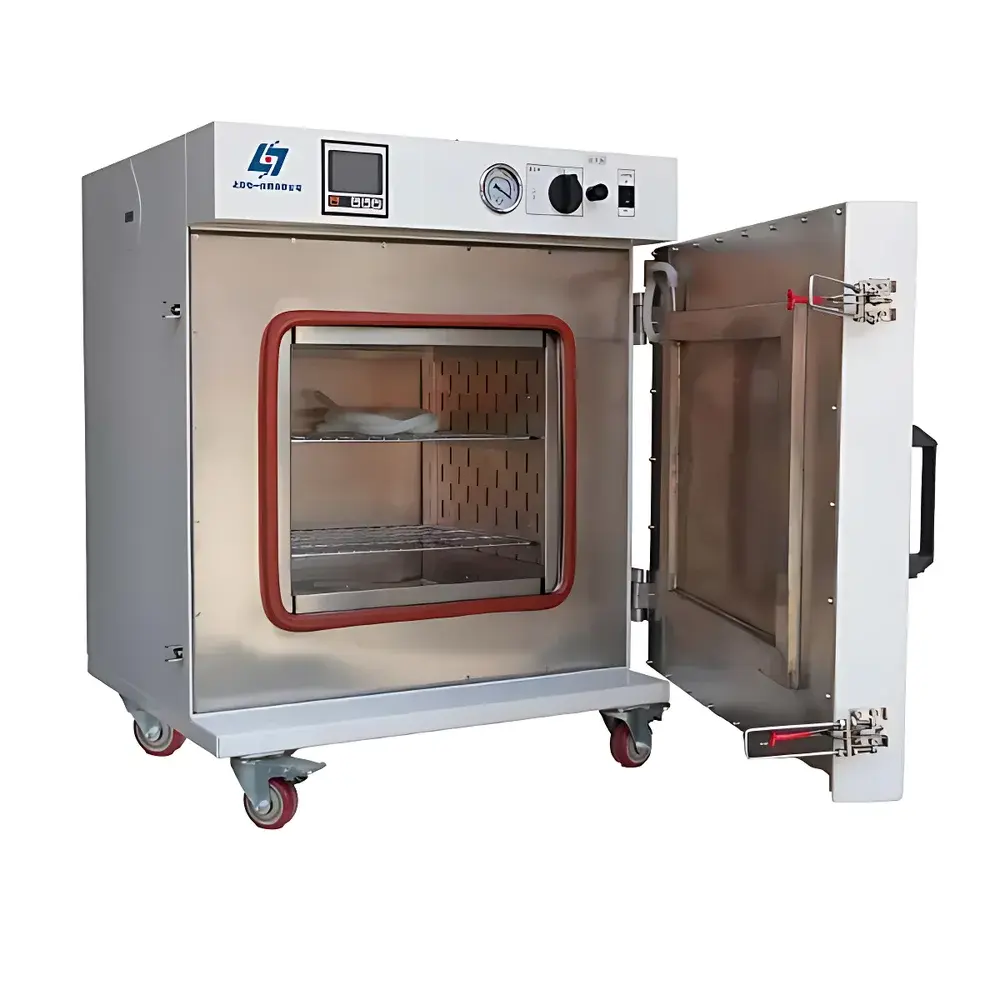
Shanghai Youyi GZF-6090B High-Temperature Vacuum Drying Oven
| Brand | Shanghai Youyi (SHYY) |
|---|---|
| Origin | Shanghai, China |
| Manufacturer Type | Direct Manufacturer |
| Instrument Type | Vacuum Drying Oven |
| Temperature Range | RT+10°C to 500°C |
| Temperature Uniformity | ±1°C |
| Chamber Dimensions | 450 × 450 × 450 mm (L×W×H) |
| External Dimensions | 810 × 765 × 1010 mm (L×W×H) |
| Temperature Resolution | 0.1°C |
| Chamber Material | 304 Stainless Steel |
| Heating Method | Electric Resistance Heating |
| Ultimate Vacuum Level | ≤133 Pa |
| Display | 4.3-inch LCD with Menu-Driven Interface |
| Control System | PID-Based Microprocessor Controller with Power Failure Recovery & Parameter Memory |
| Optional Features | Programmable Temperature Profile (5 segments), Digital Vacuum Regulation, Inert Gas Inlet Valve with Flowmeter, Gas-Liquid Separator, Vacuum Drying Vessel, Vacuum Pumps (2 L/s or 4 L/s) |
Overview
The Shanghai Youyi GZF-6090B High-Temperature Vacuum Drying Oven is an engineered solution for thermal processing under controlled low-pressure and inert atmospheres. Operating on the principle of vacuum-assisted thermal desorption, it reduces the boiling point of volatile solvents and moisture—enabling rapid, uniform drying of thermally sensitive, oxidation-prone, or structurally complex samples without degradation. With a maximum operating temperature of 500°C and ultimate vacuum capability down to ≤133 Pa, the unit supports applications requiring both high-temperature stability and oxygen-free environments—such as solvent removal from catalysts, pre-baking of ceramic substrates, residual moisture elimination in electronic components, and sterilization of heat-stable glassware. Its robust 304 stainless steel chamber, precision PID temperature regulation, and natural convection design ensure reproducible thermal profiles across the full 90 L working volume.
Key Features
- High-temperature capability up to 500°C (GZF-B series), validated for continuous operation at ≥450°C with thermal stability maintained within ±1°C.
- Sealed chamber constructed entirely from electropolished 304 stainless steel—resistant to oxidation, corrosion, and outgassing at elevated temperatures.
- Integrated silicone door gasket with adjustable compression mechanism ensures long-term vacuum integrity and repeatable sealing performance.
- Microprocessor-based PID controller with 0.1°C temperature resolution, real-time data logging, and automatic recovery after power interruption.
- 4.3-inch backlit LCD interface supporting multi-parameter display (setpoint, actual temperature, vacuum level, timer status) and intuitive menu navigation.
- Configurable safety architecture including independent over-temperature cut-off, door-open interlock, and audible/visual alarm activation upon deviation from set parameters.
- Optimized thermal efficiency via aluminum alloy heating plates—engineered for rapid heat transfer and minimal thermal inertia.
Sample Compatibility & Compliance
The GZF-6090B accommodates a broad range of sample formats: powders (e.g., metal oxides, pharmaceutical intermediates), granular materials (ceramic precursors, battery cathode composites), porous assemblies (aerogels, sintered filters), and glass/metal containers requiring dry-heat sterilization. Its vacuum environment eliminates oxidative pathways during heating—critical for maintaining stoichiometric integrity in air-sensitive compounds (e.g., Li-ion battery cathodes, organometallics). The system complies with general laboratory safety standards for Class II vacuum equipment (IEC 61010-1) and supports GLP/GMP-aligned workflows through configurable audit trails (when paired with optional programmable controller). While not certified to ISO 17025 or ASTM E2041 directly, its temperature uniformity and repeatability meet the technical requirements referenced in ASTM D1654 (coating drying evaluation) and USP (dry-heat sterilization validation protocols).
Software & Data Management
The standard control system provides local parameter storage (up to 10 user-defined programs), cycle logging (start time, duration, max temperature reached, vacuum hold time), and timestamped event records (alarms, door openings, power resumption). Optional upgrades include RS485 Modbus RTU communication for integration into centralized lab monitoring systems, and a 5-segment programmable controller enabling ramp-soak-hold sequences—for example: 60°C/2h → 120°C/1h → 250°C/3h → 400°C/2h → cool under N₂ purge. All digital vacuum regulation modules support pressure-setpoint tracking with automatic inert gas bleed control—ensuring stable partial-pressure conditions during extended thermal cycles. Data export is supported via USB flash drive (CSV format), facilitating traceability for quality documentation per FDA 21 CFR Part 11 when used with appropriate access controls and electronic signature configuration.
Applications
- Drying of nanomaterials and catalysts where surface oxidation must be avoided during thermal treatment.
- Pre-conditioning of moisture-sensitive electronic packaging substrates prior to die-attach or wire bonding.
- Residual solvent removal from polymer films and composite laminates without inducing blistering or delamination.
- Thermal stabilization of lithium transition metal oxides (e.g., NMC, LFP) under argon atmosphere before electrode slurry preparation.
- Dry-heat sterilization of borosilicate glass vials, pipette tips, and stainless-steel tools in compliance with ISO 15883-1 Annex C guidelines.
- Accelerated aging studies of sealants and encapsulants under controlled thermal-vacuum stress conditions.
FAQ
What is the maximum allowable vacuum level for continuous operation at 500°C?
The chamber maintains ≤133 Pa at all temperatures up to 500°C; however, sustained operation above 450°C requires periodic verification of gasket integrity and pump oil condition (if external pump is used).
Can the oven be purged with inert gas during heating cycles?
Yes—optional inert gas inlet valves with calibrated flowmeters (0–10 L/min range) allow continuous or pulsed nitrogen/argon purging to maintain oxygen levels below 10 ppm.
Is the temperature uniformity verified across the entire 90 L chamber volume?
Per internal validation protocol, temperature deviation remains within ±1.5°C across nine defined points (center + eight corners) at 300°C and 500°C steady-state conditions.
Does the system support remote monitoring or integration with LIMS?
With the optional RS485 interface module, real-time temperature and vacuum data can be streamed to SCADA or LIMS platforms using standard Modbus register mapping.
What maintenance is required to sustain vacuum performance over time?
Routine checks include gasket cleaning every 50 operational hours, vacuum gauge calibration annually, and replacement of desiccant in the gas-liquid separator every 6 months under continuous use.



