
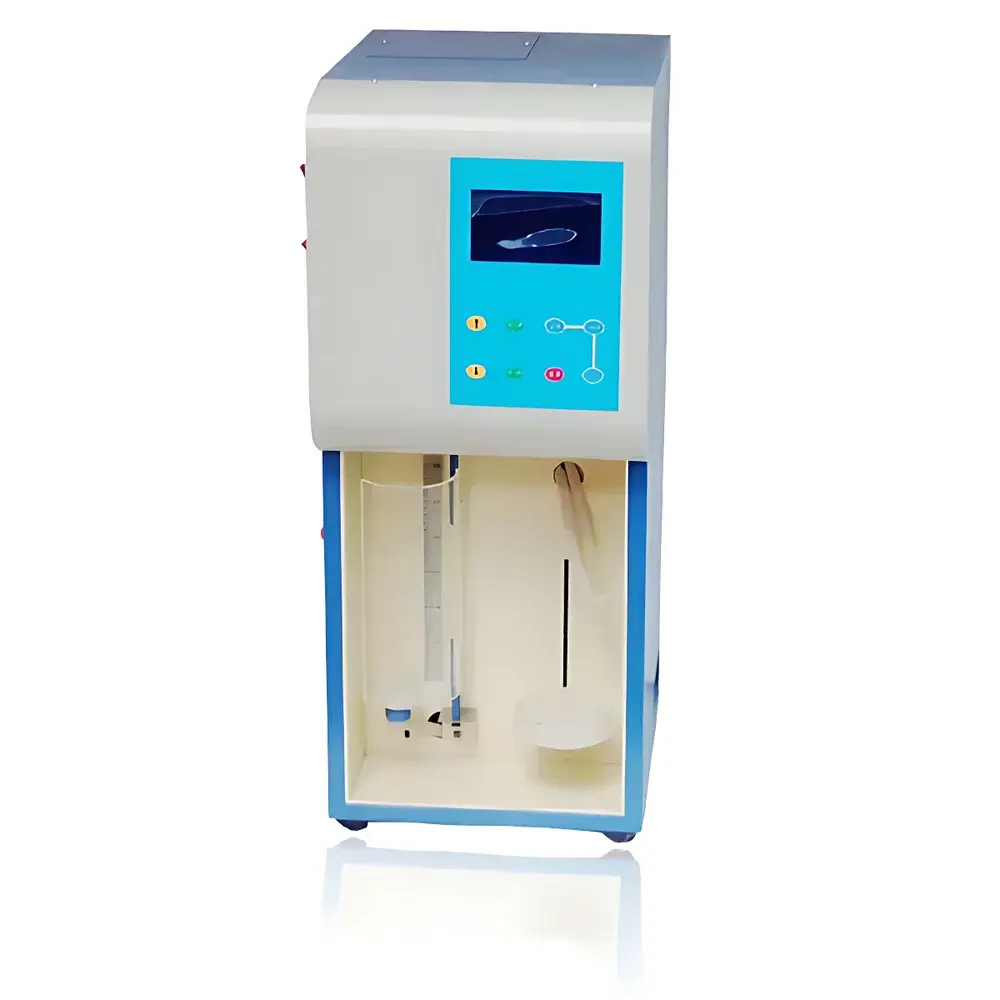
BenAng KA-1 Fully Automated Kjeldahl Nitrogen Determinator
| Brand | BenAng |
|---|---|
| Origin | Shanghai, China |
| Manufacturer Type | Authorized Distributor |
| Country of Origin | China |
| Model | KA-1 |
| Instrument Type | Kjeldahl Nitrogen Determinator |
| Nitrogen Determination Range | 0.1–200 mg |
| Distillation Time | <5 min per sample |
| Repeatability | <±1% RSD |
| Sample Weight Capacity | ≤5 g (solid) or ≤15 mL (liquid) per run |
| Nitrogen Recovery Rate | 100±1% |
| Power Consumption | 800 W |
| Dimensions (L×W×H) | 380×400×820 mm |
Overview
The BenAng KA-1 Fully Automated Kjeldahl Nitrogen Determinator is an engineered solution for quantitative nitrogen analysis based on the classical Kjeldahl digestion–distillation–titration principle. Designed for laboratories requiring reliable, reproducible, and compliant elemental nitrogen quantification, the KA-1 automates the critical distillation and absorption stages following standardized wet-acid digestion (typically performed externally using a dedicated digestion block). The instrument delivers precise ammonia liberation from ammonium salts under alkaline conditions, followed by quantitative trapping in boric acid solution and subsequent titrimetric or colorimetric evaluation. Its architecture supports routine quality control and regulatory testing across food safety, agricultural research, environmental monitoring, and pharmaceutical development workflows.
Key Features
- Robust corrosion-resistant construction: front panel with tempered resin glass safety door; main chassis fabricated from specially formulated plastic steel; critical internal zones lined with ABS anti-corrosion panels and stainless-steel base plate—engineered to withstand prolonged exposure to concentrated NaOH, H2SO4, and boric acid vapors.
- True end-to-end automation: single-button initiation executes programmed sequences including alkali addition, dilution water dosing, boric acid solution delivery, steam generation, distillation, condensation, and automatic endpoint detection.
- Intuitive human-machine interface: large backlit LCD display with native Chinese character support enables real-time visualization of operational status, step-by-step workflow guidance, and parameter confirmation prior to run initiation.
- Flexible method programming: user-definable volumes for boric acid absorbent (±0.1 mL resolution), sodium hydroxide reagent, and dilution water—enabling method optimization across diverse matrices (e.g., high-fat dairy vs. low-protein soil extracts).
- Integrated water management: auto-refill function maintains consistent coolant flow; adjustable condensate recovery volume accommodates varying laboratory drainage configurations and waste handling protocols.
- Embedded safety logic: real-time monitoring of steam pressure, temperature thresholds, liquid level sensors, and reflux integrity triggers audible/visual alarms and immediate process suspension upon anomaly detection.
- Dual-mode operation: selectable manual override mode permits granular control over individual steps during method development or troubleshooting—without compromising system calibration integrity.
- Onboard data retention: stores up to four complete sample records (including sample ID, weight, reagent volumes, distillation time, and calculated %N) with timestamped entries for preliminary traceability.
Sample Compatibility & Compliance
The KA-1 is validated for use with homogenized solid samples (≤5 g) and clarified liquid specimens (≤15 mL) across regulated and non-regulated applications. It supports analytical workflows aligned with AOAC Official Methods of Analysis (e.g., AOAC 981.10, 984.13, 991.20), ISO 8968-1 (milk protein), ISO 1871 (cereals), and USP <467> residual solvent testing where nitrogen-bearing impurities require quantification. While the KA-1 itself does not perform digestion, its distillation module is designed to accept pre-digested clear digestates meeting standard clarity and acidity specifications. The system’s repeatability (<±1% RSD) and recovery (100±1%) meet minimum performance criteria outlined in ISO 5725-2 for intermediate precision under routine laboratory conditions. No built-in 21 CFR Part 11 compliance features (e.g., electronic signatures, audit trail) are included; users implementing GLP/GMP environments must supplement with external LIMS integration or procedural controls.
Software & Data Management
The KA-1 operates via embedded firmware without external PC dependency. All method parameters, run logs, and calculation results are stored locally in non-volatile memory. Data export is not supported natively; however, values may be manually transcribed or captured via external documentation systems. For laboratories requiring digital data capture, integration with third-party titrators (e.g., Metrohm 856 or Hanna HI84532) via RS-232 or analog output (0–10 V) is feasible using standard titration interface protocols. Firmware updates are delivered via USB flash drive and require authorized service technician intervention to preserve calibration integrity and mechanical timing synchronization.
Applications
- Food & Beverage QC: crude protein estimation in flour, soy meal, infant formula, and plant-based beverages using conversion factors (e.g., N × 6.25).
- Agricultural Testing: total nitrogen content in fertilizers, compost, and soil extracts per ISO 11261.
- Dairy Industry: casein and whey protein verification in raw milk, UHT products, and cheese whey.
- Environmental Labs: ammoniacal nitrogen (NH3-N) and organic nitrogen speciation in wastewater sludge and sediment pore water.
- Pharmaceutical R&D: nitrogen balance studies in excipient purity assessment and degradation product identification.
- Feed Manufacturing: compliance verification against AAFCO protein labeling requirements.
FAQ
Does the KA-1 include a digestion unit?
No—the KA-1 is a dedicated distillation and absorption system. Sample digestion must be performed separately using a compatible block digester or open-flame apparatus prior to loading digestate into the KA-1.
What is the required digestion acid concentration for optimal KA-1 performance?
Digests should be neutralized to pH ~1–2 after H2SO4 digestion and diluted to ≤100 mL total volume; excessive sulfate or chloride carryover may impair steam efficiency and condenser longevity.
Can the KA-1 interface with an automatic titrator?
Yes—via configurable analog voltage output or RS-232 serial communication, enabling direct endpoint signal transmission to compatible titration platforms.
Is routine maintenance documented in the operator manual?
Yes—the manual includes quarterly cleaning schedules for condenser tubing, alkaline pump valves, and boric acid reservoir; recommended replacement intervals for silicone tubing and steam trap filters are also specified.
What safety certifications does the KA-1 hold?
The unit complies with GB 4793.1–2019 (Chinese equivalent of IEC 61010-1) for electrical safety in laboratory equipment; CE marking is not applicable as it is manufactured and distributed exclusively for the domestic Chinese market.






