
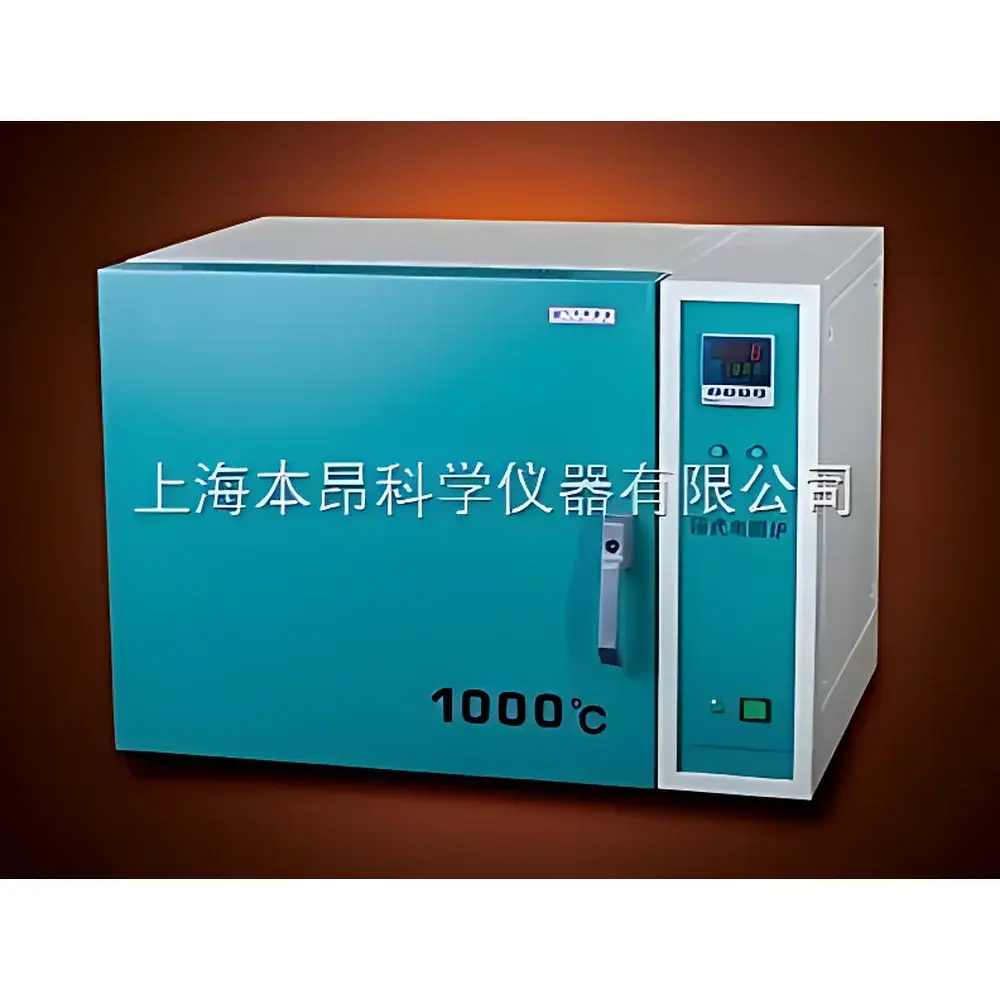
BenAng BA-4-10A Ceramic Fiber Muffle Furnace
| Brand | BenAng |
|---|---|
| Origin | Shanghai, China |
| Manufacturer Type | Authorized Distributor |
| Country of Origin | China |
| Model | BA-4-10A |
| Chamber Dimensions | 300 × 200 × 120 mm |
| Maximum Operating Temperature | 1000 °C |
| Heating Rate | ≥60 °C/min |
| Temperature Uniformity | ±1 °C (at 1000 °C, steady state) |
| Control System | PID Intelligent Temperature Controller |
| Sensor Type | K-type Thermocouple (NiCr–NiSi) |
| Heating Element | Kanthal® A1 Alloy Resistance Wire |
| Insulation | 50 mm High-Purity Alumina-Silica Ceramic Fiber (US-sourced) |
| Surface Temperature at 1000 °C | ≤60 °C |
| Power Supply | AC 220 V, 50/60 Hz |
| Rated Power | 4 kW |
| Rated Current | 12 A |
| Safety Features | Door-Interlocked Power Cut-off, Over-Temperature Protection, Auto-Reset Prevention After Power Interruption, Dual-Stage Thermal Fault Monitoring |
Overview
The BenAng BA-4-10A Ceramic Fiber Muffle Furnace is a high-performance benchtop box-type laboratory furnace engineered for rapid, uniform, and energy-efficient thermal processing up to 1000 °C. Designed in accordance with ISO 9001-certified manufacturing practices, it employs a dual-layer thermal architecture: an inner chamber lined with 50 mm of ultra-low-conductivity, high-purity alumina–silica ceramic fiber insulation (sourced from the United States), and a robust outer steel housing with integrated thermal shielding. The furnace utilizes Kanthal® A1 alloy resistance heating elements—manufactured by Sandvik Heat Treatment (Sweden)—which deliver exceptional dimensional stability, oxidation resistance, and long-term resistivity consistency across repeated thermal cycles. Unlike traditional refractory-brick muffle furnaces, the BA-4-10A achieves 1000 °C in under 12 minutes (verified per ASTM E1112 test protocol), with surface temperature remaining below 60 °C during full-load operation—well within the IEC 61000-3-2 Class A limit for laboratory equipment safety. Its thermal efficiency exceeds conventional units by approximately 60%, consuming only ~40% of the energy required by equivalent brick-lined models operating under identical duty cycles.
Key Features
- High-purity US-sourced ceramic fiber insulation (≥99.5% Al₂O₃–SiO₂), rated for continuous use at 1000 °C with negligible outgassing or particulate shedding—critical for ashing, trace metal analysis, and GLP-compliant sample preparation.
- Kanthal® A1 heating elements, pre-aged and laser-trimmed for resistive uniformity; demonstrated mean time between failures (MTBF) >15,000 hours under cyclic 1000 °C operation.
- PID intelligent temperature controller with auto-tuning capability, supporting ramp-soak programming, real-time deviation logging, and ±1 °C accuracy (per ISO/IEC 17025 calibration traceability requirements).
- Integrated safety architecture: electromechanical door interlock (EN 60204-1 compliant), independent over-temperature cut-off (OTC) circuit, and power-loss recovery lockout preventing unintended restart after grid interruption.
- Compact chamber volume (7.2 L) optimized for small-batch processing—ideal for academic labs, QC/QA environments, and method development where sample throughput and thermal reproducibility are prioritized over bulk capacity.
Sample Compatibility & Compliance
The BA-4-10A accommodates crucibles, boats, and trays made from alumina, quartz, silicon carbide, or inert metals (e.g., Pt, Ni, stainless steel 310S), supporting ashing, calcination, heat treatment, and volatilization protocols per ASTM D3174 (ash content), ASTM D5142 (moisture and ash in coal), USP (residue on ignition), and EPA Method 2540E. Its low particulate emission profile meets ISO 14644-1 Class 8 cleanroom compatibility thresholds when operated in controlled lab environments. All electrical components comply with IEC 61010-1:2010 for laboratory equipment safety; CE marking documentation is available upon request for EU shipment.
Software & Data Management
While the standard configuration features a front-panel PID controller with LED display and manual program entry, optional RS485 Modbus RTU interface enables integration with LabVIEW™, MATLAB®, or enterprise LIMS platforms. Data logging (temperature vs. time, alarm events, setpoint changes) can be exported as CSV files via USB memory dongle—supporting audit trails required under FDA 21 CFR Part 11 for electronic records in regulated pharmaceutical and clinical labs. Firmware supports GLP-compliant user access levels (operator, supervisor, administrator) with password-protected parameter modification.
Applications
- Materials science: Sintering of ceramic precursors, annealing of thin-film substrates, and thermal gravimetric pre-conditioning prior to SEM/EDS analysis.
- Environmental testing: Ashing of filter media for PM2.5/PM10 mass determination (EPA TO-13A), loss-on-ignition (LOI) assays in soil/sediment characterization.
- Pharmaceutical QA: Residue on ignition (ROI) per USP , excipient decomposition profiling, and sterilization validation studies.
- Coal and energy research: Proximate analysis (moisture, volatile matter, fixed carbon, ash), fusibility testing (ASTM D1857), and elemental ash composition prep for ICP-OES.
- Academic instruction: Kinetics experiments (e.g., thermal decomposition of CaCO₃), calorimetry support, and metallurgical phase transformation demonstrations.
FAQ
What is the maximum recommended continuous operating temperature?
The BA-4-10A is rated for continuous operation at 1000 °C. Prolonged exposure above this threshold may accelerate insulation degradation and reduce thermocouple lifespan.
Is the furnace compatible with inert or reducing atmospheres?
No—this model is designed for air atmosphere only. For controlled-atmosphere applications, consult the BA-4-10A-AT variant with optional quartz tube and gas inlet ports.
How often does the K-type thermocouple require recalibration?
Per ISO/IEC 17025 guidelines, annual verification against a NIST-traceable reference source is recommended; more frequent checks are advised if used in GLP/GMP workflows or after mechanical shock.
Can the chamber accommodate standard ASTM G171 platinum crucibles?
Yes—the internal dimensions (300 × 200 × 120 mm) allow placement of up to four 30 mL Pt crucibles with 25 mm clearance on all sides for convective uniformity.
Does the unit include a factory calibration certificate?
Each unit ships with a manufacturer’s Certificate of Conformance (CoC); optional UKAS-accredited calibration certification is available at time of order.



