
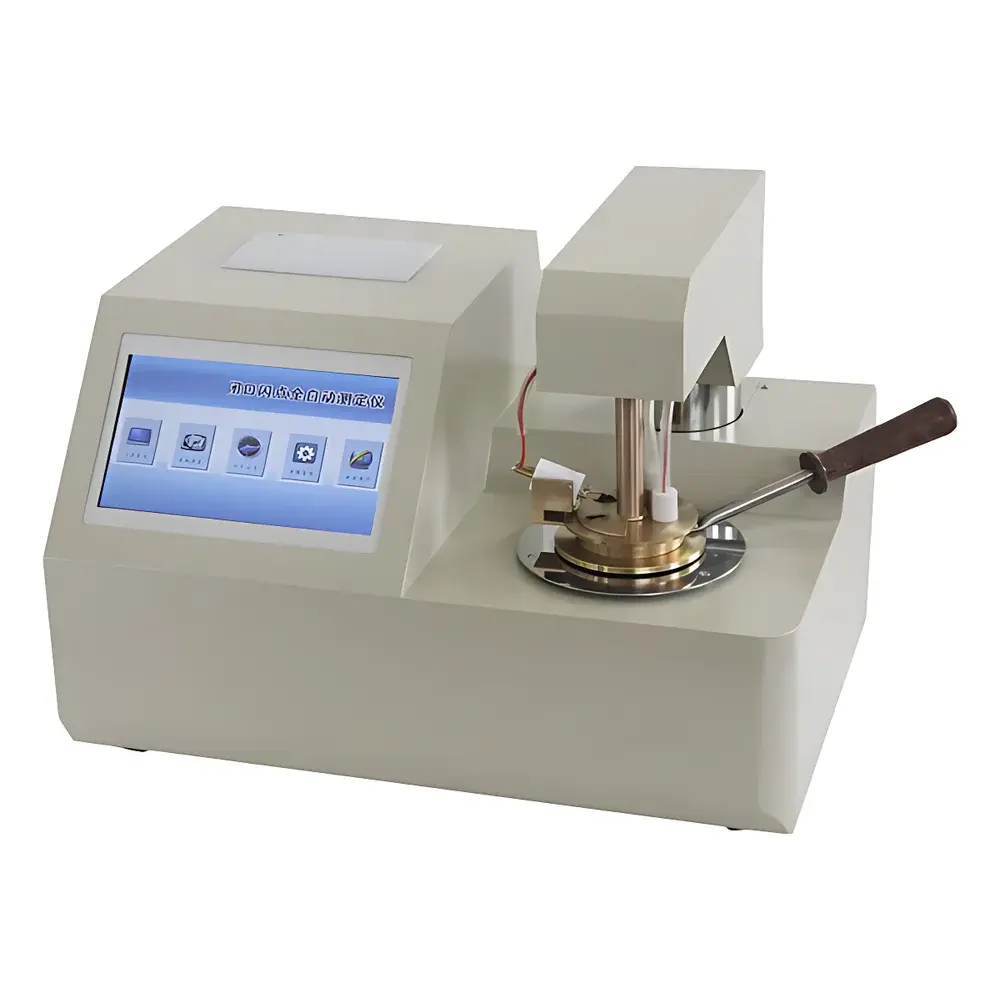
BenAng CFPT-1 Automated Closed-Cup Flash Point Tester
| Brand | BenAng |
|---|---|
| Origin | Shanghai, China |
| Model | CFPT-1 |
| Detection Method | Closed-Cup (ASTM D93 / GB/T 261) |
| Display | 7-inch color LCD touchscreen |
| Temperature Range | Ambient to 300 °C |
| Temperature Sensor | Platinum Resistance Thermometer (Pt100) |
| Accuracy | ±2 °C (≤110 °C), ±4 °C (≥110 °C) |
| Resolution | 0.1 °C |
| Ignition Method | Electric spark ignition |
| Cooling | Forced-air cooling |
| Data Storage | 20,000 test records |
| Power Supply | 220 V AC, 50 Hz |
| Max Power Consumption | ≤350 W |
| Operating Environment | 10–35 °C, ≤85% RH |
| Repeatability | Compliant with ASTM D93 and GB/T 261 |
Overview
The BenAng CFPT-1 Automated Closed-Cup Flash Point Tester is a precision-engineered instrument designed for the accurate and repeatable determination of the closed-cup flash point of petroleum products, solvents, lubricants, and other flammable liquids. It operates on the principle of controlled heating and electric spark ignition within a sealed test cup, in strict accordance with the standardized test protocols defined in ASTM D93 (Pensky-Martens Closed Cup method) and GB/T 261–2008. The system employs a high-stability platinum resistance thermometer (Pt100) for real-time temperature monitoring, coupled with an ARM-based microprocessor control architecture that ensures precise thermal ramping, automatic endpoint detection, and consistent ignition timing. Its fully automated workflow—encompassing sample heating, vapor concentration monitoring, spark initiation, flash detection, result locking, thermal cooling, and report generation—eliminates operator variability and enhances inter-laboratory reproducibility. The instrument is engineered for routine use in quality control laboratories where regulatory compliance, audit readiness, and method traceability are critical.
Key Features
- 7-inch full-color capacitive touchscreen interface with intuitive Chinese menu navigation and context-sensitive prompts
- Integrated electric spark ignition system with adjustable energy output and fail-safe arc suppression
- Forced-air active cooling module enabling rapid temperature recovery between tests (typical cooldown from 300 °C to ambient: <8 min)
- Built-in thermal printer supporting direct hardcopy output of test parameters, timestamps, flash point values, and pass/fail status
- Non-volatile memory storage for up to 20,000 complete test records—including date/time stamp, operator ID (if configured), sample ID, ambient conditions, and raw temperature vs. time profiles
- Comprehensive self-diagnostic suite verifying mechanical positioning of the test arm, igniter electrode integrity, printer readiness, and sensor continuity prior to each assay
- Robust industrial-grade enclosure rated for continuous operation in laboratory environments (IP20, CE-compliant electromagnetic compatibility)
Sample Compatibility & Compliance
The CFPT-1 accommodates standard ASTM D93 and GB/T 261 test cups (typically 50–70 mL capacity) and supports liquid samples with viscosities up to 100 mm²/s at 40 °C. It is validated for use with gasoline, diesel fuel, kerosene, jet fuel, base oils, hydraulic fluids, and organic solvents. All operational logic and reporting outputs align with the procedural requirements of ASTM D93, ISO 2719, and GB/T 261–2008. While the instrument does not include native 21 CFR Part 11 electronic signature or audit trail functionality out-of-the-box, its deterministic test sequence, timestamped data logging, and immutable record storage support GLP and GMP-aligned documentation practices when integrated into validated laboratory information management systems (LIMS). Calibration verification can be performed using certified reference materials traceable to NIST or CNAS-accredited standards.
Software & Data Management
The embedded firmware provides local data management without dependency on external PCs. Test records are stored in a structured binary format with CRC-protected integrity checks. Export is supported via USB mass storage mode—enabling transfer of CSV-formatted reports containing flash point (°C), initial flash temperature, final equilibrium temperature, heating rate, ambient humidity/temperature (if optional sensors are installed), and diagnostic flags. The system supports user-defined sample naming conventions and batch grouping. Though no remote software suite is bundled, the device’s RS-232 and USB interfaces allow integration with third-party LIMS or SCADA platforms using Modbus RTU or ASCII command protocols (documentation available upon request).
Applications
- Quality assurance testing of refinery intermediates and finished fuels per API RP 2510 and ISO 8217 specifications
- Regulatory compliance screening for transportation and storage classification under UN TDG, IMDG Code, and OSHA HCS
- R&D formulation studies evaluating volatility trade-offs in solvent blends and functional fluids
- Third-party inspection and certification labs performing ASTM-conforming flash point verification for import/export clearance
- University and government research facilities conducting fire safety characterization of novel biofuels and ionic liquids
FAQ
What standards does the CFPT-1 comply with?
It fully conforms to ASTM D93 (Method A and B), ISO 2719, and GB/T 261–2008 for closed-cup flash point determination.
Can the instrument be calibrated internally?
Yes—the system supports user-executed calibration verification using certified reference standards; full calibration requires traceable Pt100 probe adjustment by authorized service personnel.
Is the printer ribbon replaceable in the field?
Yes, the thermal printer uses standard 57-mm-wide consumable ribbons with >1000-page lifespan; replacement kits and instructions are included.
Does the CFPT-1 support multi-language UI beyond Chinese?
The current firmware version supports Chinese only; English language localization is available as a factory-configurable option upon order.
What maintenance intervals are recommended?
Daily wipe-down of test cup and igniter electrodes; quarterly cleaning of air intake filters and annual verification of temperature sensor linearity and ignition timing accuracy.





