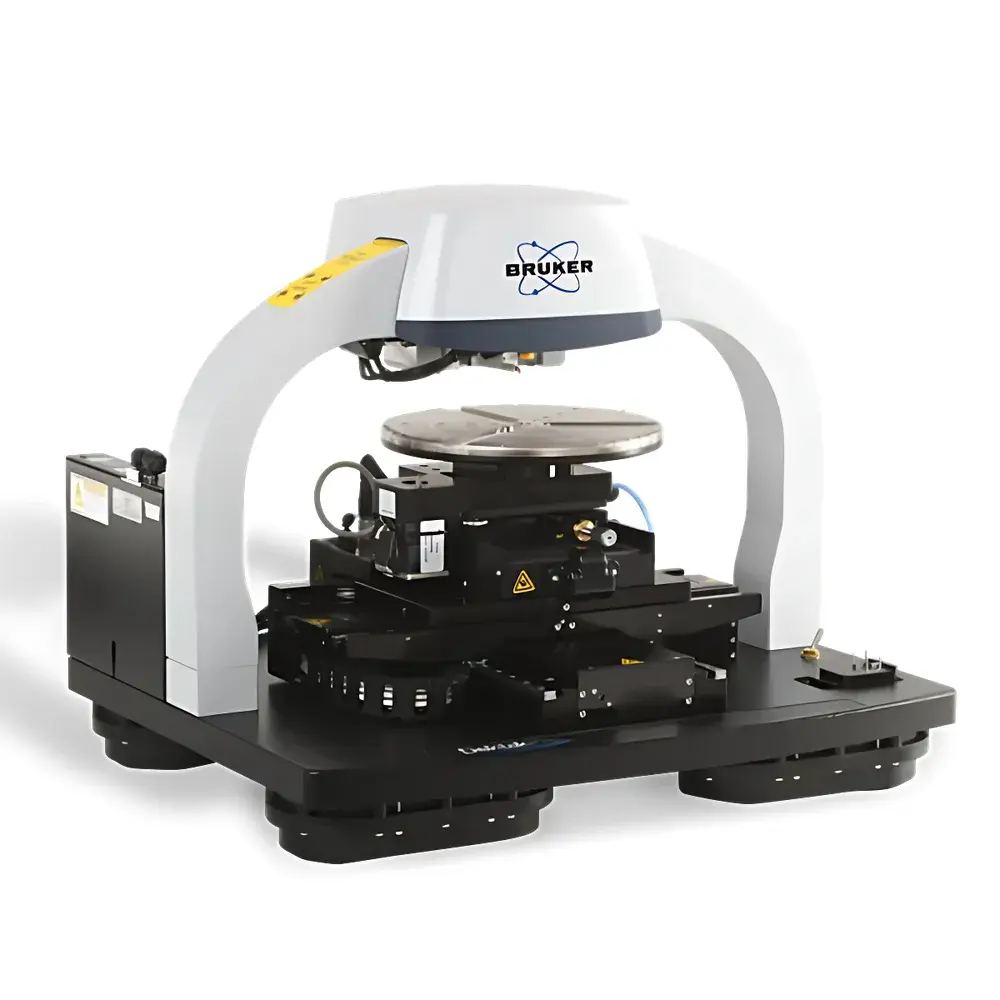
Bruker Dektak Pro Stylus Profilometer
| Brand | Bruker |
|---|---|
| Origin | Germany |
| Manufacturer Type | Authorized Distributor |
| Origin Category | Imported |
| Model | Dektak Pro |
| Price | Upon Request |
| Maximum Scan Length | 55 mm |
| Step Height Repeatability | < 2% |
| Vertical Resolution | 0.1 nm |
| Maximum Sample Size | 200 mm |
| Measurement Principle | Contact Stylus Profilometry |
| Force Range (Standard LIS 3) | 1–15 mg |
| Optional Low-Force Mode (N-Lite+) | 0.03–15 mg |
| Stylus Tip Radius Options | 50 nm – 25 µm |
| HAR Tip Geometry | 200 µm × 20 µm |
| XY Stage Options | Manual 100 mm (4″), Motorized 150 mm (6″), Motorized Encoded 200 mm (8″) |
| R-Theta Stage | Manual or Motorized, Continuous 360° Rotation |
| Field of View (Vertical Digital Zoom) | 0.275–2.2 mm |
Overview
The Bruker Dektak Pro is a high-precision, motorized stylus profilometer engineered for quantitative surface topography and step height metrology in research laboratories and advanced manufacturing environments. It operates on the principle of contact profilometry—where a diamond-tipped stylus physically traces a surface while a low-inertia sensor (LIS 3) detects vertical displacement with sub-nanometer sensitivity. This method delivers traceable, NIST-compatible measurements of step heights, roughness (Ra, Rq, Rz), critical dimensions, film thickness (via etch-depth profiling), and edge profiles. Unlike optical techniques such as interferometry or focus variation, the Dektak Pro provides direct, absolute height data without phase ambiguity or material-dependent contrast limitations—making it indispensable for characterizing opaque, transparent, or multi-layered substrates including silicon wafers, MEMS devices, photomasks, thin-film solar cells, and precision-machined optics.
Key Features
- Sub-angstrom vertical resolution (0.1 nm) enabled by Bruker’s proprietary low-inertia sensor (LIS 3) architecture and optimized signal-to-noise ratio electronics.
- Programmable force control spanning 0.03–15 mg via optional N-Lite+ low-torque actuation—critical for fragile films, polymer resists, and soft lithographic layers where stylus-induced deformation must be minimized.
- Modular stage configuration: supports manual 100 mm (4″), motorized 150 mm (6″), or high-accuracy encoded 200 mm (8″) XY stages—ensuring compatibility with standard semiconductor wafer formats and custom substrates up to 200 mm diameter.
- Integrated R-Theta rotation stage (manual or motorized) enables radial profiling, circumferential uniformity mapping, and full 360° angular analysis—essential for ring-shaped components, microfluidic channels, and rotational symmetry validation.
- Multi-radius stylus options (50 nm to 25 µm tip radius) and high-aspect-ratio (HAR) probes (200 µm × 20 µm) accommodate both nanoscale feature resolution and deep trench profiling without tip shadowing or breakage.
- Digital zoom optics with variable vertical field of view (0.275–2.2 mm) facilitate rapid visual navigation, real-time stylus positioning, and cross-sectional verification without mechanical repositioning.
Sample Compatibility & Compliance
The Dektak Pro accommodates rigid and semi-rigid planar samples up to 200 mm in diameter and 50 mm in thickness. Its open-stage design allows for custom fixtures and vacuum chucks (optional) to secure non-standard geometries—including diced dies, ceramic substrates, and glass slides. All measurement protocols are compatible with ISO 25178-2 (surface texture — areal), ISO 4287 (profile parameters), and ASTM E1077 (standard test method for determining the thickness of thin metallic coatings). Data integrity meets GLP/GMP requirements through audit-trail-enabled software; electronic records comply with FDA 21 CFR Part 11 when deployed with validated user access controls and digital signature modules.
Software & Data Management
Operation is managed via Bruker’s Vision64 software platform—a Windows-based application supporting automated recipe-driven workflows, multi-point array scanning, and statistical process control (SPC) reporting. Raw profilometry data is stored in vendor-neutral .csv and .txt formats alongside metadata-rich .v64 project files. Advanced analysis modules include power spectral density (PSD), bearing ratio curves (Abbott-Firestone), slope/curvature derivation, and overlay comparison against CAD reference profiles. Export interfaces support integration with JMP, MATLAB, and LabVIEW for custom algorithm development. Software updates are distributed through Bruker’s secure customer portal, with version history and change logs maintained per ICH Q9 guidelines.
Applications
- Semiconductor process control: quantifying photoresist develop rates, etch depth uniformity, CMP removal profiles, and gate oxide step coverage.
- MEMS/NEMS characterization: measuring released structure deflection, stiction gaps, and sidewall angle consistency post-release etch.
- Advanced packaging: evaluating underfill fillet height, solder bump coplanarity, and redistribution layer (RDL) step integrity.
- Optics and precision machining: verifying surface flatness, groove depth in diffraction gratings, and micro-lens array sphericity deviation.
- Materials science: profiling ion-beam sputtered thin films, atomic layer deposited (ALD) conformality, and thermal barrier coating delamination fronts.
FAQ
What is the maximum allowable sample weight for the 200 mm encoded stage?
The motorized encoded 200 mm XY stage supports samples weighing up to 5 kg when uniformly distributed and properly centered.
Can the Dektak Pro perform traceable calibration per ISO/IEC 17025?
Yes—when operated with certified reference standards (e.g., NIST-traceable step height artifacts) and documented calibration procedures, the system satisfies metrological traceability requirements for accredited laboratories.
Is third-party software integration supported for automated data ingestion into LIMS?
Vision64 includes COM/ActiveX APIs and configurable export triggers, enabling bidirectional communication with enterprise LIMS platforms via OPC UA or RESTful middleware.
How often does the stylus require replacement under typical usage conditions?
Stylus lifetime depends on scan frequency, surface hardness, and applied force; diamond tips typically exceed 500 m of cumulative scan distance before measurable wear affects repeatability.
Does the system support environmental enclosures for vibration-sensitive measurements?
The Dektak Pro chassis is compatible with active pneumatic isolation tables and acoustic enclosures—both commercially available and customizable per ISO 20483 vibration class recommendations.