
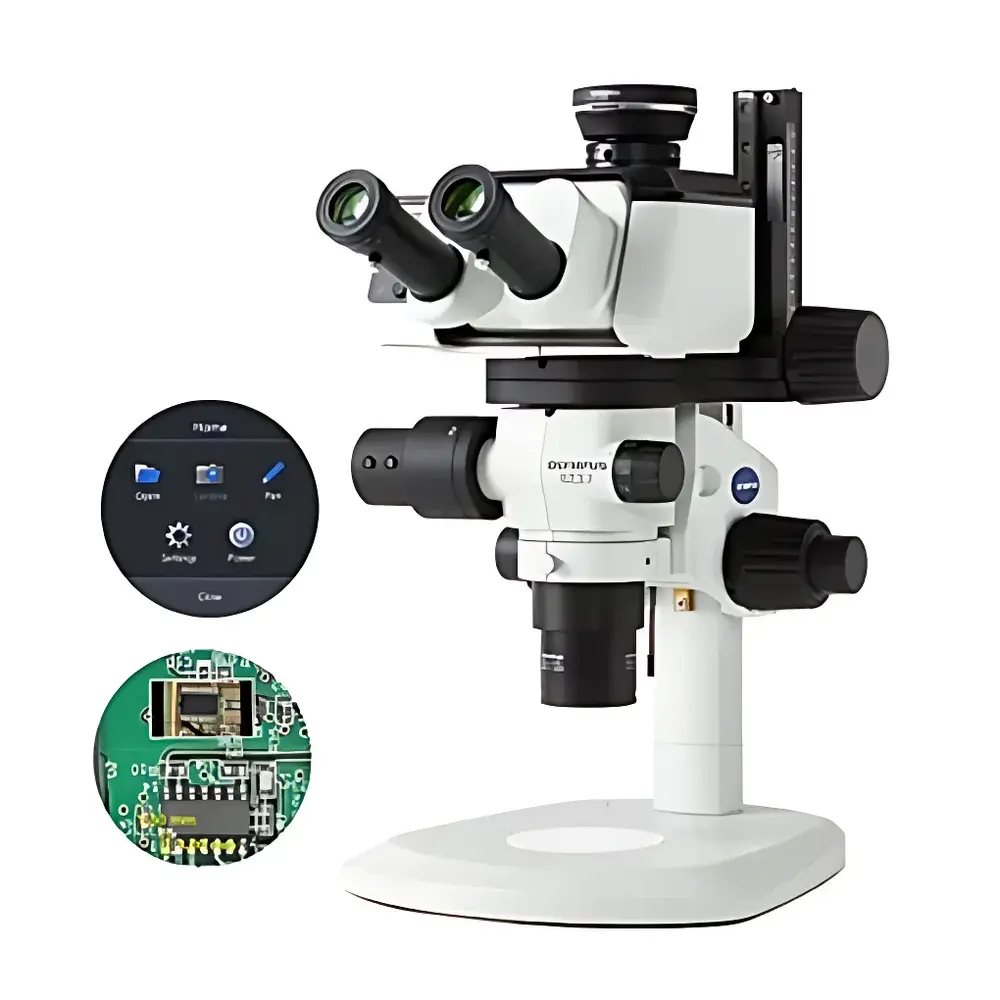
OLYMPUS SZX-AR1 Augmented Reality Stereo Microscope System
| Brand | OLYMPUS |
|---|---|
| Origin | Japan |
| Model | SZX-AR1 |
| Category | Imported Instrument |
| Distributor Type | Authorized Distributor |
| Pricing | Available Upon Request |
Overview
The OLYMPUS SZX-AR1 Augmented Reality Stereo Microscope System is an optomechanical integration platform engineered to overlay digital information—text, annotations, calibrated measurement scales, crosshairs, static images, and synchronized video—directly into the real-time optical field of view of compatible SZX-series stereo microscopes. Unlike conventional digital microscope add-ons that rely on external monitors or split attention between eyepiece and screen, the SZX-AR1 employs a beam-splitter-based optical combiner and high-luminance micro-display module mounted coaxially with the trinocular port. This architecture ensures parallax-free, eye-aligned augmentation with minimal latency (<60 ms end-to-end), preserving native binocular depth perception while superimposing context-aware guidance. The system operates on the principle of optical see-through augmented reality (AR), where virtual elements are registered to the physical specimen plane using mechanical linkage to zoom and focus actuators—enabling dynamic scaling of rulers and annotations in real time as magnification changes. Designed for precision assembly, quality verification, and technician training in regulated manufacturing environments, the SZX-AR1 supports traceable, repeatable, and ergonomic visual workflows without compromising optical fidelity or user posture.
Key Features
- Optical see-through AR overlay integrated at the trinocular port—no external monitor required, zero ocular disengagement
- Zoom-synchronized digital scale bar and crosshair generation, dynamically recalibrated across the full magnification range (typically 6.3×–115× with SZX objectives)
- Real-time annotation engine supporting handwritten notes, step-by-step procedural prompts, and embedded multimedia (H.264 video, PNG/JPEG image sequences)
- Low-latency (<60 ms) rendering pipeline compliant with ISO 9241-411 ergonomic response thresholds for visual-motor coordination
- Modular hardware design: replaces standard inclined trinocular tube; installs without optical realignment or calibration tools
- Ergonomic compatibility with EVIDENT’s adjustable eyepoint extenders and tilting binocular heads to maintain neutral neck and spinal alignment during extended use
- Native support for remote collaboration via RTSP streaming—integrates with enterprise-grade video conferencing platforms including Microsoft Teams and Zoom for live expert supervision
Sample Compatibility & Compliance
The SZX-AR1 is mechanically and optically validated for use exclusively with Olympus/EVIDENT SZX7, SZX10, SZX12, and SZX16 stereo microscope stands equipped with standard trinocular observation tubes. It does not alter the base optical path or resolution performance of the host microscope. All AR-generated overlays comply with ISO 8549-2 (stereomicroscope terminology) and IEC 62471 (photobiological safety of lamps and lamp systems) for Class 1 LED emission. The system supports GLP/GMP-aligned documentation practices: all captured images and videos embed EXIF metadata (timestamp, magnification, objective ID, AR layer state) and may be exported in DICOM-SR or TIFF+XML formats for audit trail integrity. While not FDA-cleared as a medical device, the SZX-AR1 meets ISO 13485:2016 requirements for manufacturing process support equipment used in Class II/III medical device production.
Software & Data Management
The SZX-AR1 Control Software (v3.2+) runs on Windows 10/11 x64 and provides a browser-based authoring interface for creating guided assembly procedures without coding. Procedures are stored as encrypted JSON bundles with version control and role-based access permissions (e.g., “Trainer,” “Operator,” “QA Auditor”). All session logs—including start/stop timestamps, overlay activation events, and manual annotation entries—are recorded in SQLite databases with SHA-256 hashing for tamper-evident audit trails. Export options include PDF work instructions with embedded video thumbnails, CSV event logs, and MP4 recordings encoded at 1080p60 with H.264 baseline profile for long-term archival. The software supports 21 CFR Part 11-compliant electronic signatures when deployed with domain-authenticated Windows accounts and time-stamped digital certificates.
Applications
- Electronics assembly: Visual-guided soldering of 01005 components, wire bonding alignment, and microconnector mating verification
- Mechanical watchmaking: Stepwise gear train assembly with torque-sensitive positioning cues and tolerance-boundary overlays
- Medical device manufacturing: Catheter tip welding validation, stent crimping sequence tracking, and sterile packaging inspection with pass/fail AR checklists
- Technical training: Remote onboarding of new operators using prerecorded procedure walkthroughs synchronized to actual magnification states
- Failure analysis labs: Correlating SEM/EDS reports with live optical views via side-by-side AR annotation layers
- Regulatory auditing: Capturing time-stamped, geotagged (via host PC), and operator-identified evidence of conformance to SOPs
FAQ
Is the SZX-AR1 compatible with non-Olympus stereo microscopes?
No. Mechanical mounting, optical back focal distance, and trinocular port diameter are specific to the SZX-series platform. Interchangeability with Leica, Zeiss, or Nikon systems is not supported.
Does the AR module affect the native resolution or light transmission of the microscope?
No. The beam-splitter design introduces <0.8% total luminance loss (measured per ISO 9335) and no measurable degradation in MTF at 50 lp/mm under standard Köhler illumination.
Can overlay content be updated remotely during live operation?
Yes—via secure HTTPS API endpoints. Trainers may push revised annotations or video segments to connected units without interrupting ongoing sessions.
What cybersecurity protocols are implemented in the control software?
TLS 1.2+ encryption for all network communications, local database encryption using AES-256, and optional integration with Active Directory for centralized credential management.
Is firmware update capability available over-the-air?
Firmware updates require local USB installation with cryptographic signature verification; no unattended OTA updates are permitted for industrial control integrity.





