
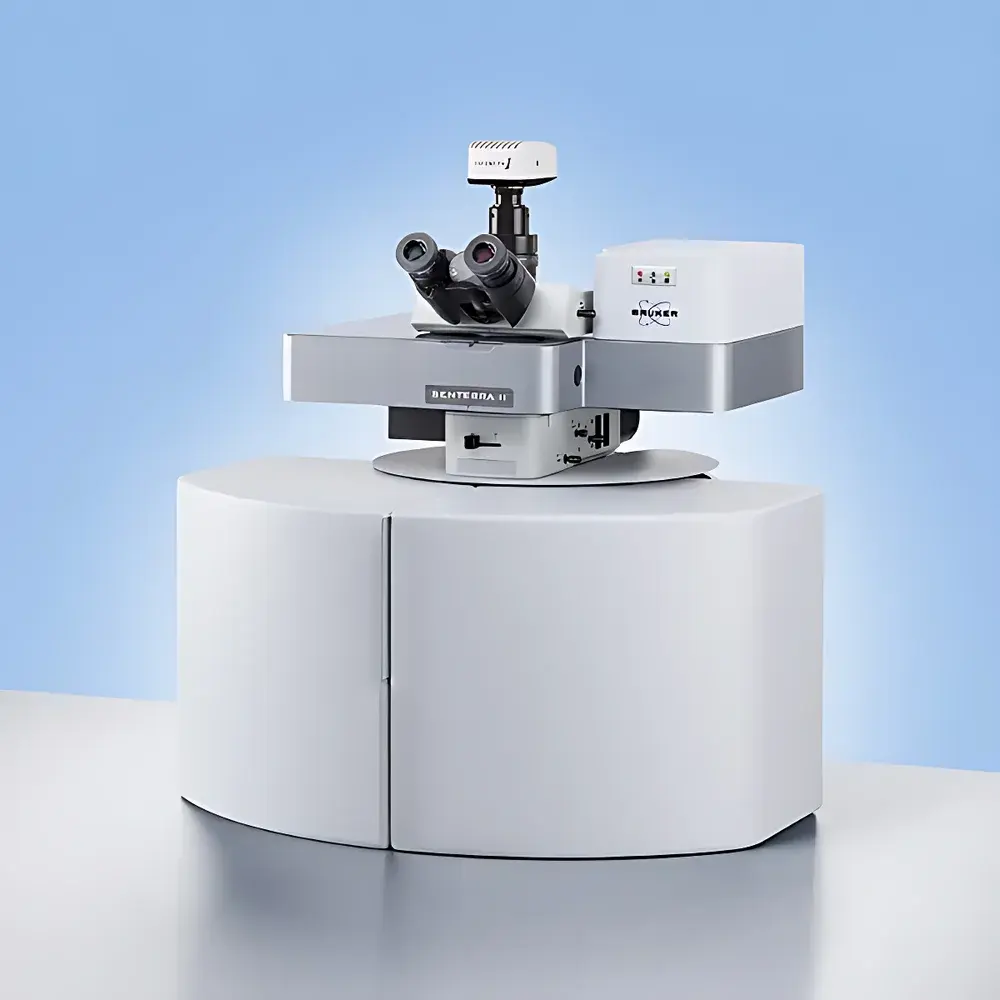
Bruker SENTERRA II Confocal Raman Microscope
| Brand | Bruker |
|---|---|
| Origin | Germany |
| Model | SENTERRA II |
| Instrument Type | Confocal Raman Microspectrometer |
| Spectral Range | 50–4400 cm⁻¹ |
| Spectral Resolution | 1.5 cm⁻¹/pixel |
| Spatial Resolution | Lateral 1 µm, Axial 2 µm |
| Low-Wavenumber Limit | 50 cm⁻¹ |
| Wavenumber Reproducibility | ±0.06 cm⁻¹ |
Overview
The Bruker SENTERRA II Confocal Raman Microscope is a research-grade, fully automated microspectroscopic platform engineered for high-fidelity chemical imaging and molecular identification at diffraction-limited spatial resolution. Based on confocal laser Raman spectroscopy—where monochromatic excitation induces inelastic scattering from molecular vibrational modes—the system delivers quantitative, label-free compositional mapping with sub-micrometer spatial precision. Its optical architecture integrates a motorized inverted microscope with high-numerical-aperture objectives, a precision XYZ stage, and a thermoelectrically cooled CCD detector optimized for low-noise spectral acquisition. Designed for rigorous laboratory environments, the SENTERRA II operates across a broad wavenumber range (50–4400 cm⁻¹) with exceptional reproducibility (±0.06 cm⁻¹) and maintains long-term calibration stability via Bruker’s proprietary SureCal™ real-time wavelength referencing technology—eliminating manual recalibration and ensuring traceable spectral accuracy per ISO/IEC 17025 and ASTM E1840 requirements.
Key Features
- Fully automated hardware control: seamless switching between four integrated lasers (e.g., 532 nm, 633 nm, 785 nm, and optional 405 nm), motorized filter wheels, and interchangeable gratings—all managed through unified software logic.
- SureCal™ active wavelength calibration: continuous, non-intrusive spectral reference tracking using built-in neon emission lines, guaranteeing <0.1 cm⁻¹ absolute wavenumber accuracy without user intervention or external standards.
- High-speed 3D Raman imaging: synchronized stage scanning and spectral acquisition enable volumetric chemical mapping with axial sectioning capability down to 2 µm resolution, supporting depth profiling and particle-layer analysis.
- Class 1 laser safety architecture: fully interlocked enclosure with redundant mechanical shutters, beam path monitoring, and proximity-sensing door switches—compliant with IEC 60825-1:2014 and designed for unsupervised student use in teaching labs.
- Integrated Fourier-transform Raman (FT-Raman) module option: enables complementary near-infrared excitation (1064 nm) to suppress fluorescence interference in highly fluorescent samples such as pharmaceuticals or biological tissues.
Sample Compatibility & Compliance
The SENTERRA II accommodates diverse sample formats—including bulk solids, thin films, powders, liquids, gels, and biological sections—without requiring conductive coating or vacuum conditions. Its confocal pinhole configuration provides inherent optical sectioning, minimizing signal contamination from out-of-focus layers. The system meets stringent regulatory requirements for quality-controlled environments: full 21 CFR Part 11 compliance is enforced via audit-trail-enabled software (OPUS 8.x), electronic signatures, role-based access control, and immutable data archiving. All OQ (Operational Qualification) and PQ (Performance Qualification) protocols are preconfigured and executable within the instrument’s self-diagnostic framework, supporting GLP and GMP workflows in pharmaceutical development, polymer certification, and forensic casework laboratories.
Software & Data Management
Controlled by Bruker’s OPUS spectroscopy suite (v8.5+), the SENTERRA II offers an intuitive, workflow-driven interface with customizable method templates for routine analysis (e.g., polymorph screening, contaminant ID, stress mapping). Advanced chemometric tools—including PCA, cluster analysis, and spectral library matching against commercial (e.g., RRUFF, ICDD) and user-defined databases—enable automated phase identification and quantification. Raw spectra and hyperspectral cubes are stored in vendor-neutral HDF5 format with embedded metadata (instrument parameters, calibration history, user annotations), ensuring FAIR (Findable, Accessible, Interoperable, Reusable) data principles. Data export supports ASTM E131, JCAMP-DX, and CSV formats for third-party integration with LIMS or ELN systems.
Applications
- Pharmaceutical materials science: polymorph differentiation, API distribution in tablets, excipient compatibility studies, and counterfeit drug detection.
- Advanced polymer characterization: crystallinity mapping, filler dispersion analysis, degradation profiling, and multilayer film delamination assessment.
- Environmental forensics: microplastic identification in water/sediment matrices, airborne particulate composition, and soil contaminant speciation.
- Materials science: stress/strain evaluation in semiconductors, carbon nanotube chirality assignment, and 2D material layer counting (e.g., graphene, MoS₂).
- Life sciences: label-free cellular component mapping (lipids, proteins, nucleic acids), tissue histopathology support, and bacterial strain discrimination.
FAQ
Is the SENTERRA II compliant with FDA 21 CFR Part 11 for regulated pharmaceutical environments?
Yes—the system includes full electronic signature support, audit trail logging, user access tiers, and data integrity safeguards validated per Part 11 Annex 11 requirements.
Can the SENTERRA II perform depth profiling on multilayer coatings?
Yes—its confocal design enables precise axial sectioning with 2 µm step resolution; combined with automated Z-stacking, it reconstructs 3D chemical volume models of stratified structures.
Does the instrument require external calibration standards for daily operation?
No—SureCal™ ensures continuous internal wavelength calibration; only annual verification using NIST-traceable polystyrene or silicon standards is recommended for QA documentation.
What laser options are available, and how are fluorescence artifacts mitigated?
Standard configurations include 532 nm, 633 nm, and 785 nm lasers; optional 405 nm and FT-Raman (1064 nm) modules provide flexibility for fluorescence-prone samples.
Is remote operation and maintenance supported?
Yes—OPUS software supports secure remote desktop access, diagnostic telemetry, and firmware updates via encrypted HTTPS channels, enabling global technical support and minimal downtime.






