
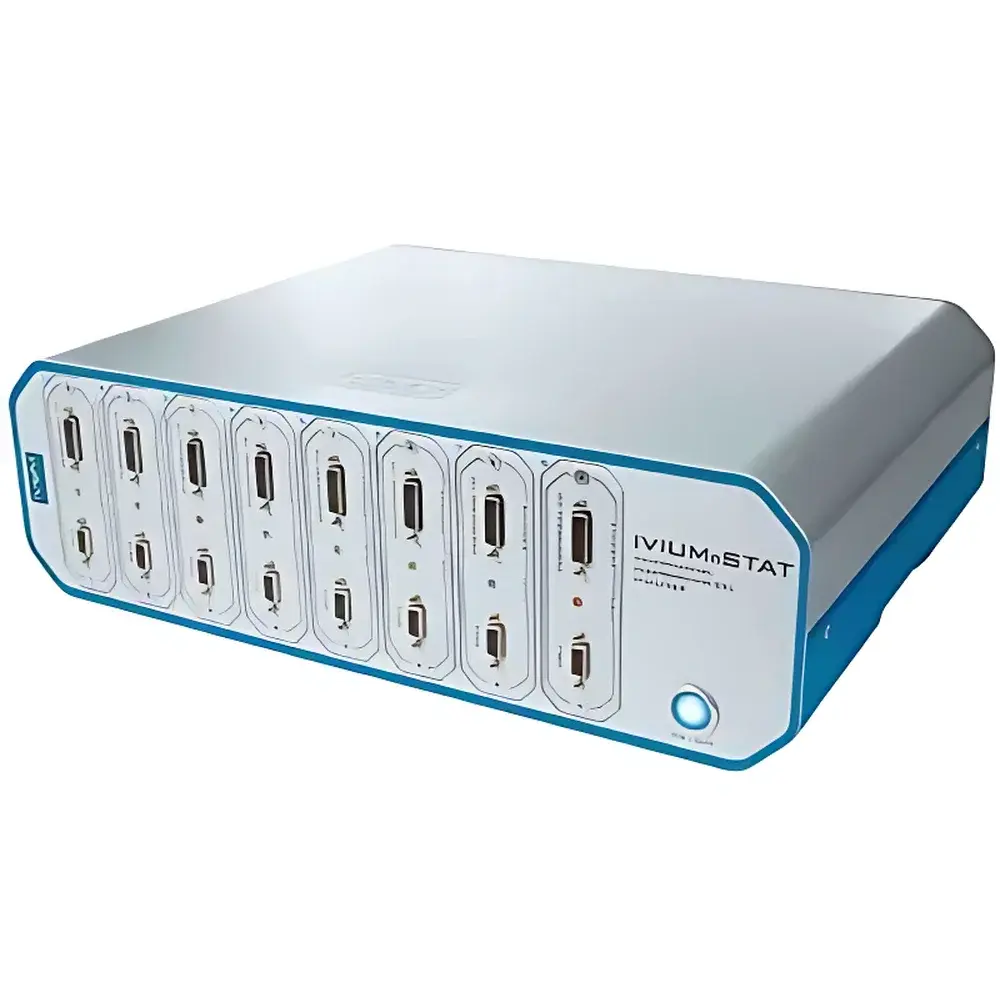
Ivium Technologies n-Stat Multi-Channel Electrochemical Workstation
| Brand | Ivium |
|---|---|
| Origin | Netherlands |
| Model | n-Stat |
| Instrument Type | Electrochemical Workstation |
| Channel Count | Up to 64 (8 per unit, stackable) |
| Current Range | ±10 nA to ±10 A |
| Current Resolution | 1 pA |
| Potential Accuracy | ±1 mV |
| Potentiostatic Range | ±10 V |
| EIS Frequency Range | 10 µHz to 1 MHz |
| Data Acquisition Rate | 100 kHz |
| Analog/Digital I/O | Multiple isolated inputs/outputs |
| Max. Power Output | ±40 A @ ±10 V (expandable) |
| Compliance Standards | CE, RoHS, ISO/IEC 17025-compatible operation |
Overview
The Ivium n-Stat Multi-Channel Electrochemical Workstation is a modular, high-fidelity potentiostat/galvanostat platform engineered for advanced electrochemical research and industrial quality control. Built on Ivium Technologies’ proprietary digital signal processing architecture, the n-Stat employs true four-quadrant operation with galvanic and electrolytic mode support, enabling precise control of current and potential across multiple independent electrochemical cells simultaneously. Its core measurement principle integrates high-speed analog-to-digital conversion (100 kHz sampling), real-time digital feedback loops, and embedded frequency response analysis (FRA) for robust electrochemical impedance spectroscopy (EIS). Designed for laboratories requiring parallel experimentation—such as battery cycling arrays, corrosion monitoring networks, or sensor array validation—the n-Stat delivers metrological traceability aligned with ISO/IEC 17025 practices and supports audit-ready operation under GLP and GMP frameworks.
Key Features
- Modular scalability: Each n-Stat unit supports up to 8 fully independent channels; up to 8 units can be synchronized via Ethernet or USB, achieving a total of 64 parallel electrochemical interfaces.
- Dual-mode operation per channel: Each channel functions as a standalone potentiostat/galvanostat with integrated impedance analyzer (10 µHz–1 MHz), eliminating external lock-in amplifiers or auxiliary EIS hardware.
- Wide dynamic current range: ±10 nA to ±10 A (extendable to ±40 A with external booster modules), with 1 pA current resolution and ±1 mV potential accuracy over ±10 V compliance range.
- High-fidelity data acquisition: 100 kHz real-time sampling with 24-bit ADC resolution ensures accurate transient capture during pulse techniques (e.g., chronoamperometry, pulse voltammetry) and fast EIS sweeps.
- Galvanically isolated analog and digital I/O: Eight programmable analog inputs (±10 V, 16-bit), four analog outputs (±10 V), and eight TTL-compatible digital I/O lines enable seamless integration with environmental chambers, flow cells, or external actuators.
- Firmware-upgradable architecture: Field updates preserve long-term compatibility with evolving test protocols and regulatory requirements—including future support for FDA 21 CFR Part 11-compliant electronic signatures and audit trails.
Sample Compatibility & Compliance
The n-Stat accommodates standard three-electrode configurations (working, counter, reference) as well as two-electrode and pseudo-reference setups. It supports aqueous, non-aqueous, and molten salt electrolytes, and is routinely deployed in battery R&D (Li-ion, solid-state, Na-ion), corrosion science (ASTM G5/G102/G106), electrodeposition studies (ASTM B604), and biosensor characterization (ISO 15197). All units comply with CE marking directives (2014/30/EU EMC, 2014/35/EU LVD), RoHS 2011/65/EU, and meet essential performance criteria outlined in IEC 61010-1 for laboratory electrical equipment. When operated with IviumSoft’s validated configuration, the system satisfies documentation and traceability prerequisites for ISO/IEC 17025-accredited testing laboratories.
Software & Data Management
Controlled exclusively via IviumSoft v11+ (Windows-based), the n-Stat provides a unified interface for method development, real-time visualization, and post-experiment analysis. The software includes preconfigured templates for cyclic voltammetry, linear sweep, EIS, galvanostatic intermittent titration (GITT), and hybrid techniques such as multi-step chronoamperometry with in-situ EIS. Raw data are stored in vendor-neutral .txt and .csv formats; binary .ivium files retain full metadata (timestamp, instrument ID, calibration history, user annotations). Audit trail functionality logs all parameter changes, method executions, and user logins—configurable to meet FDA 21 CFR Part 11 requirements when paired with network authentication and electronic signature modules. Data export supports direct import into MATLAB, Python (via iviumlib), OriginLab, and commercial LIMS platforms.
Applications
- Battery material screening: Parallel charge/discharge cycling of cathode/anode half-cells under identical thermal and SOC conditions.
- Corrosion mapping: Simultaneous electrochemical noise monitoring and EIS on multi-zone coated steel panels.
- Electrocatalyst evaluation: High-throughput polarization curve acquisition across catalyst libraries using identical reference electrodes and electrolyte batches.
- Flow battery optimization: Real-time monitoring of vanadium redox species concentration gradients via coupled amperometric detection and impedance tracking.
- Biointerface studies: Impedimetric detection of protein adsorption kinetics on functionalized gold electrodes across replicate sensor surfaces.
FAQ
Can the n-Stat perform true simultaneous EIS on all channels?
Yes—each channel contains a dedicated FRA engine, enabling concurrent frequency-domain measurements without time multiplexing or shared oscillator resources.
Is remote operation supported over LAN or internet?
Yes—Ethernet connectivity enables secure remote access via IviumSoft Remote Control; firewall-configurable ports support IT-managed lab networks.
What calibration standards are recommended for traceable measurements?
Ivium provides NIST-traceable calibration resistors (1 Ω–10 MΩ) and certified voltage references; annual recalibration services include uncertainty budgets per ISO/IEC 17025.
Does the system support custom scripting for automated sequences?
Yes—Python API (iviumlib) and COM interface allow full programmatic control of methods, triggers, and data streaming for integration into automated test benches.
How is channel crosstalk mitigated in high-current multi-channel operation?
Each channel features galvanic isolation, separate ground planes, and shielded analog signal paths; typical inter-channel crosstalk is < –120 dB at 1 kHz under full ±10 A load.
Related Products






