
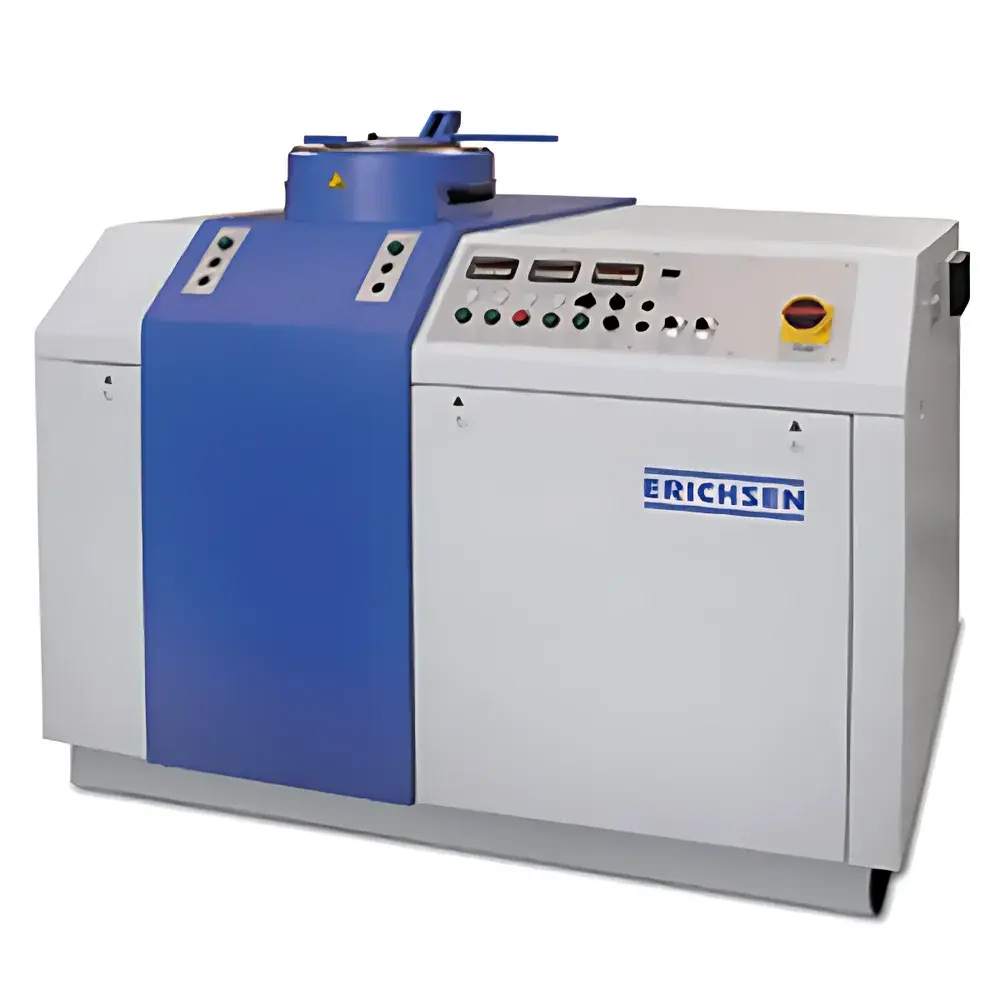
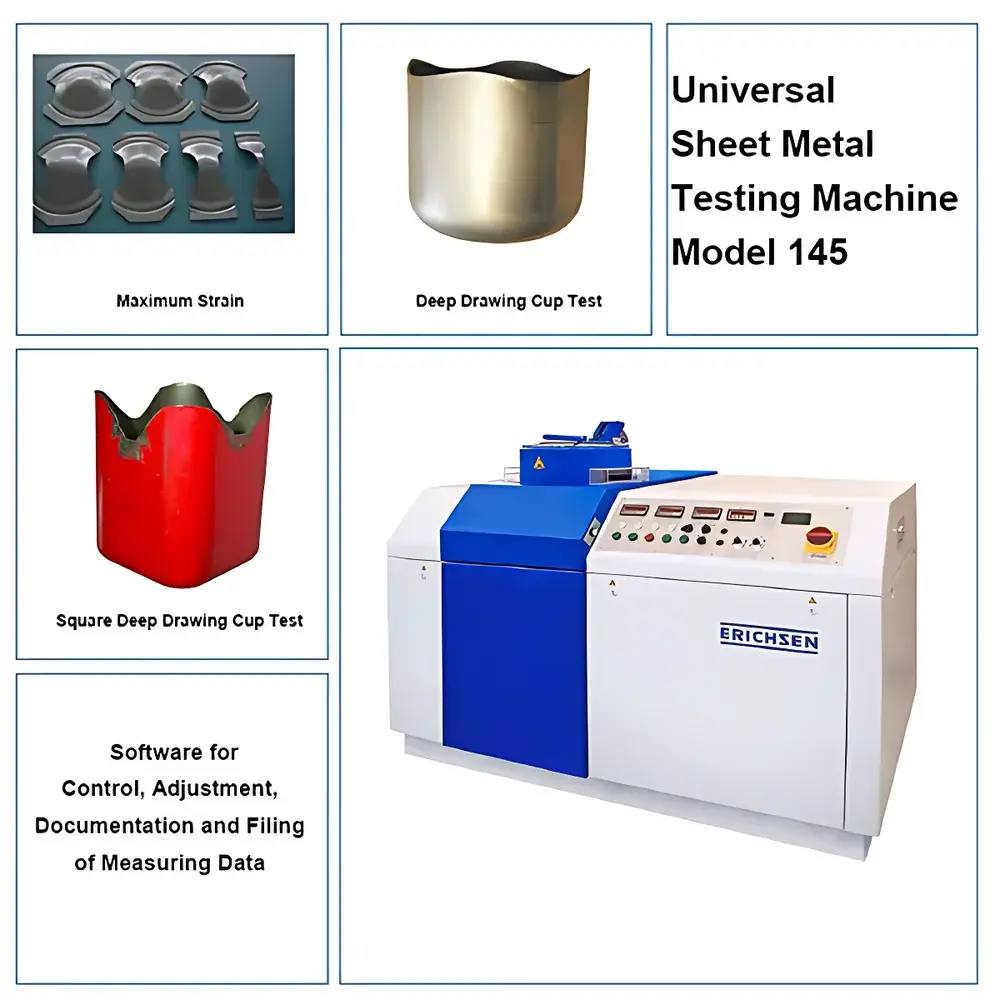
Erichsen Model 145-60/100 Automatic Sheet Metal Forming Testing Machine
| Brand | Erichsen |
|---|---|
| Origin | Germany |
| Model | 145-60 / 145-100 |
| Maximum Punch Force | 600 kN / 1000 kN |
| Maximum Blank Holder Force | 600 kN / 1000 kN |
| Maximum Shearing Force | 700 kN / 1000 kN |
| Max. Punch Diameter | 100 mm |
| Max. Stroke | 150 mm (250 mm optional) |
| Blank Holder Stroke | 38 mm |
| Ejector Stroke | 150 mm |
| Max. Specimen Diameter | 220 mm |
| Punch Speed | up to 750 mm/min |
| Cupping Test Thickness Range | 0.1–6.0 mm |
| Deep Drawing Thickness Range | 0.2–3.0 mm (up to 6.0 mm for Model 145-100) |
| Hole Expansion Thickness Range | 0.2–3.0 mm |
| Operating Temperature | up to 550 °C (high-temp configuration available) |
Overview
The Erichsen Model 145-60/100 is a fully automatic, high-capacity sheet metal forming testing machine engineered for precision mechanical characterization of metallic and coated sheet materials under controlled deformation conditions. Based on the fundamental principles of deep drawing, cupping, and bulge testing—governed by ISO 20482, ASTM E643, ISO 12004, ISO 16630, and EN 10162—the system delivers reproducible force-displacement data critical for evaluating formability, strain localization, fracture initiation, and material response across multiple loading modes. Its dual-force architecture (600 kN and 1000 kN configurations) supports both standard cupping tests and advanced experimental protocols such as Forming Limit Curve (FLC) determination, Lubrication Performance Assessment, and high-temperature deep drawing up to 550 °C. The machine’s rigid C-frame construction, hydraulic servo-control system, and integrated real-time load monitoring ensure compliance with GLP and GMP-aligned laboratory practices where traceability and audit readiness are required.
Key Features
- Two configurable force ratings: Model 145-60 (600 kN punch force / 600 kN blank holder force) and Model 145-100 (1000 kN punch force / 1000 kN blank holder force), enabling scalability from R&D to production validation.
- High-resolution hydraulic servo control of punch speed (0.1–750 mm/min) and blank holder force (0–1000 kN), programmable via front-panel interface or external PC integration.
- Integrated digital display showing real-time values for punch force, blank holder force, punch velocity, and stroke position—traceable to internal calibration records.
- Modular tooling platform compatible with standardized Erichsen cupping dies, Swift/Olsen test fixtures, Fukui and Engelhardt geometries, LDH (Limit Dome Height) tool sets, and custom-designed bulge dies.
- Safety-certified interlock system compliant with EN ISO 13857 and EN 60204-1, including light curtain integration, emergency stop circuitry, and mechanical overload protection.
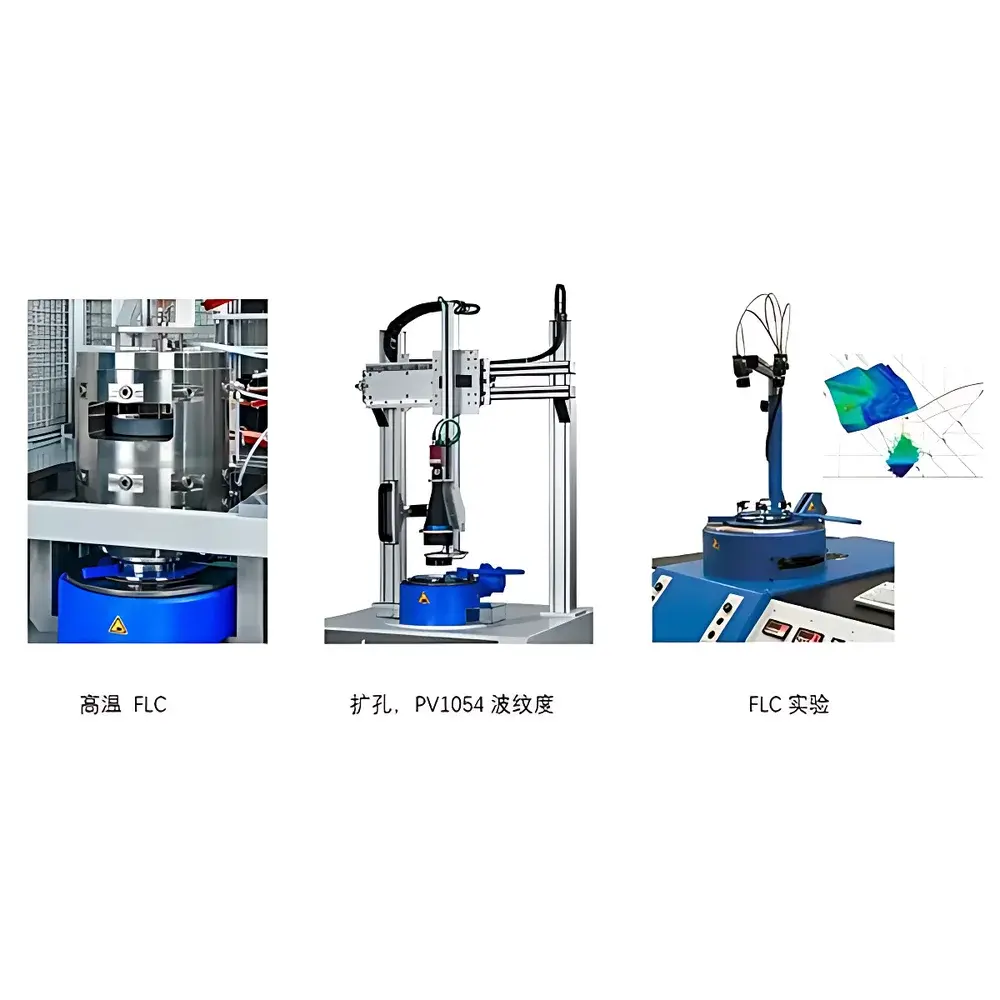
- Optional high-temperature module supporting deep drawing tests at elevated temperatures up to 550 °C, with thermocouple feedback and PID-controlled heating zones.
Sample Compatibility & Compliance
The Model 145-60/100 accommodates flat sheet specimens up to 220 mm in diameter and thicknesses ranging from 0.1 mm (for thin foils in Erichsen cupping) to 6.0 mm (for heavy-gauge structural steels in deep drawing). It supports coated substrates—including zinc-, aluminum-, and polymer-coated steels—as well as aluminum alloys (e.g., AA5xxx, AA6xxx), stainless steels (AISI 304, 430), and advanced high-strength steels (AHSS) such as DP980 and TRIP780. All test methods align with internationally recognized standards: ISO 20482 (Erichsen cupping), ISO 12004-2 (FLC determination), ASTM E2234 (hole expansion ratio), ISO 16630 (bending-under-tension), and EN 10162 (cold-formed sections). Data acquisition meets FDA 21 CFR Part 11 requirements when paired with validated software packages supporting electronic signatures and audit trails.
Software & Data Management
The system operates with Erichsen’s proprietary TestControl Suite—a Windows-based application supporting full test sequence scripting, multi-channel synchronized data logging (punch force, blank holder force, displacement, temperature), and automated report generation in PDF or Excel formats. Raw data files are stored in ASCII-delimited (.csv) format for third-party post-processing in MATLAB, Python (NumPy/Pandas), or commercial FEA pre-processors. Software modules include FLC curve fitting algorithms per ISO 12004-2 Annex B, strain calculation using digital image correlation (DIC) metadata import, and statistical analysis tools for repeatability assessment (n ≥ 5 per condition). Optional integration with LIMS platforms via OPC UA ensures seamless alignment with enterprise-level quality management systems.
Applications
- Determination of Forming Limit Curves (FLCs) for stamping process simulation input and die design validation.
- Quantification of lubricant performance under varying contact pressures and sliding velocities in cold forming operations.
- Evaluation of weld integrity in tailor-welded blanks (TWBs) via modified cupping tests with localized heat-affected zone (HAZ) assessment.
- Characterization of thermal softening behavior during hot stamping simulations using the 550 °C high-temperature module.
- Validation of anisotropic yield criteria (e.g., Hill’48, Yld2000-2d) through biaxial bulge testing with pressure–displacement mapping.
- Quality assurance of painted or pre-coated steel sheets used in automotive body-in-white applications, per OEM-specific cupping specifications (e.g., VW TL 226, Ford WSS-M2P199-C).
FAQ
What standards does the Erichsen Model 145-60/100 support for cupping and deep drawing tests?
It complies with ISO 20482, ASTM E643, ISO 12004-2, ISO 16630, EN 10162, and DIN 50101 for mechanical testing of metallic sheets.
Can the machine perform tests at elevated temperatures?
Yes—optional high-temperature configurations enable deep drawing and cupping tests up to 550 °C, with integrated thermocouple monitoring and closed-loop temperature control.
Is the system compatible with digital image correlation (DIC) systems?
Yes—synchronized trigger output and displacement data export allow direct integration with commercial DIC hardware (e.g., Correlated Solutions, LaVision) for full-field strain analysis.
What is the maximum specimen size supported?
Circular specimens up to 220 mm in diameter and 6.0 mm thick (Model 145-100); minimum thickness is 0.1 mm for cupping tests.
Does the machine meet regulatory requirements for pharmaceutical or medical device manufacturing environments?
When configured with 21 CFR Part 11-compliant software and operated under documented SOPs, it supports GxP-aligned material qualification workflows for regulated industries.
Related Products



