
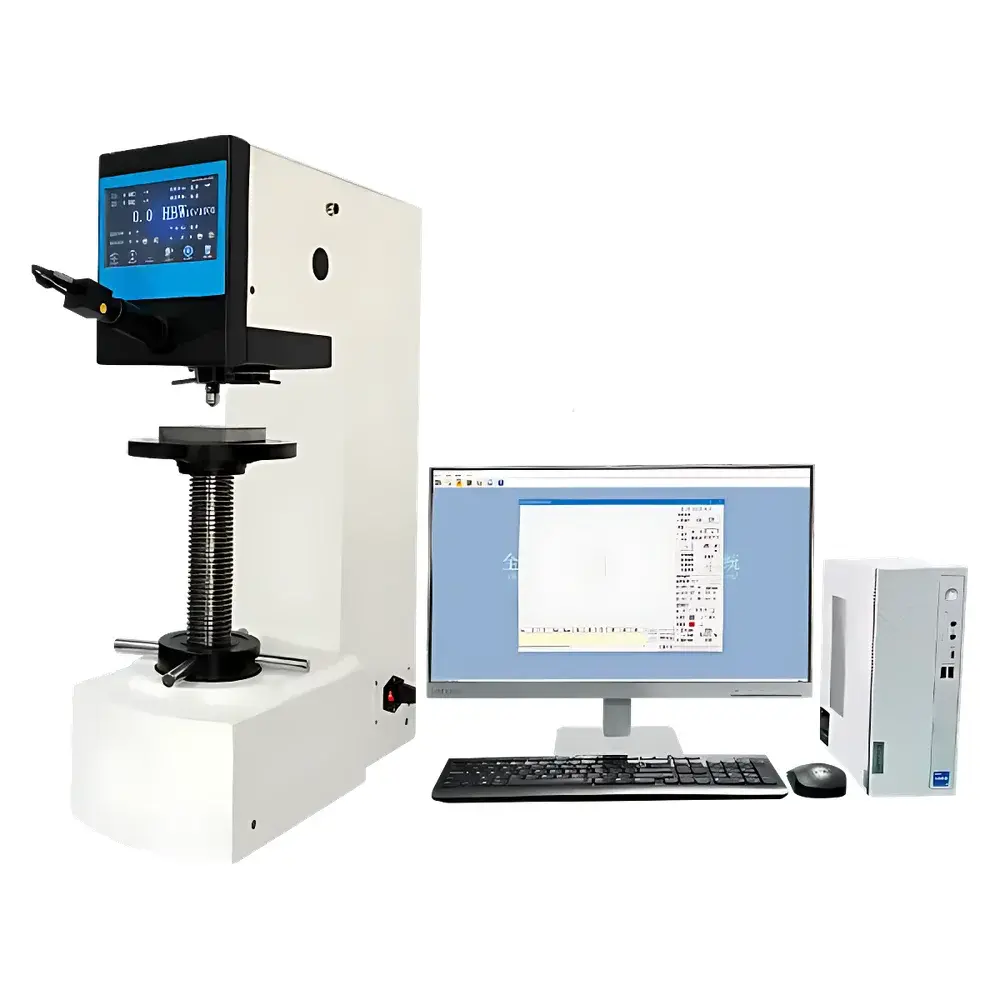
YANRUN HMAS-D3000M7 Automated Brinell Hardness Testing System with 3D Indentation Analysis
| Brand | YANRUN |
|---|---|
| Origin | Shanghai, China |
| Manufacturer Type | Manufacturer |
| Country of Origin | China |
| Model | HMAS-D3000M7 |
| Instrument Type | Brinell Hardness Tester |
| Measuring Range | 8–650 HBW |
| Loading Method | Motor-driven Force Application via Load Cell |
| Standard Compliance | GB/T 231.1, GB/T 231.2, JJG 150 |
| Test Force Levels | 62.5–3000 kgf (612.5–29,400 N) |
| Indentation Imaging | 130 W Industrial Camera |
| Magnification | 20× Digital Eyepiece |
| Resolution | 0.5 µm |
| Dwell Time | 0–60 s (1 s increments) |
| Max Specimen Height | 230 mm |
| Distance from Indenter Center to Chamber Wall | 155 mm |
| Data Output Formats | Excel, Word, PDF |
| Hardness Scale Conversions | HRC, HV, HK, HBW, HRA, HRD, HR15N/30N/45N, HR15T/30T/45T, HRB, HRF |
| Display | Touchscreen + PC Software Interface |
| Power Supply | AC 220 V / 50 Hz |
| Dimensions (L×W×H) | 535 × 185 × 750 mm |
| Net Weight | 116.5 kg |
Overview
The YANRUN HMAS-D3000M7 is an automated Brinell hardness testing system engineered for high reproducibility, metrological traceability, and full digital integration in industrial quality control and materials R&D laboratories. It operates on the fundamental principle of Brinell hardness measurement—applying a precisely controlled spherical indenter (tungsten carbide ball, 2.5 mm, 5 mm, or 10 mm diameter) under standardized test forces (62.5–3000 kgf) onto the specimen surface, followed by optical measurement of the resulting permanent indentation diameter. The system complies strictly with ISO 6506-1 and its national implementation GB/T 231.1, ensuring alignment with international calibration and verification requirements (JJG 150). Unlike conventional manual Brinell testers, the HMAS-D3000M7 integrates closed-loop load cell force feedback, motorized loading/holding/unloading sequencing, and a high-resolution 130 W industrial camera coupled with advanced image processing algorithms—enabling both operator-independent measurement and quantitative 3D topographic reconstruction of the indentation.
Key Features
- True 3D Indentation Reconstruction: Proprietary stereo-imaging algorithm generates a geometrically accurate 3D model of the Brinell impression, allowing direct visualization and numerical extraction of indentation width, length, and depth—critical for evaluating plastic flow behavior, subsurface deformation, and microstructural heterogeneity.
- Intelligent Simulated Autofocus: Real-time image enhancement engine applies adaptive contrast optimization and edge sharpening based on local gradient analysis, replicating optical focus behavior without mechanical refocusing—improving repeatability across specimens with varying surface finish or reflectivity.
- Statistical Error Evaluation Module: Built-in uncertainty propagation framework calculates combined standard uncertainty per ASTM E23-22 Annex A3 guidelines, incorporating contributions from indenter geometry tolerance, load cell accuracy, pixel resolution, and operator-defined measurement variability.
- Material Brittleness Grading (Nitrided Layers): Dedicated evaluation interface implements GB/T 11354–2005 criteria for assessing crack formation and spalling severity around Brinell impressions—supporting QC workflows for case-hardened steels, nitrided components, and thermal-spray coatings.
- Multi-format Reporting & Audit Trail: Generates compliant reports in Excel (.xlsx), Word (.docx), and PDF formats with embedded metadata—including timestamp, operator ID, calibration certificate references, environmental conditions (optional sensor input), and full measurement history—fully traceable for GLP/GMP and ISO/IEC 17025 audits.
- Twelve Adjustable Background Modes: Optimized illumination presets accommodate high-contrast imaging across diverse metallurgical microstructures—from low-reflectivity cast iron and aluminum alloys to highly polished copper, titanium, and post-heat-treated tool steels.
Sample Compatibility & Compliance
The HMAS-D3000M7 accommodates flat, cylindrical, and irregularly shaped metallic specimens up to 230 mm in height and 155 mm from indenter center to chamber wall. Its modular test force range (62.5–3000 kgf) and selectable ball diameters (2.5/5/10 mm) support full compliance with Brinell scale designations HBW 2.5/62.5 through HBW 10/3000 per ISO 6506-1. The system meets mandatory metrological requirements outlined in JJG 150 (Chinese Verification Regulation for Hardness Testers) and is suitable for use in accredited testing laboratories operating under CNAS-CL01 (equivalent to ISO/IEC 17025). All hardness conversions (HRC, HV, HK, etc.) are calculated using NIST-traceable polynomial functions defined in ASTM E140–22.
Software & Data Management
The HMAS software platform runs on Windows OS and supports dual-mode operation: standalone touchscreen control or PC-integrated analysis. Raw image data, force-time curves, and dimensional measurements are stored in a relational SQLite database with immutable logging. Each test record includes digital signatures, time-stamped audit trails, and configurable user access levels (admin/operator/viewer). Export modules support direct integration with LIMS environments via CSV or ODBC. Software validation documentation—including IQ/OQ protocols and 21 CFR Part 11-compliant electronic signature capability—is available upon request for regulated pharmaceutical and aerospace applications.
Applications
This system is routinely deployed for incoming material inspection of forged crankshafts, cast engine blocks, and gear blanks; process validation of annealing, quenching, and nitriding cycles; failure analysis of fatigue-cracked components; and certification of weld metal hardness per AWS D1.1 and ISO 15614-1. Its 3D indentation capability provides unique insight into strain localization in duplex stainless steels, aluminum-lithium aerospace alloys, and additively manufactured Ti-6Al-4V parts—where traditional 2D diameter measurement may underestimate true plastic zone development.
FAQ
Does the HMAS-D3000M7 require external calibration certification before first use?
Yes. Initial verification must be performed using certified reference blocks traceable to NIM (National Institute of Metrology, China) or equivalent NMIs. Factory calibration certificates are supplied with each unit.
Can the system measure non-ferrous metals such as aluminum or copper alloys?
Yes. Twelve background modes and adjustable illumination intensity ensure optimal contrast for low-hardness, high-reflectivity materials. HBW 5/250 and HBW 10/1000 scales are recommended per ISO 6506-1 Annex B.
Is remote software update supported?
Firmware and application updates are delivered via secure HTTPS download with SHA-256 checksum verification. No cloud connectivity is required—updates can be applied offline using USB media.
What is the minimum indentation diameter resolvable at 20× magnification?
With 0.5 µm digital resolution and sub-pixel centroid detection, the system reliably resolves indentations ≥80 µm in diameter—sufficient for all standard Brinell test loads and ball sizes.
How is compliance with FDA 21 CFR Part 11 enforced in report generation?
Electronic signatures require dual authentication (username/password + time-limited token), with all actions logged to a write-once audit trail. Signature timestamps are synchronized to NTP servers and cryptographically sealed.



