
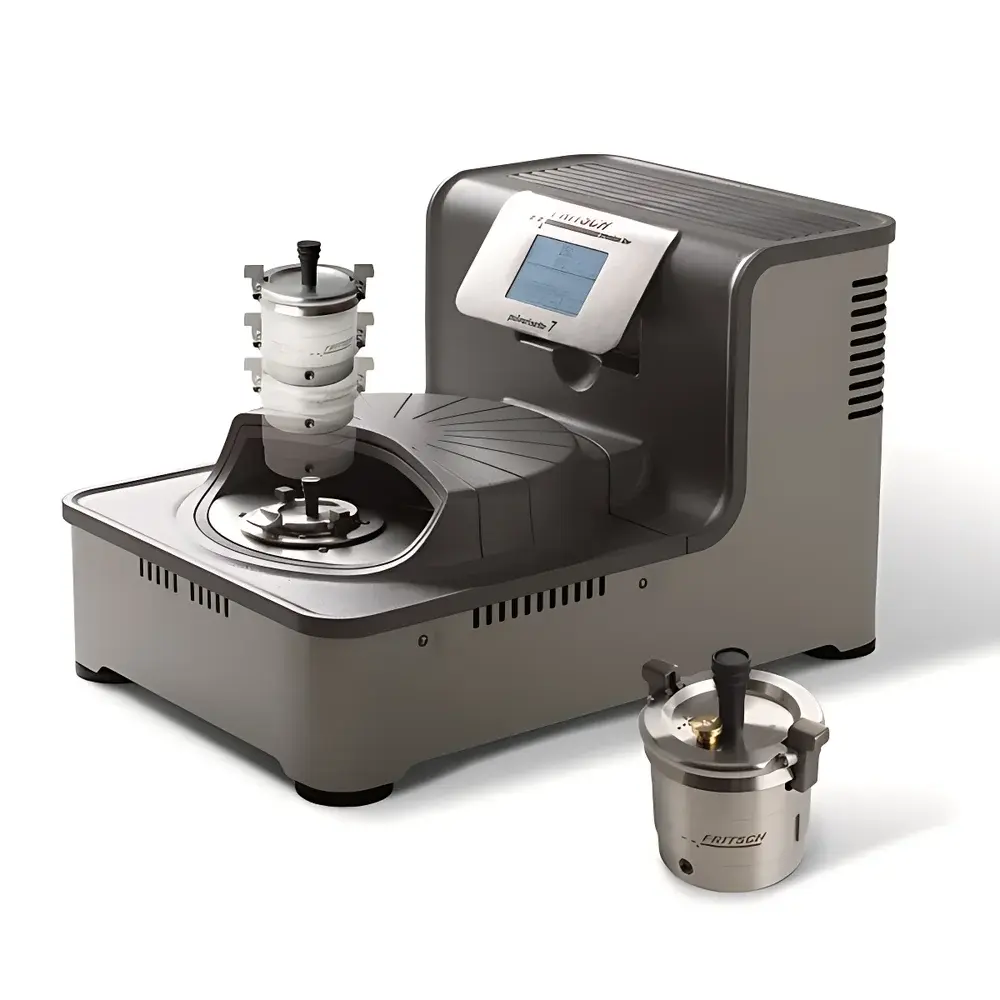
Fritsch PULVERISETTE 7 Premium Planetary Micro Mill
| Brand | Fritsch |
|---|---|
| Origin | Germany |
| Model | PULVERISETTE 7 Premium |
| Instrument Type | Planetary Ball Mill |
| Sample Suitability | Hard, brittle, and medium-hard materials |
| Max. Feed Size | 5 mm |
| Final Particle Size | < 0.1 µm |
| Batch Volume | 20–450 mL per bowl |
| Grinding Bowl Options | 20, 45, 80 mL |
| Grinding Media Diameter | 0.1–20 mm |
| Main Disc Speed | 150–1100 rpm |
| Centrifugal Acceleration | 95 g |
| Transmission Ratio (Main Disc | Bowl): 1 : –2 |
| Effective Main Disc Diameter | 140 mm |
| Inert Gas Grinding | Yes |
| Integrated Pressure & Temperature Monitoring | Yes |
| Human-Machine Interface | Touchscreen with 10-language support |
| Data Logging | USB interface with timestamped event logging |
| Bowl Exchange Time | < 5 seconds |
| Safety Certification | CE, ISO 13849-1 compliant |
| Compliance | Designed for GLP/GMP environments |
Overview
The Fritsch PULVERISETTE 7 Premium is a high-energy planetary micro mill engineered for reproducible, ultra-fine comminution of hard, brittle, and medium-hard materials down to the nanoscale. Operating on the principle of planetary ball milling, it generates intense mechanical energy through the superimposition of two rotational movements: the main drive disc rotates in one direction while the grinding bowls rotate in the opposite direction at twice the angular velocity (transmission ratio 1:–2). This configuration produces centrifugal accelerations up to 95 g—among the highest available in laboratory-scale planetary mills—enabling rapid particle size reduction via impact, shear, and friction between grinding media and bowl walls. Unlike conventional mills, the PULVERISETTE 7 Premium’s eccentric bowl mounting ensures uniform energy distribution across the entire sample volume, minimizing thermal gradients and preventing localized overheating. Its compact footprint (≤0.5 m²) and near-silent operation (<65 dB(A)) make it suitable for shared lab spaces, cleanrooms, and regulated environments where acoustic and spatial constraints are critical.
Key Features
- High-performance planetary kinematics delivering up to 95 g centrifugal acceleration for accelerated nanoscale grinding
- Touchscreen HMI with intuitive menu navigation, real-time parameter monitoring, and 10 language options (English, German, French, Spanish, Italian, Portuguese, Chinese, Japanese, Korean, Russian)
- Tool-free, sub-5-second grinding bowl exchange enabled by an integrated self-locking mechanism—no wrenches or alignment tools required
- Dual-station design supporting simultaneous operation of two independently controlled bowls (20/45/80 mL), enhancing throughput without cross-contamination
- Inert atmosphere compatibility: sealed grinding bowls with gas-tight fittings for operation under N₂, Ar, or other process gases; optional integrated pressure and temperature sensors for reaction monitoring
- USB-based data logging with automatic timestamping of all operational events (start/stop, speed changes, bowl detection, error codes), supporting traceability requirements
- Robust housing with electromagnetic braking, overload protection, and interlocked safety lid meeting ISO 13849-1 Category 3 PL e standards
Sample Compatibility & Compliance
The PULVERISETTE 7 Premium accommodates a broad spectrum of inorganic and organic samples—including oxides, alloys, ceramics, pharmaceutical actives, geological matrices, battery cathode materials, and polymer composites—without requiring cryogenic pre-cooling in most applications. Its ability to achieve final particle sizes < 0.1 µm (100 nm) enables preparation of feedstock for XRD, SEM-EDS, BET surface area analysis, and colloidal dispersion studies. The system complies with CE marking requirements and adheres to key international standards including ISO 13849-1 (safety-related parts of control systems), IEC 61000-6-3 (EMC emissions), and ISO 532-1 (acoustic noise measurement). When paired with Fritsch’s validated LabSuite software, the instrument supports 21 CFR Part 11–compliant electronic records, audit trails, and user access controls—making it suitable for QC/QA labs operating under FDA, EMA, or PMDA regulatory oversight.
Software & Data Management
While the mill operates autonomously via its onboard controller, full integration with Fritsch LabSuite (Windows-based, version 4.0+) unlocks advanced data governance capabilities. LabSuite provides method templates, batch reporting, trend analysis of grinding efficiency (e.g., d₅₀ vs. time), and export to CSV, PDF, or LIMS-compatible XML formats. All parameter changes, run logs, and sensor readings (pressure, temperature, RPM) are cryptographically timestamped and stored with immutable audit trails. User roles (Operator, Supervisor, Administrator) enforce hierarchical access control, and digital signatures can be applied to final reports—fulfilling ALCOA+ (Attributable, Legible, Contemporaneous, Original, Accurate, Complete, Consistent, Enduring, Available) data integrity principles.
Applications
This instrument serves as a critical preprocessing tool across multiple R&D and quality control workflows: homogenization of heterogeneous geological core samples prior to geochemical assay; mechanochemical activation of catalyst precursors in battery material synthesis; particle size reduction of API powders for dissolution testing per USP ; preparation of nanosized ceramic slurries for tape casting; and top-down synthesis of metal–organic frameworks (MOFs) via solvent-free grinding. It is routinely deployed in accredited laboratories performing ASTM C117 (material fineness), ISO 13320 (laser diffraction particle sizing), and ISO 9277 (BET surface area) test methods.
FAQ
What is the maximum recommended sample mass per grinding bowl?
For optimal energy transfer and reproducibility, Fritsch specifies a fill level of 1/3 to 1/2 of bowl volume. At 80 mL capacity, this corresponds to 25–40 mL of bulk material or ~30–60 g depending on density.
Can the PULVERISETTE 7 Premium perform cryogenic grinding?
No—this model is not equipped with liquid nitrogen ports or低温-rated components. For cryo-milling, Fritsch recommends the PULVERISETTE 9 or PULVERISETTE 17 series.
Is grinding under vacuum possible?
Yes—when used with optional vacuum-sealed bowls and connected to an external vacuum pump, the system supports low-pressure grinding to suppress oxidation or volatile loss.
How is calibration verified?
Speed accuracy is factory-validated using laser tachometry; no user calibration is required. Routine verification can be performed using an external optical tachometer per ISO 17025 internal audit protocols.
What maintenance intervals are recommended?
Annual inspection of drive belts, bowl sealing rings, and touchscreen calibration is advised. Grinding bowls and media should be inspected for wear before each use; replacement is determined by visible abrasion or dimensional deviation > ±0.05 mm.



