
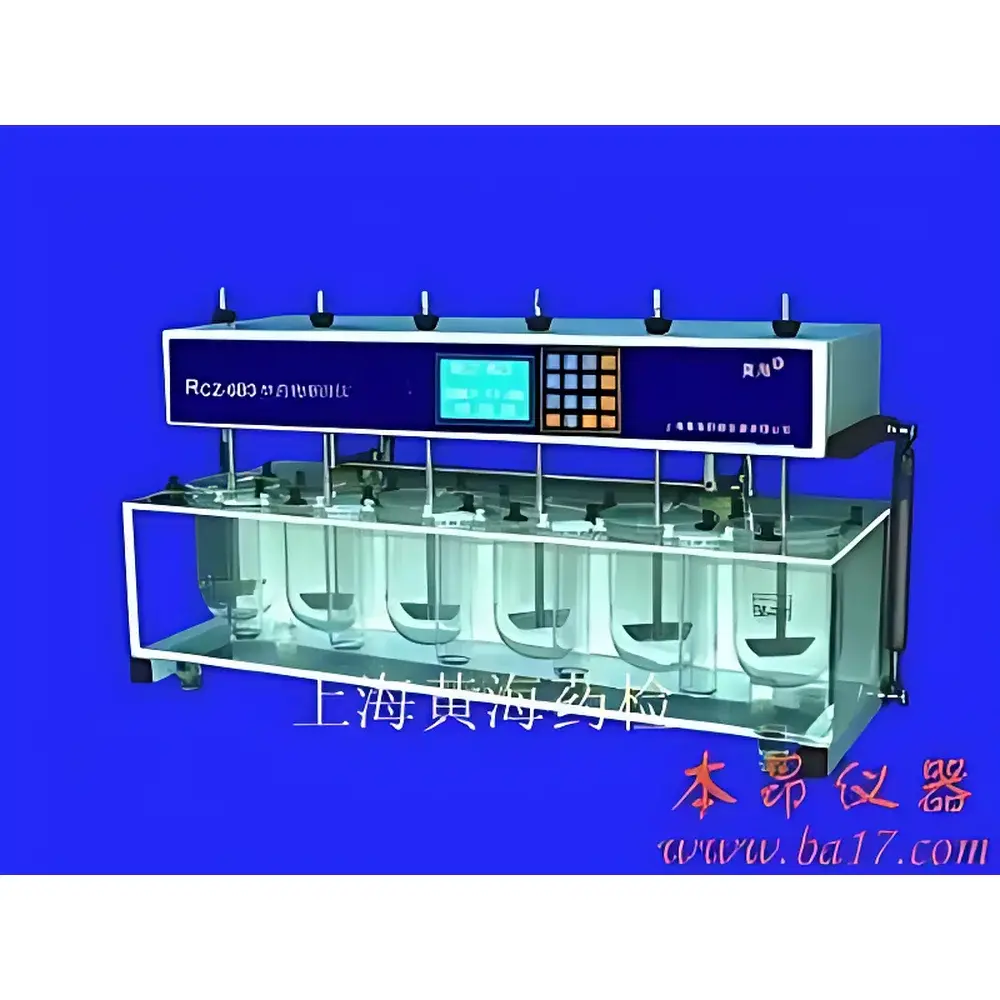
RCZ-6B3 Six-Vessel Intelligent Drug Dissolution Tester
| Origin | Shanghai, China |
|---|---|
| Manufacturer Type | Authorized Distributor |
| Origin Category | Domestic (PRC) |
| Model | RCZ-6B3 |
| Price | USD 4,450 (FOB Shanghai) |
| Stirrer/ Basket Runout | ≤0.5 mm (paddle), ≤1.0 mm (basket) |
| Speed Range | 25–250 rpm |
| Speed Resolution | 1 rpm |
| Speed Accuracy | ≤±1% |
| Temperature Range | 10°C (ambient) to 45°C |
| Temperature Resolution | 0.01°C |
| Temperature Uniformity & Stability | ≤±0.05°C |
| Total Timer Range | 0–5999 min (count-up/count-down) |
| Sampling Cycles | Up to 10 programmable intervals |
| Sampling Interval Duration | 0–5999 min per cycle |
| Human-Machine Interface | Backlit Chinese LCD with menu-driven navigation |
| Data Storage | USB flash drive logging (timestamped dissolution profiles, parameter logs, event history) |
| Firmware Upgrade | Field-upgradable via USB |
| Safety Features | Self-diagnostic routines, thermal overload protection, motor stall detection, error-code display |
| Peripheral Support | Optional thermal mini-printer (RS232/USB interface) |
Overview
The RCZ-6B3 Six-Vessel Intelligent Drug Dissolution Tester is a GMP-aligned, benchtop dissolution apparatus engineered for precise, reproducible in vitro release testing of solid oral dosage forms—including immediate-release tablets, extended-release capsules, and multiparticulate systems—according to pharmacopoeial standards. It operates on the USP Apparatus 1 (basket) and Apparatus 2 (paddle) principles, maintaining hydrodynamic consistency across all six vessels through synchronized rotational control and uniform jacketed water bath temperature regulation. Designed in full compliance with the *Chinese Pharmacopoeia (ChP) 2005 Edition*—and functionally compatible with USP , EP 2.9.3, and JP 17 dissolution methodologies—the instrument delivers metrologically traceable performance for QC laboratories, formulation development units, and regulatory submission support. Its robust mechanical architecture minimizes vibration transmission and vessel-to-vessel variability, while the integrated PID-controlled thermal system ensures rapid equilibration and long-term thermal stability critical for dissolution profile fidelity.
Key Features
- Six independent dissolution stations supporting simultaneous operation of either paddle or basket assemblies (interchangeable without tooling)
- High-precision stepper motor drive with microstepping power supply: achieves ±1% speed accuracy across 25–250 rpm range, with 1-rpm resolution and low acoustic emission
- PT1000 platinum resistance temperature sensor embedded directly in the water bath jacket; real-time feedback enables PID-based thermal regulation with ≤±0.05°C deviation from setpoint
- Intuitive Chinese-language LCD interface with hierarchical menu navigation—no external PC required for routine operation or method recall
- Non-volatile memory stores up to 10 user-defined dissolution methods, including speed, temperature, sampling schedule, and timer configurations—retained after power cycling
- Comprehensive self-diagnostics: automatic detection of motor failure, temperature sensor drift, water level deficiency, and mechanical runout anomalies; displays standardized error codes for rapid troubleshooting
- USB-host port enables direct data export to FAT32-formatted USB flash drives—records time-stamped dissolution points (time, vessel ID, temperature, speed), system events, and calibration logs
- Optional RS232/USB-connected thermal printer supports GLP-compliant hardcopy output of run summaries and alarm histories
- Firmware update capability via USB ensures long-term adaptability to evolving pharmacopoeial revisions or internal SOP enhancements
Sample Compatibility & Compliance
The RCZ-6B3 accommodates standard USP/ChP-compliant 1-L dissolution vessels and supports both 10-mm and 14-mm diameter baskets, as well as 10-mm and 12-mm paddles. Vessel alignment is verified using optical centering tools per USP mechanical calibration guidelines. The system meets ChP 2005 requirements for mechanical validation—including paddle/basket concentricity (≤0.5 mm and ≤1.0 mm runout, respectively), vertical shaft alignment, and temperature uniformity across all positions. While not certified to ISO/IEC 17025 by default, its documented performance characteristics enable qualification under laboratory-specific IQ/OQ/PQ protocols aligned with FDA 21 CFR Part 11 (when paired with validated USB logging and audit-trail-enabled software), EU Annex 11, and WHO TRS 986 Annex 5 expectations for dissolution equipment used in regulated environments.
Software & Data Management
No proprietary PC software is bundled; however, the instrument’s native USB data export generates comma-separated (.csv) files containing timestamped dissolution timepoints, vessel identifiers, actual vs. setpoint temperature/speed values, and system status flags. These files are fully compatible with LIMS integration, Excel-based statistical analysis (e.g., f2 similarity factor calculation), and automated reporting workflows. When deployed in validated environments, laboratories may implement supplementary electronic record controls—such as encrypted USB write-lock policies, user access logs, and version-controlled firmware archives—to satisfy ALCOA+ data integrity principles. The device supports manual entry of sample IDs and batch numbers via the LCD interface, ensuring traceability without dependency on external computing resources.
Applications
- Routine QC release testing of commercial batches against dissolution specifications (Q-value determination at t=15/30/45/60 min)
- Comparative dissolution profiling for generic product development and bioequivalence bridging studies
- Formulation screening during preformulation and early-phase development
- Stability-indicating dissolution method verification under stressed conditions (e.g., pH-shifted media, surfactant-containing buffers)
- Investigation of manufacturing process changes (e.g., compression force, granulation method) on drug release kinetics
- Support for ANDA submissions requiring ChP- or USP-aligned dissolution data packages
FAQ
Does the RCZ-6B3 comply with current USP mechanical calibration requirements?
Yes—its measured paddle runout (≤0.5 mm), basket runout (≤1.0 mm), and temperature uniformity (≤±0.05°C) meet the acceptance criteria defined in USP for Apparatus 1 and 2 qualification.
Can dissolution data be exported in a format compliant with 21 CFR Part 11?
The instrument itself does not provide electronic signatures or audit trails; however, when integrated into a validated data management system with appropriate procedural controls (e.g., controlled USB media, operator authentication, and change history tracking), the CSV output satisfies Part 11 predicate rule requirements.
Is third-party calibration certification available?
Calibration services—including NIST-traceable temperature and rotational speed verification—are offered by authorized service partners in APAC and EMEA regions upon request.
What maintenance intervals are recommended?
Daily visual inspection of vessel alignment and water bath cleanliness; quarterly verification of temperature sensor accuracy and annual mechanical recalibration per ChP Appendix XIX D are advised for sustained regulatory compliance.
Can the RCZ-6B3 operate unattended overnight?
Yes—its built-in timer supports up to 5999 minutes (≈99.98 hours) of continuous operation with programmable multi-stage sampling cycles, thermal cut-off protection, and fault-hold functionality to prevent uncontrolled runaways.




