
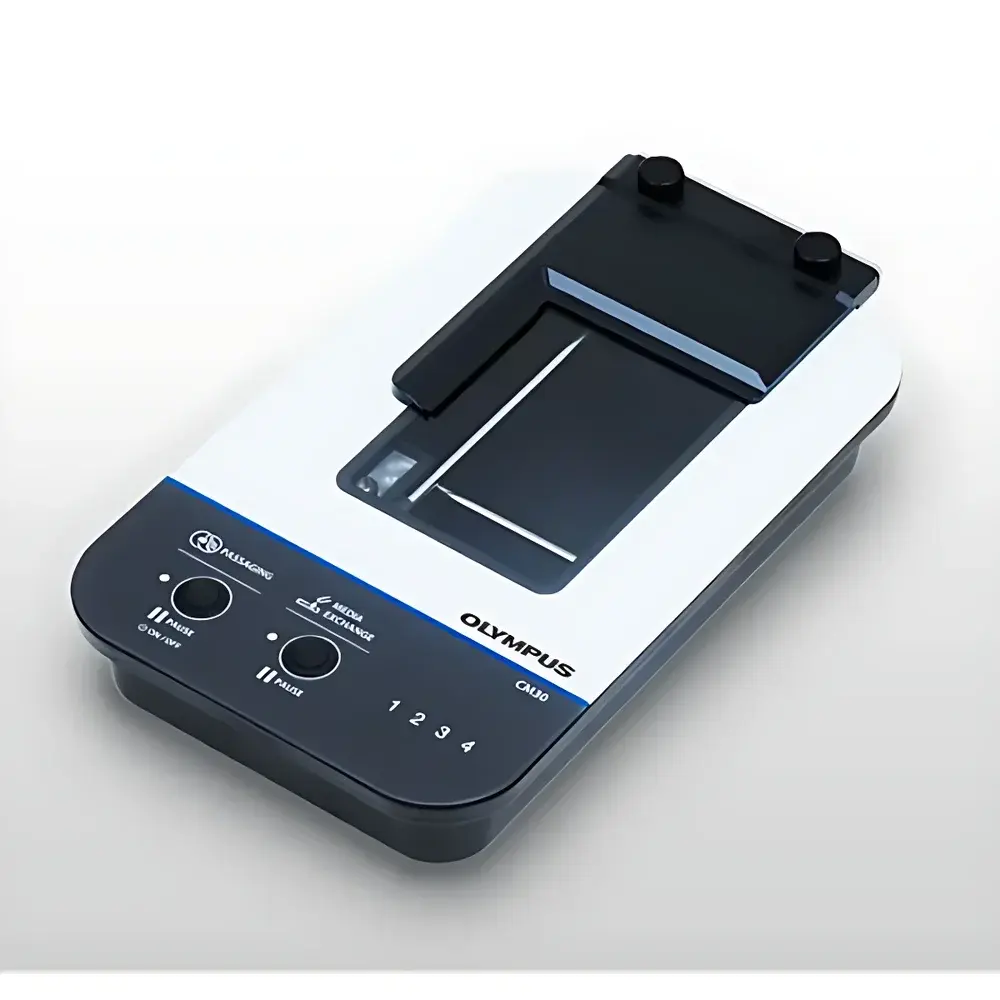
Olympus/EVIDENT CM30 Cell Culture Monitoring System
| Brand | Olympus/EVIDENT |
|---|---|
| Origin | Japan |
| Model | CM30 |
| Type | Automated, Non-invasive, Label-free Live-Cell Imaging and Quantification System |
| Compliance | Designed for ISO 13485-aligned lab environments |
| Software Architecture | Cloud-enabled with local data storage option |
| Imaging Modality | Brightfield + Phase Contrast Time-Lapse Microscopy |
| Analysis Engine | Machine Learning–based Image Analytics (Pre-trained CNN models for confluence, morphology, and colony detection) |
Overview
The Olympus/EVIDENT CM30 Cell Culture Monitoring System is an automated, label-free, non-invasive imaging platform engineered for longitudinal quantitative assessment of adherent mammalian cell cultures within standard CO₂ incubators. Unlike endpoint assays or fluorescence-based methods requiring exogenous dyes or genetic modification, the CM30 employs high-resolution brightfield and phase contrast microscopy combined with embedded computational imaging algorithms to extract morphometric and confluence metrics directly from native cellular features—nuclei size, cytoplasmic texture, edge contrast, and spatial distribution. This eliminates phototoxicity, metabolic perturbation, and inter-assay variability introduced by labeling protocols. The system operates autonomously inside incubators (up to 40 °C, 5% CO₂, 95% RH), capturing time-lapse image sequences at user-defined intervals (e.g., every 15–120 minutes) across multiple positions per vessel. Its core function is to transform subjective visual inspection into traceable, auditable, and statistically robust quantitative outputs—including % confluence, cell count density (cells/mm²), average cell area (µm²), and colony formation index—enabling objective decision-making in passaging, harvesting, and quality control workflows.
Key Features
- Label-free, non-destructive monitoring: No fluorescent dyes, transfection reagents, or enzymatic treatments required—preserves native cell physiology and downstream assay integrity.
- Multi-position, multi-vessel scanning: Supports simultaneous monitoring of up to 6 culture vessels (e.g., 6-well plates, T25/T75 flasks, or microcarrier bioreactors) with configurable XY-stage positioning and Z-stack acquisition capability.
- Machine learning–driven analytics: Pre-validated convolutional neural network (CNN) models trained on >50 human and rodent cell lines (including HEK293, HeLa, CHO-K1, iPSCs, and primary fibroblasts) deliver reproducible confluence estimation (±2.3% CV) and morphology classification (e.g., spindle vs. epithelial shape transitions).
- Incubator-integrated architecture: Compact, fanless design with IP54-rated enclosure; compatible with standard humidified CO₂ incubators without compromising sterility or environmental stability.
- Remote operation & audit-ready data capture: Web-based interface accessible via institutional network; all image acquisitions, analysis parameters, timestamps, and operator IDs are logged in accordance with ALCOA+ principles (Attributable, Legible, Contemporaneous, Original, Accurate, Complete, Consistent, Enduring, Available).
- Configurable analysis pipelines: Users define region-of-interest (ROI) masks, thresholding logic, and morphological filters per experiment—supporting GLP-compliant method validation and SOP documentation.
Sample Compatibility & Compliance
The CM30 accommodates standard tissue-culture-treated plasticware including 6-, 12-, 24-, and 96-well plates, T-flasks (T25 to T225), and roller bottles. It supports both monocultures and co-cultures (e.g., endothelial–pericyte systems), provided cells exhibit sufficient phase contrast differentiation. While not a medical device, its design aligns with ISO 13485 risk management frameworks for laboratory instrumentation. Data export formats (TIFF, CSV, JSON) comply with FAIR principles (Findable, Accessible, Interoperable, Reusable). Audit trails meet FDA 21 CFR Part 11 requirements for electronic records and signatures when deployed with validated IT infrastructure and role-based access controls.
Software & Data Management
CM30 Control Software (v3.2+) provides a secure, browser-based dashboard for scheduling acquisitions, reviewing time-series heatmaps, and exporting metadata-rich datasets. All raw images are stored locally on encrypted SSDs (optional NAS integration); processed metrics are synchronized to cloud repositories with versioned backups. Built-in comparison tools enable side-by-side statistical analysis across batches, donors, or treatment conditions using ANOVA or Mann–Whitney U testing. Export modules support direct ingestion into ELN platforms (e.g., LabArchives, Benchling) and LIMS via RESTful API. Software validation packages—including IQ/OQ documentation, test scripts, and deviation logs—are available upon request for regulated environments.
Applications
- Optimized subculturing: Objective confluence thresholds (e.g., 85% ± 3%) trigger automated notifications—reducing over- or under-confluence errors that compromise viability and differentiation potential.
- Bioprocess development: Tracking attachment efficiency, proliferation kinetics, and senescence onset in stem cell expansion or viral vector production workflows.
- Toxicity screening: Quantifying morphological deviation (e.g., rounding, vacuolation, detachment) in response to compound libraries without cytotoxic dye interference.
- Quality assurance in cell banking: Documenting pre-freeze confluence, post-thaw recovery rate, and passage-dependent phenotypic drift across master/working cell banks.
- Teaching & training: Standardized visual benchmarks for student labs performing routine cell culture—minimizing instructor-dependent variability in assessment criteria.
FAQ
Does the CM30 require external calibration or daily maintenance?
No. The system performs automated optical self-calibration prior to each imaging session using built-in reference targets. No consumables or alignment tools are required beyond routine incubator cleaning.
Can I integrate CM30 data with my existing LIMS or ELN?
Yes. Native API support enables bidirectional data exchange with major laboratory informatics systems. Custom field mapping and SSO authentication are configurable during deployment.
Is the machine learning model retrainable with proprietary cell types?
Yes. EVIDENT offers optional model fine-tuning services using customer-provided annotated image sets, subject to data governance review and contractual data use agreements.
How is data security ensured during remote access?
All communications use TLS 1.3 encryption; authentication follows institutional SAML 2.0 or LDAP protocols. Local data never transmits to Olympus/EVIDENT servers unless explicitly enabled for technical support under signed DPA.
What regulatory documentation is provided for GMP/GLP environments?
A full validation toolkit—including URS, FRS, IQ/OQ/PQ protocols, trace matrices, and change control logs—is supplied with each system and updated annually per ICH Q5A(R2) and ISO/IEC 17025 guidance.
Related Products



