
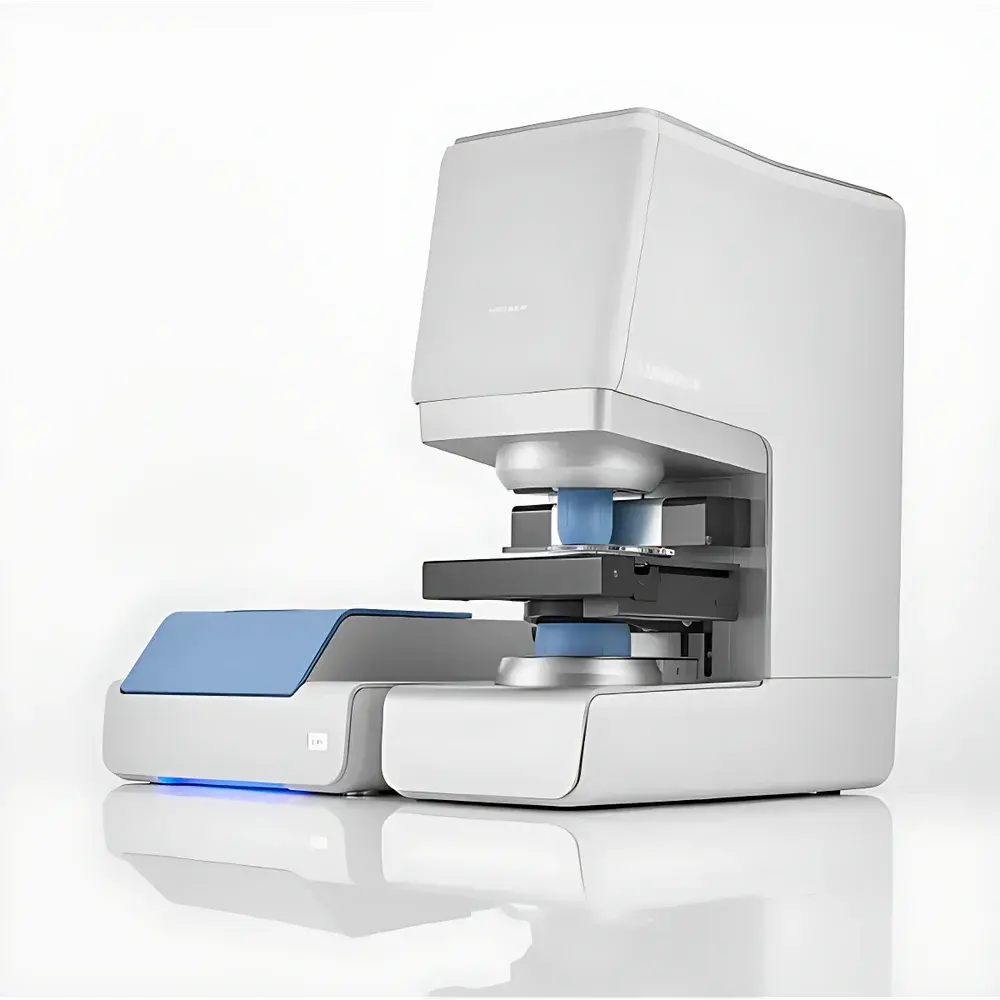
Bruker LUMOS II ILIM Quantum Cascade Laser-Based Infrared Imaging Spectrometer
| Brand | Bruker |
|---|---|
| Origin | Germany |
| Model | LUMOS II ILIM |
| Instrument Type | Laboratory Benchtop QCL-FTIR Imaging System |
| Detection Technology | Focal Plane Array (FPA) |
| Primary Excitation Source | Tunable Quantum Cascade Laser (QCL) |
| Application Domain | Chemical Imaging, Spatially Resolved Spectroscopy, Microscale Material Characterization |
| Compliance Context | Designed for GLP-compliant laboratories |
Overview
The Bruker LUMOS II ILIM is a laboratory-grade, quantum cascade laser (QCL)-driven infrared imaging spectrometer engineered for high-speed, spatially resolved chemical mapping. Unlike conventional Fourier-transform infrared (FTIR) microscopes that rely on thermal broadband sources and step-scan acquisition, the LUMOS II ILIM integrates a tunable mid-infrared QCL source with a high-sensitivity focal plane array (FPA) detector. This architecture enables rapid hyperspectral image acquisition—orders of magnitude faster than traditional FTIR imaging—while maintaining diffraction-limited spatial resolution and high spectral fidelity across the 900–1800 cm⁻¹ range (typical for organic functional group analysis). The system operates in reflection or transmission mode, supporting both single-point spectroscopy and full-field chemical imaging without stage scanning. Its optical design incorporates motorized objectives, automated aperture control, and integrated visible-light microscopy for precise region-of-interest selection—making it suitable for routine analytical workflows in regulated and research-intensive environments.
Key Features
- Quantum cascade laser (QCL) excitation source: Delivers narrow linewidth, high spectral power density, and rapid wavelength tuning—enabling shot-noise-limited signal-to-noise performance and high reproducibility in spectral acquisition.
- Focal plane array (FPA) detection: 128 × 128 or 64 × 64 pixel MCT detector with liquid nitrogen or Stirling-cooled operation, optimized for high frame rates (>10 fps per spectral channel) and low dark current.
- Integrated visible-light microscope: Co-aligned optical path with real-time overlay of IR chemical maps onto high-resolution optical images for intuitive sample navigation and annotation.
- Motorized optical components: Automated objective turret, beam splitter selection, and aperture positioning ensure repeatable measurement conditions and reduce operator-induced variability.
- Benchtop form factor with vibration-damped baseplate: Engineered for stable operation in standard laboratory environments without requiring dedicated optical tables or acoustic enclosures.
- Modular sample interface: Supports transmission cells, reflection stages, ATR accessories, and custom holders for biological tissues, pharmaceutical tablets, thin-film electronics, and cultural heritage specimens.
Sample Compatibility & Compliance
The LUMOS II ILIM accommodates diverse sample geometries and physical states—including unstained frozen or formalin-fixed paraffin-embedded (FFPE) tissue sections, intact pharmaceutical dosage forms, polymer laminates, semiconductor wafers, mineral thin sections, and aged parchment or pigment layers. Its non-destructive, label-free operation meets requirements for archival material analysis and quality control under ISO 17025-accredited testing protocols. Data acquisition and processing workflows are compatible with Good Laboratory Practice (GLP) and current Good Manufacturing Practice (cGMP) frameworks. When deployed with OPUS 8.x or later software, the system supports audit trail generation, electronic signatures, and user-access controls aligned with FDA 21 CFR Part 11 compliance for regulated industries.
Software & Data Management
Control and analysis are performed via Bruker’s OPUS software platform, which provides unified instrument control, real-time spectral visualization, multivariate image analysis (e.g., cluster analysis, PCA, classical least-squares unmixing), and report generation. Raw interferograms or direct QCL spectra are stored in Bruker’s proprietary .0 format, fully convertible to open standards (e.g., JCAMP-DX, HDF5) for third-party integration. Batch processing scripts support automated spectral preprocessing (baseline correction, normalization, atmospheric compensation) and image segmentation. Data security features include encrypted project files, time-stamped metadata logging, and role-based permissions for multi-user lab deployments.
Applications
- Biomedical & Pathological Imaging: Label-free identification of lipid/protein distribution in tissue sections; spatial correlation of metabolic markers in tumor margins; rapid intraoperative margin assessment.
- Pharmaceutical Development: Quantitative mapping of active pharmaceutical ingredient (API) homogeneity in tablets; excipient crystallinity profiling; counterfeit drug detection via spectral fingerprint comparison.
- Materials Failure Analysis: Identification of oxidation products, delamination interfaces, or residual solvents in microelectronics packaging; contamination mapping on wafer surfaces.
- Cultural Heritage Science: Non-invasive identification of binding media, pigments, and degradation products in paintings and manuscripts; stratigraphic analysis of varnish layers.
- Environmental & Food Safety: Microplastic particle classification by polymer type in environmental filters; spatial distribution of starch, protein, or mycotoxins in grain kernels and feed pellets.
- Geosciences: Mineral phase discrimination in polished rock sections; hydration state mapping in clay-rich samples; fluid inclusion characterization.
FAQ
What distinguishes the LUMOS II ILIM from conventional FTIR microscopes?
It replaces the thermal globar source with a tunable QCL, enabling orders-of-magnitude faster spectral acquisition and higher brightness—critical for high-resolution chemical imaging of dynamic or beam-sensitive samples.
Can the system perform quantitative analysis?
Yes—when calibrated with reference standards and validated using established methods (e.g., ASTM E168, ISO 18382), it supports quantitative mapping of component concentrations in homogeneous matrices.
Is ATR imaging supported?
Yes, via optional motorized ATR objectives compatible with the LUMOS II ILIM optical train, enabling surface-sensitive measurements on opaque or highly scattering samples.
What is the typical spatial resolution achievable?
Diffraction-limited resolution of ~3–5 µm in the mid-IR range (dependent on objective magnification and QCL wavelength), consistent with standard IR microscopy performance expectations.
Does Bruker provide application-specific method templates?
Yes—preconfigured OPUS methods are available for pharmaceutical content uniformity, tissue lipidomics, microplastic identification, and mineral phase mapping, with documentation supporting method transfer and validation.





